
Mies conceived of building as arising out of a field of tension that consisted of intrinsic lawfulness on one hand and creative freedom on the other. It should afford the “required privacy combined with the freedom of open room forms” and provide a “defining” but not a “confining space” suitable for contemporary living. Behind this concept of space and architecture that defined “building” in a philosophical sense as a “giving form to reality” stood for Mies the question of the “value and dignity of human existence,” namely: “Is the world as it presents itself bearable for man? . . . . Can it be shaped so as to be worthwhile to live in?”
Neumeyer
For decades I have been moved by Mies van der Rohe’s Brick Country House without knowing why. Not knowing why may be a large part of the attraction, along with a sense of release when I look again at the drawings, also without knowing why, or where, but without feeling I have left the ground. But it is open and direct about what it is, factual, honest, as Mies would have it. This honesty may be its greatest strength, its largest mystery.

We only know it by two drawings, or rather photographs of drawings as the originals have been lost, one a three-dimensional perspective study

the other a ground floor plan, both images resting within large open space. The project was never built and if there were other drawings or preliminary sketches—there must have been—they have not survived.
Separately or together the drawings are compelling. Separately or together they appeared in avant-garde publications and exhibitions around 1924. The plan was taken as a herald of Modernism, and both drawings, separately or together, have reappeared in architecture histories ever since. The country house, with its spread of structure in asymmetrical arrangement, goes back to antiquity and enjoyed a resurgence in Germany during Mies’s formative years. But the Brick Country House, along with his Concrete Country House, a project of the same time, also unbuilt, takes the tradition and revises it and propels it forward, representing a radical shift in Mies’s thought.
.
Details

And separately and together the drawings are problematic. The divinity of details is cast into doubt. The perspective is especially hard to read. The angles that define the volumes are so obtuse they barely exist.

We are looking up, slightly. The blue line marks the horizon, set by eye level of someone standing beyond the lowered ground beneath the terrace wall, maybe, while the red lines contain the large chimney. Obviously it was important to include as much of the garden walls as possible, as they determine the layout and the overall sense of the project,

but doing so leads to distant vanishing points, well off the page. The garden walls are taller at the ends and recede inward, putting them closer to us and the house proper at some distance. But the front garden wall appears almost on the same line as the one on the left when in reality they should meet at a right angle. We are aware not of depth but of thin presence, a nearly straight line of forms across the page with slight variations. Without the shadows and windows we would be hard put to define or locate the different volumes, much less get any sense of the whole.
 Most, the perspective drawing does not match the ground plan in many respects. Note, as Tegethoff points out, the shadow at A, easy to overlook. Clearly the roofline of the wall at B ends at the smaller chimney and pulls it closer, not far from the garden wall. That chimney has also been moved well forward. A more accurate plan would be:

Likely the small complex on the right would be moved forward as well or the chimney wouldn’t be functional. Everything beyond is called into question.
There are other divergences. The brick wall and window at B are both longer, with different proportions, while the front room is moved further away from the large chimney, marked at C. The wall at D has a different and narrower window and, again, different proportions. The forward room on the second floor, at E, is hard to place. It is set further back, beyond the chimney, but it’s difficult to tell where it stops on the right. The wall at F looks to be longer. Also the chimneys have different lengths, the smaller notably longer, and a different relationship. Closer inspection might yield more discrepancies.
While I’m at it, the windows on the second floor, on the left, are rendered black. They aren’t in shadow and I doubt would be tinted. The base of the large chimney is wider than the rest, at G. Obviously it is intended for support of the deck above, but the deck already has that support inside the chimney and extrusion breaks the simplicity of the design and stands out, at any rate does not appear in the plan.

The left side likely remains the same or similar. Seen directly, it would look like this, and we realize how much glass characterizes its face.

The front would look roughly like this, where we see how much the large room has been lengthened and shifted right.

From above, a revised layout for the perspective drawing would look something like this. Again, everything beyond the two sides can’t be determined. My revisions are just guesses. In this adjusted model, the top and bottom garden walls are much further apart—compare with those in the plan. These lines are two of three poles that set the energy of the design, and spreading them calls for a change in internal dynamics and external design of the unseen sides. Interior layout changes are also needed, along with other revisions we can’t predict.
In short, the perspective drawing we see is based on a substantially different floor plan from the one we have been given. Mies must have made one, at least a quick sketch, but if he did we don’t have it now.
But I’m not convinced the perspective drawing is accurate or consistent. Walls may be longer or shorter than they appear, and not everything lines up. Determining spatial relationships in such an attenuated perspective is difficult, if not impossible with any accuracy. While I concede my limited skills, I’m not sure a fully reasoned analysis, such as Vredeman’s, above, is even possible—the lines would be too close together to be useful. Likely Mies drew a few perspective lines and eyed it from there. I had similar problems trying to understand spatially Mies’s pastel sketches for an early version of the Esters House.
As for the floor plan, likely the front of the house, the most public face, is at the bottom, with substantial view blocks to ensure privacy. But really we have no indications of site orientation. The main entry might be at the back, next to the wall, in the opening in the upper left quadrant. The only indications of program are the abstract designations “living area” on the main structure and “service area” on the small cluster on the right, at some distance. This distinction, their separation mattered, but we’re left guessing how to break the plan down further. Perhaps the right area holds the kitchen, perhaps also a small room for a servant. Or perhaps it might be used for a small office or studio. The larger area might hold a living room and dining room, with spaces for other smaller functions. The second floor might have two bedrooms flanking a sitting area, before the glass. Again, I’m guessing. The plan tells us nothing about the second floor other than, from the stairs across from the chimney in the main room, there is one.
But there are several odd spaces, and I don’t know how they might function. Much of the space has to be given to passage. Doors and windows are not explicitly marked, so it’s not at all certain where we might enter or leave the house and walk the lawns. There is no marking for anything in the opening at the upper left, and we follow a path deep into the interior unimpeded. If actually built, the garden walls would have to stop somewhere, abruptly, oddly. And the only communication between the three large areas they define is from the interior. Practicality has been put aside in the service of an idea, rather the design of an idea. An actual program rests only in its shadows.
As for structure, Mies departs from Modernism in using brick as his primary material and making the walls load bearing, rather than having the weight supported by pillars that open up an interior. Still they are free, separated by space and full glass. But when you look at all the glass areas and the large spans, despite their easy statement, you realize support would have to be a complex and difficult task, especially where the first floor has to bear the second. The deck before the broad windows on the side is quite large—that extrusion at the chimney would do little to help. The house promotes a new sense of construction then pushes it. Liberation nears the edge.
Tegethoff, in his careful and extensive research of contemporary documents, proposes that Mies did consider building the brick house, possibly for himself, in fact considered two sites which accounts for the differences—the perspective and plan are based on different locations. If for himself, he would have had license to explore ideas freely. I can’t argue, but the economy in Germany was stressed and he would have had trouble finding clients for such radical designs. Either would have been expensive, and Mies, still early in his career, likely didn’t have the resources. Even if he had built the Brick House, he would have had to, as happened with the Esters House, made substantial concessions—bathrooms, closets, doors, etc., along with structural revision—that would have compromised his intent.
All that is absolutely certain is that the Brick Country House was never built and we have nothing else to go on beyond the two drawings. If Mies did have himself as a client in mind, his first priority would have been to explore concepts. He also had an influential audience to consider, the avant-garde circles where he traveled and was well known, where his work was exhibited and well received, who were receptive to his ideas. Along with them, eventually, us now, as we look back. As to why he didn’t change one of the drawings so both aligned, it doesn’t matter. The perspective is so rarefied that differences and discrepancies are scarcely apparent. These are the drawings he wanted and passed on. If they still appear incomplete and inconsistent, it’s because the project is a tentative proposal and he had other concerns in mind more pressing.
Coming to terms with the Brick Country House doesn’t require piercing insight or a leap of faith but the ability to manage uncertainty and open-ended complexity. The two drawings may have best represented two contrasting yet complementary aspects of his vision, both suggestive, separately and together, neither complete, together only contradictory upon close inspection, both leaving questions unanswered, the possibility of yet another design not yet realized. Or they are complete in this respect: they best show in different ways the related ideas he most cared about. He may not have had great interest in working all the problems out or presenting a final solution. Mies, of course, knew what he was doing. I go to all this trouble so I can put it behind me. What matters in both drawings, where Mies is in complete control, is effect, not practical realization. Divinity has not been lost.
.
Impressions of Forms/Forms of Impressions
The house looks out upon the world, humble in its low forms lying close to the ground, supplicant; bold in its complex assertion, its seeking, its seeing. Dominant, the white space that surrounds, not absence but presence, light that informs every detail, which the house receives, its windows return. This presence, the space and light—two aspects of the same thing, undefined yet whose existence is certain—matters, not depth. And the sky and ground are not differentiated in texture or color but are part of a larger whole that, guided by the garden walls, reaches beyond the frame, extends seemingly endlessly. We are looking out on and joining the vastness of creation, contemplating some greater truth, maintaining our existence with, within it.

The composition is essentially a thin band within the large, undifferentiated space, the band a procession of forms that extends across the page. But the house is not overwhelmed by that space, rather asserts it without losing presence. Since the house rests above the same white ground, it exists in active suspension that energizes the composition and highlights that space, this suspension, the sky, the ground charged by the asymmetric divide. Only by dividing straight down the middle can we rest. This composition will not let us. And the presence of light in the sky makes itself known dramatically in the shadows. Also there is variety in the band, contrasting dark and light shapes, rectangles long and short, and triangles of varying sizes that set a pattern that is irregular but steady, poised yet insistent, creating a pulsing, accelerating rhythm across the page.

Instead of the expected V that retreats to a distant point on the horizon we would see in a traditional—and functional—perspective drawing, we get one that opens up laterally, following the rhythm of the forms without taking us deeper into the background. One ray is determined by the chimneys, the other by the terrace wall, both about the same shallow pitch. Here we see why Mies made this drawing. Not only does this point of view emphasize the horizontal, his making the second chimney larger and moving it forward establishes the upper line in smooth transition, doing do with an insistent 1—2-3, this direction counterpointed by the pattern of the other rising, extending forms. Having the front room set back further and made longer keeps the line and creates the apparent space between the right chimney and the rest of the house that makes a pause that precedes quick acceleration and release. Enclosing all the forms within this projected V gives them containment and outward thrust.
Miraculously, it is the windows in shade, almost all of them, that are also white, like the space above, as if nonetheless reflecting the light that comes from the sun, upper left, beyond, while the panes of the only one facing it directly, on the second floor, are solid black. The greater marvel is that we do not notice this impossibility. Mies could have lightly tinted the windows in shade, but obviously he wanted them to stand out, and the contrast of white with the dark forms reinforces the rhythm, the pattern of contrasts. The black window has to be directly opposed to the white ones to differentiate it, but it also adds a dark form that complements the dark walls and, forward, contrasting with the gap, adds to the acceleration. Above two walls in shade, it provides the apex of a triangle that stabilizes the house. The four white windows also mark a triangular pattern that secures the house at a different point and references the sky as well as participates in the pervasiveness of the light throughout. Thematically, perhaps, Mies wanted to show that what the house receives it also returns. St. Francis beams with inner light.
More can and should be said. A hallmark of this drawing is how much it suggests other readings, how much it doesn’t rest with any.
In the ground floor plan we are again made aware of the surrounding space, but now as a flat plane, as we would expect. What it doesn’t do is give us definite orientation within ordered space, rather the walls pivot around an indeterminate point, somewhere off-center. Nor is there a guiding shape that might contain plan and program—a rectangle, for example, that would indicate the main part of the house. We are aware of these, of a center, symmetry, of domestic containment—tradition tells us this and sets our expectations—and we can’t find them. The plan is dynamic in its suggestion and avoidance.
And again another inversion. It is the small service area on the right that most energizes the plan. Located near a centered horizontal line, not given, without an axis of a garden wall, it sits in unbounded space, its compressed forms, here close to a square, contained in opposition to the openness, with the contrast highlighting that space, its presence. A tight fist makes us think of an open hand. Its compression is released into the narrow corridor, an acceleration chamber, into the complex forms of the main house, spread out further, less charged or more freed, their energy then released into the garden walls of the upper quadrant and beyond, or via windows into the lower quadrant, out to the open borders of the drawing. If placed lower, as it is in the perspective drawing, the energy of the service area would be diminished and its relationship to the rest of the house weakened into a predictable line. Also the plan of the main rooms is more compact, thus more energetic, than it would be in the perspective drawing—but we don’t see that.
Drawings that do not coincide schematically in their own way reinforce the same idea of release and expansion. Unlike the perspective drawing, the plan suggests another reading: space from beyond is received, channeled, condensed and stored. Or internal energy is released without. Or both are happening in continuous process, back and forth.
Reading the plan depends upon where you look. We could focus on the axes of the garden walls as the driving engine of the design. Off-center, without symmetrical axes, they are like an eccentric crank that sets in motion the unpredictable activity throughout the design. In the plan the top and bottom axes are close together, giving them greater concentrated potential. In the perspective, since further apart, that potential is lessened, its energy approaching stasis—but, again, we do not see that.
Or we could read the plan as a dialog between abstract notions of service and living, graphically depicted, related, contrasted. As a floor plan, it does what the exterior rendering cannot do, chart our path within. With the openness, we are aware of other rooms, their functions. Activity in one will keep in mind that in the adjoining along with those distant, their possible connections, the variations, the extensions that define life. The different functions of our lives, our various identities, exist in an open, flexible relationship. As Mies says later, in another context, it might be “a building where the way of life is not determined by the arrangement of the house, but the house follows the process of dwelling.”
The walls are not a maze. We will not get lost as we can always orient ourselves by the different views and light from the windows. Locating ourselves within the structural relationships of walls and suggested rooms is another matter. What we will have trouble doing is conceiving the whole house from within it, from without. Inside, our view is interrupted by varying openings and closures, fragments and suggested wholes that lead to other fragments and suggested wholes. Outside, the walls block our sight of the house beyond the quadrants they mark off. Only from an aerial view do we have a sense of the overall container, but that masks its varied internal structure.
We have to live this house to know it, and living is process that requires experience. But even after we have lived there and come to know it, we have to question what we understand other than that there is no resolution, no final understanding. In varying degrees, through windows, the extending openness within, we also sense space beyond us and realize that we exist in some interchange between ourselves and nature, the outside world, that is everywhere present yet beyond final comprehension. It is the reason there is no door at the opening top left. The openness pervades the house, with much channeling, without interruption. Once we enter the house we will carry memory of the outside world throughout.
When we analyze Mies, we always feel we have said too much and will never say enough. Again, the plan invites still more readings, all attractive, none final. What both drawings also have in common, for all their variety, their energy, is how subtle and convincing they are, have a poise we cannot define, certainly not on a grid, inspire an awe that moves us to silence and makes us want to speak.
The new art has revealed the substance of the new consciousness of the age: an equal balance between the universal and the individual.
De Stijl, first manifesto
Specific influence is difficult to pin down with precision, especially in the case of Mies who left us little reference, but I’m not certain where it takes us anyway. We lose larger vision in fixing specific facts, aways hard to assemble. At any rate it is a matter for scholars, which I am not. General influence is pervasive and can often be assumed, however, without resolving the particulars. We notice things—words, images, patterns—and even if only from a glance they leave impressions and move us to other thought. Past trends speak through present work. In architecture Mies would have known the history of symmetry and axial design, which set the ground for his departures. And he would have seen much modern art. In the visual arts, from Corot to Cezanne to the Cubists, the tendency of western art was to narrow the vast space defined by perspective and put it within our reach, bringing with the foreshortening different takes on the universal, or challenges to such notions. The artists of Mies’s time brought space close to the point that it coincided with the frontal picture plane, where the forms within were determined by the borders of the frame instead of distant vistas where volumes retreat to a vanishing point, seemingly infinitely distant, where we are diminished to nothing. With the flattening, abstraction, and arrangements less symmetrical, more dynamic, more intimate.
The De Stijl artists assembled the fragmentation of early Cubism into a dynamic assembly of forms that presented a different take on reality (the word always gets us in trouble, but we need a pointer). Mies knew van Doesburg, was familiar with De Stijl, and would have seen much else. Both the perspective drawing and ground plan are guided by current trends, in fact exist as contemporary works of art. They were created and shown in that context. We see the flattened space and the priority of the frontal plane in determining their creation, in different ways in each drawing, with different effects in form and impression. This esthetic decision may have been the dominant determinant for the drawings, not accurate representation of space or actual construction.
As art works, they have an advantage. The borders of both mark the boundaries and set the compositions, but we are taken nonetheless well beyond. More representative depiction of long garden walls would weaken the overall design and diminish the size of the essential parts of the house. As drawn on the page, both drawings present the notion of extension yet remain contained in coherent statements with sufficient emphasis of the off-centered subject. Extension remains close, along with all that extension and closeness might imply.
As art works, each is complete and compelling on its own. They also work together in a coherent overall impression we can project, one complementing the other. The discrepancies between the two are scarcely visible, and when noticed they do not jar.
Yet however abstract, they are still plans for the building of a house and exist in that context as well. They are architectural drawings, with different determinants that guide design and bring us down to earth to think, however abstractly, of walls and windows and roofs, of rooms and halls, of living in a house that might be built, that might actually exist on an actual landscape. We are moved to think of construction, not just pictorial ideas.
Whatever specific influence De Stijl had is slight, and Alfred Barr’s comparison with van Doesburg’s Rhythm of a Russian Dance is superficial and forced. Generally, however, contemplation of the relationship of the universal and the particular lives on, however you view the drawings, artistic or architectural, and they take advantage of the best of both approaches. Either way, Mies not only looked forward but also looked back, and he had a larger point to picture, or deflect.
.
Metaphors of Space
Beauty is the radiance of truth.
Mies
My comparison with Bellini’s St. Francis in Ecstasy is not casual, not for the man who read Sts. Augustine and Aquinas early in his career. In the painting and perspective drawing we are presented with a sense of awakening, of revelation, literally and figuratively of light received and light returned. In both I interpret a sun rising from the left and being met and responded to, and while the left side of architectural plans is usually situated west, where the sun sets, for a culture that reads text left to right, standing right and facing left is the right position for reception. In both we feel we are in the presence of some larger understanding that pervades the smallest detail, the greatest mass.
Only a relationship which touches the essence of the time can be real. This relation l like to call a truth relation. Truth in the sense of Thomas Aquinas, as adaequatio intellectus et rei. Or as a modern philosopher expresses it in the language of today: Truth is the significance of facts.
Mies’s comments are, like his work, sparse, emphatic—and enigmatic. They speak with clarity and precision, and we do not know what they mean. But we are confronted with the word “truth,” which takes us to thought of the essential.
Throughout his life he read philosophy, past and contemporary, along with that, experienced whatever filtered generally down through his culture, through his study of architecture itself. It is unlikely he explored any philosophy to full systematic grasp—we have no evidence—or came to terms with their inconsistencies and contradictions. Nor can we expect him to have responded by working out his own coherent system. But he couldn’t voice ideas in his work anyway. This project is based on abstract drawings, only lines and forms without symbols or verbal markers, with no vehicles for statement. The same is true for all architects and artists who avoid explicit reference. They cannot speak fully or sensibly about their creations. Their work speaks for itself—a point Mies often made—and only on its own visual terms. Yet in Mies’s drawings there is an full play of forms and linear suggestions, their juxtapositions, their interrelationships, their shadings, of spatial explorations in two dimensions that bear some relationship to the third, of parts coming together into a coherent whole, creating a charged discussion that speaks in images and cannot be put into words yet exists as a pictorial discourse.
Mies’s visual explorations echo and challenge others depicted throughout the ages. Seeing the complexity of his, having them oppose our engrained sense of placement, of proportion, will move us to questions. Placing abstract forms in vast, seemingly limitless space will move us to contemplation of space itself, of basic tenets about all that might lie beyond us. Placing a habitation in that space takes us to issues of our existence, our place in that space. Mies often talked about the relationship of his work to nature and detailed landscaping in his other drawings. There is none in either of these, and leaving space bare moves us to abstraction. What the perspective and plan give us, separately, together, in different forms, different ways, similar ways, is an abstract picture of an idea, a metaphor.
A metaphor is a picture that takes us into the world of facts and sends us elsewhere.
Metaphors are never true—they are fictions—metaphors are always true. They are true because they exist, because they were once used, have been used for centuries, and persist in some form. They are also true because their reality lies is something objective, their verbal or visual pictures, there before us on the page, on an actual site. And they are true because they touch something within us, also real but which we cannot explain. We cannot and do not need to prove metaphors. We can, however, see them work.
Philosophy itself is abstract and can get trapped in words that refer to nothing, leaving us in a state I call, somewhat tongue-in-cheek, dizziness. Still, it has occupied us for millennia, taking on matters other disciplines put aside. And it leaves us with ways of thinking about those other matters with pictures—with metaphors—no matter what the contradictions and dead ends. A well-built metaphor, like a well-constructed building, survives and can revive past thought, past creation in new form, as well as provide a vehicle for future thought, not anticipated, beyond original intent, beyond the tenor. Past metaphors still speak to us today. Metaphors have life.
One test of an enduring metaphor is how complete, coherent, and compelling it is, another how well it touches something vital within us. Our love is a red rose. Still another is how much it takes us beyond ourselves into something vital and worthwhile beyond us, in our world, our culture, possibly beyond. Past metaphors anchor us in our culture and allow us to create new ones out of old, helping us exist in time and maintain continuity with the past, look forward. Without this anchor we are set adrift, left stranded, have to create new systems, one replacing the other, ad infinitum, without basis, without resolution—endless change, endless vacillation.

In the perspective drawing brick is the predominant fact and provides the only texture, closely rendered. While drawn in black and white, we project, we see its color, the projected color moves us.
A brick is an obdurate object of ambiguity that hovers between idea and matter, between life and death. Its texture can be smoothed to glide our touch or left rough and abrade. It can be molded into even shapes for consistent construction or made uneven, presenting individual challenges each time one is laid in a course. The hues can be made consistent, offering an even appearance, or they can vary from one brick to another, presenting individual challenges. But while it can come close to an ideal shape, it never attains perfection, and it can as much be said that it approaches perfection as it resists it. A brick has the right heft for throwing through a window in revolt. It can also be stacked to encase one solidly. Its color takes on that of blood or the earth from which it is made, or both inseparably combined. Whether it preserves blood or shows it spilled, whether it reveals decay or stalls it—these questions cannot be answered. In spite of its ambiguity, however, we are always aware, in mind and in hand, of its touch, of its mass and weight, of its presence. Brick is human. A single brick is a metaphor of existence. Assembled, bricks figure collected experience.

As most of these people were shot in front of a brick wall, a brick wall would be what I would build as a monument.
It is not an accident that Mies’s memorial to those slaughtered in the November Revolution, built a few years later, was made of brick.
Or the Brick Country House. Much as Mies promoted the new materials and technologies, his brick takes us back to days of craftsmanship and material expression. The medieval brick buildings of the narrow streets of Aachen impressed Mies’s in his boyhood, leaving memories. At fifteen he apprenticed to a construction concern where he roughed his hands. Here the bricks are oblong—Roman?—likely smooth and even in color, and evenly laid in rows made visible by the mortar, which is white like the sky and ground, reinforcing in detail the overall horizontal character of the house and containing, reflecting the open space that surrounds. Order is asserted and put in context.
The house not only looks back but also forward in its sparseness, its open layout, its flat roof. Bricks aside, the slate has been wiped clean. For Mies, the flat roof was the test of the new building art, and you only have to walk the streets of Aachen again, and listen to reactions against the flat roof, then and not much later from the Nazis, to realize the cultural entrenchment of pitched roofs and opposition to flat. The flat roof is, he tells us, “a prerequisite of the free ground plan,” and that is not hard to understand—just try to picture a possible alternative solution. A pitched roof literally would bring the structure to a point that closes the open wandering beneath and figuratively contradict it. And his flat roof emphasizes the horizontal, which underlines the space above, not intrudes or divides it.
There’s a statement made about the sheer horizontality of this drawing. It suggests life is to be lived in a thin line of presence in the vastness of undefined space yet its place is not precarious, rather is assured. And the line keeps us down to earth, yet encourages us to look out, look up. Still the horizontality, quite thin, in fact extreme, takes my breath and leads me to interior questions and external enigmas that will not land—I’ll put these aside.
If the perspective drawing provides a picture of experience, the plan offers a schema. It organizes and controls the space where we live with linear relationships and implies unlimited extension of that control.
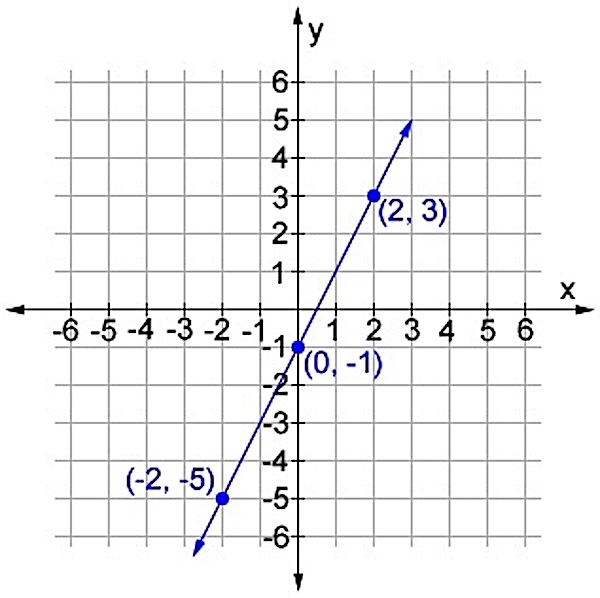
What it resembles is the Cartesian grid, a system that can plot points in space and chart relationships—here the formula y = 2x-1—with certainty and mathematical precision, theoretically infinitely, throughout all space, all existence.
These long chains of reasonings, quite simple and easy, which geometers are accustomed to using to teach their most difficult demonstrations, had given me cause to imagine that everything which can be encompassed by man’s knowledge is linked in the same way, and that, provided only that one abstains from accepting any for true which is not true, and that one always keeps the right order for one thing to be deduced from that which precedes it, there can be nothing so distant that one does not reach it eventually, or so hidden that one cannot discover it.
Descartes
The grid itself is a metaphor of thought, a picture that provides a basis for total understanding, for a philosophy of some sort. What we can do on paper we can do with our minds, with precision and certainty, without limits.

Add the third dimensions, and we can create perspective, a visual system where we can place and relate anything, everything. Perspective itself is a metaphor, a picture, a framework that holds the world we see, a world where we see each other and are seen, where we have a place, where everything fits, a world governed by whatever it is that exists between and beyond us and holds all things together.

And it creates a picture of the world for construction, where size and placement of all parts can be mapped out, total structure comprehended.

Renaissance artists firmly adhered to the Pythagorean concept “All is Number” and, guided by Plato and the neo-Platonists and supported by a long chain of theologians from Augustine onwards, they were convinced of the mathematical and harmonic structure of the universe and all creation. If the laws of harmonic numbers pervade everything from the celestial spheres to the most humble life on earth, then our very souls must conform to this harmony.
Wittkower
Add symmetry and defined relationships, and the world is stable, balanced, and orderly, our buildings sing.
One of the essential tasks of philosophy, of religion is to place us in the world, in space, define our relationship to it, decide what we know about it and how we know it, and establish a basis.
The eternal silence of these infinite spaces terrifies me
We have not all been comfortable with that space
The God that holds you over the pit of hell, much as one holds a spider or some loathsome insect over the fire, abhors you, and is dreadfully provoked. His wrath towards you burns like fire; he looks upon you as worthy of nothing else but to be cast into the fire. He is of purer eyes than to bear you in his sight; you are ten thousand times as abominable in his eyes as the most hateful, venomous serpent is in ours.
Jonathan Edwards
or with the basis
There is a universe behind and before him. And the day is approaching when closing the last book on the last shelf on the far left; he will say to himself, “now what?”
Sartre
and we have doubted we understand anything at all.
Since therefore the divine being is not a being received in anything, but He is His own subsistent being as was shown above, it is clear that God Himself is infinite and perfect.
Aquinas
“Is truth then a nothing, simply because it is not spread out through space either finite or infinite?” Then from afar you cried to me, “By no means, for I am who I am.”
Augustine
We can get caught in tautologies and unresolved mysteries. Saying God is the answer is not an answer, whether God exists or not. Or if God is the answer, it is a God who does not answer questions.
In any event, that the positive plenitude of classical infinity is translated into language only by betraying itself in a negative word (in-finite), perhaps situates, in the most profound way, the point where thought breaks with language.
Derrida
Or we trip over the words we use when we try to explain, throwing everything up for grabs.

I made a model that tried to reproduce the perspective drawing, keeping the plan in mind. I thought if I analyzed the plan carefully enough, long enough, I might come up with an inspiration that would provide a central concept that, once applied, would reveal the structure for the needed adjustments. I discovered the opposite, that there is no central concept, rather the opposite. The design, as much of it as we see, depends upon being active and unpredictable. Order is a point of departure, and its relationship to that order is indeterminate. But the plan needs that projection of order for the excursion. It is not chaotic.
The comparison with the Cartesian grid is apt and puts the plan in context. Regardless of Mies’s intent we will see it, and once seen it will provide a figure to help us understand his design. The practice of using a grid to organize space has been hardwired into our cultural DNA for centuries, whenever we practice geometry or draw plans for a building, where Mies spent a lifetime, as has the grid as a metaphor of understanding. Generally that metaphor rested in the background of our collective subconscious, where it remains today. With the metaphor, a confidence, a certainty only challenged the last century.
Again, the plan is a mapping out of space. Its greatest connection with the Cartesian grid is, however much it might resemble one, how much it is not a predicable grid, though in directed ways. Imagine trying to plot points in the picture above. The horizontal axis at x could only be used to plot points up to just inside the house. After that, x is indeterminate. Space in the upper left quadrant could be plotted with x and y², that in the lower left by x and y¹. Most interior space of the main part of the house would be determined by some figure, again indeterminate, between y¹ and y², but we have no certain x. As for space to the right we are left guessing, haunted by the ghosts of x and y. Extending the lines x and y¹ and y² across the page would only lead to a different uncertainty. Then take all that and try plotting a formula. These suggestions are as intriguing as they are impossible, in fact absurd, and the absurdity breaks the regimen and frees us to an open course.
Even Plato recognized the changes of forms in state and society and saw these changes as transformations in the soul of the populace that forms state and society, while the soul in turn is influenced in a myriad of ways by the forms of life that surrounds it.
Mies
Plato began discussions millennia ago that explored our relationship to the world, to some larger truth, that set the terms and provided a core for thought ever since, with revisions, reactions. Neumeyer speculates Mies’s education at a Catholic cathedral school would have oriented him to Medieval architecture and a Neoplatonic world view, where God provides the vanishing point of universal truth, which certainly would have disposed Mies favorably towards Aquinas.
Soul, spirit, essence, truth—here and elsewhere Mies uses the language. And we have no idea what he is talking about. These things do not exist, do not refer to anything. But the words have endured and have metaphorical value.

Putting ourselves at the center of the universe has no objective validity, yet we believed it for centuries and, figuratively, it is at the center where we remain today. Our needs, our concerns, our feelings before us still have priority, whatever circles above us or where it actually lies. Astronomy cannot map our sense of ourselves, our desire for closeness to each other.
The heavens themselves, the planets and this centre
Observe degree, priority and place,
Insisture, course, proportion, season, form,
Office and custom, in all line of order;
And therefore is the glorious planet Sol
In noble eminence enthroned and sphered
Amidst the other; whose medicinable eye
Corrects the ill aspects of planets evil,
And posts, like the commandment of a king,
Sans check to good and bad. . . .
There are reasons we still read Shakespeare, that he still speaks to us. We have dethroned kings and queens, yet we still want to believe our lives have special status and elevation. We still want to believe in a harmony of some sort, that there is something beyond us that guides and corrects us, that gives our lives meaning and keeps us whole. That worldview, as metaphor, provides a picture against which to compare ourselves, our experiences, then as now, and when we realize it doesn’t fit our internal sense of ourselves, our perceptions of the world, we make corrections. The world view gives a guide. This world view has another advantage: it sets the stage for disruption, also true to our experience in a world where there are no easy answers, and nobody can rattle that view better than Shakespeare. The disruption is meaningful as well, as it helps us come to terms with the tragic, an essential part of our existence. Maybe there’s a hint of tragedy in the irregular design, in the bricks of the house, certainly more than that in his Monument to the November Revolution.
We still use words like spirit and soul and heaven, even though they don’t exist and, again, refer to nothing. But we need a word that holds our sense of something vital and essential in ourselves that neurochemistry and psychology, sealed in their empirical observations and technical language and theories, can’t provide or touch our emotions. We still want to believe we’re headed to something better in this life, even if not the one hereafter.
In western culture God, as a metaphor, has been the central figure for reflection for centuries and given us a base. In this sense He exists, because we talked about Him. We have vast libraries of discussion for proof. And he exists because we have built churches and cathedrals to Him that still stand. We wanted to believe that there was good in the world and we could correct ourselves and fit in. God anchored those possibilities and maintained a presence, albeit in ghostly form. The advantage of God is that He, not nationalist, not imperialist, neither capitalist nor Marxist, transcended factions and political ideologies, which have only led to division, interminable conflict, and unspeakable wars. And He spoke to all of us, whether we were listening or not. While some of our worst wars have been fought over religion, they are cases where religion went off the rails. More likely, religious justification covered something basely personal. At any rate we would have found other excuses for those wars, and we did and still do.
That God transcends our differences, our disputes, our divisions can’t be disputed yet can’t be proved raises questions that can’t be answered. We will never understand His ways, His reason. They are beyond us. God can’t answer the question because He can’t, not for us in our limited understanding. And His understanding transcends such a question—it is beneath Him, or somewhere else we can’t place—in ways we still can’t understand. He doesn’t have to. We have to take His word. This is another advantage to the metaphor. There is so much we don’t understand and never will, another fact of our existence. Recognition of this fact is healthy, it is sane. We always get into trouble when we think we have all the answers. With God we can live with this uncertainty, our limitations, and still keep faith in ourselves, in each other, in something better. Augustine and Aquinas, metaphorically, are right; the metaphor has served us well.
I am not being religious but responding to the culture that shaped Mies—and me. The religious will object to the notion of God as metaphor. I won’t argue, but note they ignore the power of metaphor, often the weakness of the literal. Atheists will object on different grounds but ignore the ways the metaphor has shaped the culture—and them. Much western culture cannot be understood without some sense of God, however much He has been qualified, questioned, ignored, His existence doubted.
The entire striving of our epoch is directed toward the secular.
The times, however, as Mies saw them, now were shaped not by religion but by economic shifts and new societal structures, by technological advances, new materials, glass, steel, concrete, and by more efficient ways to assemble them. With the changes, the ascendence of economic and rational thought. From these influences we can find expression and build, yet they present the problems of mechanization and standardization, of indifferent architecture, and they don’t hold a basis or answer the questions we most want answered.
The battle cry “rationalization and typification,” along with the call for the economizing of the housing industry, represent only parts of the problem, for, although important, they have significance only if seen in right proportions. Next to them, or rather above them, stands the spatial problem that can only be solved by creativity rather than by calculation or organization.
Reason has its limits, glass, steel, concrete, and the new techniques are not enough. Creativity—and the creator, now with a small c—essential, stand apart.
It must be possible to heighten consciousness and yet keep it separate from the purely intellectual. It must be possible to let go of illusions, see our existence sharply defined, and yet gain a new infinity, an infinity that springs from the spirit.
The building art is in reality always the spatial execution of spiritual decisions.
God, if he existed for Mies has been abstracted or absorbed. Still Mies keeps the language. The spirit—within, without, can this distinction be made? does that matter?—still stands apart and has been given divine extension.
And we still don’t know what he is talking about.
We do have manifestos:
Architecture is the will of the age conceived in spatial terms.
Living. Changing. New.
and
Only intensity of life has intensity of form.
Every How is carried by a What.
The unformed is not worse than the over-formed.
The former is nothing; the latter is mere appearance.
Real form presupposes real life.
But not something that already existed, nor something thought out.
Here lies the criterion.
We do not evaluate the result but the starting point of the creative process.
Precisely this shows whether the form was discovered by starting from life, or for its own sake.
That is why I consider the creative process so essential.
Life is for us the decisive factor.
In all its fullness, in its spiritual and real commitments.
Better, we have a picture:
Which best serves as a metaphor. As a metaphor the plan is complete, coherent, and compelling. Complete because it is contained by the frame and nothing else can be added or removed. Coherent because all the parts, self-referring, fit together in a pattern. That the pattern is not symmetrical and can’t be measured in predictable ways is beside the point, rather is its organizing principle. Compelling because, with its complex, interlocking, opening parts, its spatial tensions, it is energetic. And it moves us. If we imagine wind, we can hear it resonate within the open chambers in a complex chord. If we picture the plan as a figure of life, we can imagine it drawing breath throughout the interior spaces, giving them life. The entry, upper left, has to be left open to provide air. If it is a figure of the creative process, we realize creativity is a dynamic presence, like wind, like breath, like ourselves, that it has possibilities, possibly unlimited, which we can explore.
And as a metaphor it is compelling because it takes us beyond ourselves and makes us stop and think. We are not just presented with a picture of the larger world, of all space, but also given a vital place within it. But form has to be based on something essential, not created for its own sake. How can that be envisioned when it can’t be based on anything that existed before, what has not yet been thought out? What is the starting point of the process and why should we accept it? What is to keep us from endless change, chaff blown about by perpetual winds of whim as we chase the new? Placing Mies’s plan in the context of the history of metaphors of truth, in the progression of thought over centuries, provides the mooring. It recalls past schemes, past confidence, past language, and reinvigorates them. Just as the perspective drawing takes past material and craftwork, bricks laid by hand, and shapes them in new form, the plan takes the Cartesian grid, its sense of truth, of divinity, and sees it afresh, with questions, with revision. One metaphor has grown out of another.
We still haven’t answered any questions. We can’t. We can no more define the essence of life and what makes it worthwhile than we can delineate the nature of God. We can’t explain how God, infinite, exists in the finite any more than how God might be in the details of Mies’s work. We don’t need to. We need a picture that contains what we do not know yet allows us to assert ourselves, make assertions, that helps us maneuver in the unknown, keep the faith, create, and live.
The Cartesian grid did not necessarily lead to beliefs and construction that were static and sterile. It has its own dynamics. But it did reduce understanding and planning to precision and regularity. Discovery and structural conception could only be based on what we already knew. If it looked to the world God created, it reduced it and Him to immutable and everlasting terms, where our only option was to learn the order and adapt. Mies’s plan allows the possibility of growth and change, of advancing into what is unknown without preconception, without losing our bearings. Revelation is replaced with seeking, with becoming, with the life of spirit, the spirit of life.
An “inner breadth,” an “ability to believe in skepticism,” as Guardini called it—this “infinity that emerges from the spirit” of which Mies spoke—should drive existence from “subjective constraints and arbitrariness” out into the larger perspective of “objective order,” toward “a new self-discovery in the world” that, for Guardini’s philosophy of religion and Mies’s philosophy of architecture, is the proper goal of the human spirit.
Neumeyer
Mies knew Guardini’s work and likely met him. The “infinity that emerges from the spirit”—we are given a picture of that in the plan, maybe, but other readings are possible and the notion raises more questions as to the source of the spirit, its basis, its relationship to Guardini’s God—and Augustine’s and Aquinas’s—and Mies’s divinity. Also skepticism is not a word Mies used. There is confidence in his words, his work, provisional certainty placed against, within the unknown. An ability to recognize and negotiate uncertainty might be a more accurate phrase. Along with his confidence, there is recognition and respect. Nothing in life is simple. Nothing in life is easy. Nor is the plan a picture that charts the way for the ego, or the spirit, to conquer worlds, rather one to recognize and live with, within what we do not know, what appears large, possibly endless in the plan. What makes us pause and reflect, what keeps the plan in our minds, is the recognition of uncertainty, with all its potential but also its questions, along with, for all its energy, the plan’s reserve, its careful and thoughtful design, and its own sense of proportion. An inner breath—the plan takes and holds suspension of belief, our lungs are full.
The will of the age—Hegelian thought and others of the 19th century, present in the currents of Mies’s Germany, perhaps are suggested. But his plan is not a picture of an ongoing process, of dialectic, Hegelian or Marxist, which has no beginning point or center or terminus, or if it does is suspect. There is no synthesis in Mies’s figure, rather open statement of relationship, fixed on the page near the middle, almost centered, and the plan, except for the walls, points to no other construction beyond what it shows. We cannot project reformulation beyond it. That possibility is left entirely open. And we’d have problems aligning such thought or any other with any precision to Mies’s words and creations, this house or any other. There’s an advantage to keeping the discussion general. Philosophy has always been in flux, with shifting language. Reviewing general tendencies in basic terms helps maintain continuity and avoids traps and detours.
This is all too abstract. The best way to understand the plan is to look at it again.
.
Praxis
Ich war, ich bin, ich werde sein
I was, I am, I will be
The final written words of Rosa Luxemburg, one of the revolutionaries, communist, before she was murdered. They also appeared on Mies’s plan for the November Revolution Monument and may have made a brief appearance on the completed structure. If I’m not wrenching context too much, they might also stand for the plan of the Brick Country House. How fresh, how invigorating it appears a century later, how much it still stirs us to thought.
A design for an upper class suburban home, especially one with rooms for servants, will not lift the world. A house that “follows the process of dwelling”—class aside, this desire may be more an ideal that does not fit the actual ways we live, in fact may lay its own obstacles. The plan as metaphor, however, unbuilt, freed from specificity of site, of class constraints, from necessities of utility, utilities, and construction, and applied to larger contexts gains extension. We won’t we get a picture of collective life in an individual house, though we gain a sense of individual integrity, an identity that promotes our potential, encourages us to think beyond ourselves, be open and flexible yet work within a framework of reserve and proportion, that recognizes the distinction as well as the relationship between service and living, abstractly conceived.
[I built it] in a square shape. I meant clarity and truth to join forces against the fog that had descended and was killing all hope—the hopes, as we rightly perceived at the time, of a durable German republic.
Mies on the monument decades later. The period in Germany after WWI was a time of economic and social distress and political turmoil, complex and contentious, difficult to sort out, as the country attempted to transition from monarchy to a democratic state, all proposals, every decision hotly contested by factions left to right. What is certain and not complex is that Rosa Luxemburg was clubbed and shot, and her body was thrown into a canal, not found until months later.
I suppose the stacked, sliding volumes, arranged in no discernible pattern, might be read as the confusion and turmoil of the time, which the overall rectangular shape contains and stabilizes. But Mies avoided overt representation and the design is not chaotic, rather asserts its own free sense of order. The dimensions of the controlling rectangle itself are not certain, only suggested, with alternative possibilities, and the various rectangular volumes within complement and pull away from its overall suggested size and symmetry, as well as pull away from and complement each other, and do so with energy, proportion, and composure. The implied rectangle functions the same way the implied regular axes of the grid provide a base for variation in the plan for the Brick Country House. The two designs, taken together, suggest two metaphors that could complement each other as well. A durable state needs complexity and vitality, not fixity and absolute enclosure. To be vital, the state needs vital, free individuals, and vital individuals need a vital state in which to thrive.
Given all the factions in play, at odds then in Germany, the monument might reflect the need for a variety of voices maintaining separate recognition yet working together. I see the somber construction as hopeful, not funereal. What Mies does not give us is a scheme for a specific political ideology. While he had some affinity for the Soviet state, the star likely was required and served as a marker that identified the loyalties of the fallen, not as a promotion of its version of communism. Mies himself avoided politics, which at the time may simply have been practical wisdom.
Nor does either design offer a picture of an economic system, a scheme for distribution of resources and wealth, or a system or ethics and a code of behavior, certainly not a theology and its creed. What their metaphors might give us is a way to think about those disciplines that is open and flexible, that can think within but also beyond them as well as preserve past formulations and keep their essential thrust alive, reinvigorate them, recast them in light of present change. The designs could be taken as pictures of thought itself, complex, open, capable of assertion, that recognize there is no single answer, that realize one assertion does not necessarily cancel another, that negotiate the unknown as well as live with it.
I meant clarity and truth to join forces against the fog—
Mies again invokes the larger understanding that transcends circumstances and particulars, here social and economic conditions and ideologies and factions. Empirically that projection makes no sense and has no validity. Metaphorically, however, it may be worth observing. The perspective today that every act, every belief is motivated by politics ignores what ideologies box out, what they have brought us, what conflicts they fail to resolve, what conflicts they engender. Capitalism, equated by many with democracy, has been seen in opposition to Marxism, and vice versa. They depend on each other for their definition and see no common ground. Capitalism, however, is a practice without ideology yet is treated as if it has one. Marxism, on the other hand, is an ideology that has not been put into practice, not the way intended. The causes for these discrepancies and their implications need sounding. Practically, both are locked within narrow terminology they can’t see past, both have led to formulations for endless conflict, both to states where the people have not been free in any vital way or free at all, that have depleted natural resources and spoiled the environment, that esthetically left us on the one hand with bland towering glass enclaves for the privileged, devoid of meaning, and sterile, repressive boxes of the offices of the state and of housing for the masses on the other. It’s tempting to say both were influenced by corruptions of past divinity, by distilled, displaced conceptions of Eden. Or Armageddon—the two are related. Transcendence is a moot point in the case of the November Monument, however. It was leveled by the Nazis in 1935.
Architecture is the will of the age—
What is the will of the age today. As I write this I strain to maintain perspective and composure. In the recesses of my thoughts two major wars continue to spread and show no signs of ending or solution, rather have led to talk of global realignment, shifts of mere power, to the displacement of millions, to mindless slaughter, tens of thousands dead, hundreds, both numbers rising. With those wars, other instabilities, conflicts throughout the world, more dead, more displaced, those numbers rising. Nature, compromised, closes in. God today is dead for many; for many others He is the figurehead of mindless strictures, conformity, exclusion. Communism is dead as well, except in academia and in the mouths of rabid reactionaries who do not know meaning of the word. Capitalism, ascendent, mindlessly exuberant, has taken on the air of a kind of faith. We recognize our differences but have no common identity. The individual reigns supreme, as long as his or her attention can be held. On the home front, an election approaches that has divided us, perhaps irreparably, that has taken on the tone of frank vengeance and endless retribution, merely personal, wholly mindless. As for architecture the technology has advanced by leaps, by bounds, and we build larger, taller structures that stretch belief or loom transparent, seemingly immaterial—
We live in a fog.
Ich war, ich bin, ich werde sein—
We need a plan.
.
.
See also
Mies van der Rohe: The Brick Country House Revisited/Revised is a companion post in which I attempt to make a full model based on the perspective drawing, from which I take the photographs above.
For comparison, in Mies van der Rohe: The Brick Country House/According to Plan I make a model based on the ground floor plan.
In my earlier essay, Completing the Mies van der Rohe Brick Country House, An Odyssey, which takes us in a different direction, I had not read the Tegethoff when I made the rough model, which is closer to the ground floor plan. Part of this essay is drawn from there. An abbreviated version of the essay appeared at Archinect. More pictures of the model can be found here.
.
Notes/credits
According to Schulze and Windhorst there is no direct evidence Mies ever said “God is in the details.” If so, I’m curious how this attribution got started. It’s not hard to see, however, why it has been widely accepted.
There is question, in fact, Mies even made the perspective drawing, rather it was drawn by an assistant. It’s a moot point to me. It bears relationship to the plan and, more importantly, is a compelling image in its own right.
Only philosophical understanding reveals the true ordering principles of our service and thence the value and dignity of our service.
However interesting it may be to trace the intellectual impulses of an art period and illuminate its formal problems, the spiritual forces of an era can also here be effective.
Mies, found in Fritz Neumeyer, The Artless Word: Mies van der Rohe on the Building Art, MIT, sadly out of print. This is an excellent resource, and it is what got me started on my general reflections. The appendix has an extensive selection of Mies’s writings. Neumeyer traces esthetic and philosophical currents of the time thoughtfully, in detail, to which Mies must have had at least brief exposure. The “will of the age”—Schopenhauer we know he read and likely was at least an indirect influence. I would still argue that we won’t find specific influence—there is little direct reference from Mies. Nor can we assume his full understanding or reception of those ideas. And Mies’s philosophical orientation is at best general. Again, we won’t be able to connect any idea directly to his work. Both approaches, scholarly analysis and general reflection like mine have value, I want to believe, and the ground floor plan may provide a guide as a way to manage details, assertion, speculation, uncertainty, and unspoken possibilities. Most, the Brick Country House is a deeply esthetic creation, and both drawings should be appreciated as such. Much of my effort has been spent responding to what appears in the two images, whatever Mies’s intent, which we do not know well.
Mies denied the influence of Mondrian and, presumably, by extension, of De Stijl. Van Doesburg’s Maison Particulière, however, does give pause. Similarities to Constructivism are possible, and Wright’s pinwheel design has also been suggested. Much was in the air, and Mies would have seen much of it, but in absence of his own statements about influence we are left guessing. The Brick Country House, still, is different in significant ways, maybe sui generis. Detailed statement beyond his general manifestoes might have helped explain its special character. But then we have the problem of attaching theory to actual construction, which is limited and suspect for any creation. Movements don’t align well with work and tend to fix it in our understanding, diminishing the continuity with past influences and the power to still hold our imagination on other terms, at other times, once the movement has passed. They also tend to ignore general esthetic criteria. There may be reasons Mies avoided explicit statement. Once more, we have his work to consider and see what it says.
Compare the flat, indeterminate space with that in Muqi Fachang’s Six Persimmons. There are, of course, other cultures to consider, and we are closer to them now, but we won’t find strong ties to Mies.
Wolf Tegethoff, Mies van der Rohe: The Villas and Country Houses, MIT: 1985, also, sadly, out of print. I take both images of the Brick Country House from there. The book, well illustrated and thoroughly researched, analyzes and gives historical background of Mies’s modern home projects, many unbuilt. We see a mind at work in a variety of domestic settings, with a variety of solutions. The projects are as interesting in their solutions as in the architectural ideas they explore. Invention, perhaps, like charity, begins at home. His discussion of the Brick Country House is especially extensive, where he corrects some of the critical excursions, past and present.
There is another drawing of the floor plan, based on the original, made by Werner Blaser under Mies’s supervision much later in his life, 1965, that details the placement of each brick—and adds a hearth to the large chimney. As Blaser states,
. . . the ground plan of the brick house is a good example of the manner in which Mies van der Rohe developed the art of the structure from the very beginning. The structure of a brick wall begins already with the smallest divisible unit: the brick.
Cited by Kent Kleinman and Leslie Van Duzer in Mies van der Rohe: The Krefeld Villas. The brick placement, however, has little relationship with the original drawing and Blaser’s drawing does not match it in many respects. Besides, as the authors point out, such a claim cannot be true. Rather, the drawing served as a manifesto of Mies’s method then, well after the fact, without consideration for actual construction. According to them, referencing Dan Hoffman, discussing other brick houses actually built:
Mies has consequently been credited with coaxing a machined precision out of the handiwork of bricklaying to the point where the masonry units and mortar joints merged to form an overall texture of such regularity that it approached the appearance of an industrialized surface. Craft was pushed to a degree of such perfection that it disappeared.
Which takes us in another direction. The Blaser drawing was made at a different time, when Mies was in a different frame of mind.
I was not, in fact, able to connect the diagonal lines in my wide perspective analysis, above. It is difficult, if not impossible, to get precise registration on rough lines at this angle. Again I’m not at all convinced the perspective is consistent, which for his purposes is not a concern. The protrusion at G in the other diagram, however, still bugs me.
Giovanni Bellini, St. Francis in Ecstasy via Wikipedia.
“the house follows the process of dwelling. . .” from conversation with Paul Westheim, 1927, cited in Dietrich Neumann, Mies van der Rohe: An Architect in His Time.
De Stijl first manifesto, 1918, from Kenneth Frampton, Modern Architecture.
“Beauty is the radiance of truth”—from Neumeyer:
. . . this postulate of the late-antique Neoplatonist Augustine, recorded for the first time in Mies’s notebook in 1928, and later frequently quoted in debates and interviews, appealed in the twenties not only to Mies.
Neumeyer comments on Mies’s lecture in 1928:
That epoch [the breakup of the order of antiquity] also offered a suitable solution for the crisis. On the basis of the Platonic order, Augustine formulated “the medieval idea of order” that introduced a new epoch. In it, the antique spirit of “proportion exemplified and founded by Plato,” in which Mies saw the noblest inheritance from antiquity, opened up a “totally new dimension.” Here was an exemplary—if not to say the exemplary—solution offered by history, namely how, by a recollection of the Platonic world of ideas, the problems of a period could be solved. That this orientation toward Plato was initiated by Guardini can practically be taken for granted. Antiquity had moved for Mies into a new perspective.
“Only a relationship which touches the essence” from Steven Kent Peterson, “The Dematerialization of Architecture.”
Image of November Revolution Monument and Mies’s quotations via The Charnel-House.
“a prerequisite of the free ground plan” from draft of a letter, found in Neumeyer.
Linear equation graph via Mathplanet.
Perspective engravings, one enhanced by me, by Jan Vredeman de Vries.
Descartes, Discourse on the Method.
Palladio, Plan and Elevation of Villa La Rotonda via The Morgan Library and Museum.
Rudolph Wittkower,
Blaise Pascal, Pensées.
Jonathan Edwards, sermon, “Sinners in the Hands of an Angry God,” 1741.
Sartre, Roquentin on the Self-Taught Man, Nausea.
“Is truth then a nothing,” Augustine, Confessions. My essay was greatly influenced by the thought that Mies spent time with Augustine, wondering how that, along with his Catholic education and upbringing, shaped him and even might have influenced his work. Many modern architects went to see the Parthenon. Mies wandered through The Confessions. Take a minute here:
Do the heaven and earth then contain Thee, since Thou fillest them? or dost Thou fill them and yet overflow, since they do not contain Thee? And whither, when the heaven and the earth are filled, pourest Thou forth the remainder of Thyself? or hast Thou no need that aught contain Thee, who containest all things, since what Thou fillest Thou fillest by containing it? for the vessels which Thou fillest uphold Thee not, since, though they were broken, Thou wert not poured out. And when Thou art poured out on us, Thou art not cast down, but Thou upliftest us; Thou art not dissipated, but Thou gatherest us. But Thou who fillest all things, fillest Thou them with Thy whole self? or, since all things cannot contain Thee wholly, do they contain part of Thee? and all at once the same part? or each its own part, the greater more, the smaller less? And is, then one part of Thee greater, another less? or, art Thou wholly every where, while nothing contains Thee wholly?
Full text here.
Aquinas, Summa Theologiae.
Derrida, “Violence and Metaphysics,” Writing and Difference.
“Even Plato recognized”—I’m not sure what he is referring to—from a draft of an unpublished lecture, around this time, details unknown, found in Neumeyer.
The celestial spheres, from Peter Apian’s Cosmographia, 1539, via Luke McKernan.
Shakespeare, Ulysses speaks in Troilus and Cressida.
“The entire striving of our epoch is directed toward the secular” from “Building Art and the Will of the Epoch!” 1924, found in Neumeyer.
“The battle cry ‘rationalization and typification,’” from introductory remarks to the special issue “Werkbundausstellung: Die Wohnung,” Die Form, 2, no. 9 (1927), found in Neumeyer.
“It must be possible to heighten consciousness” and “The building art is in reality always the spatial execution of spiritual decisions” from lecture “The Preconditions for Architectural Work,” 1928, found in Neumeyer.
“Architecture is the will of the age” from “Working Theses,” 1923, and “Only intensity of life has intensity of form” from “On form in architecture,” 1927, letter to Dr. Riezler, both found in Ulrich Conrads, Programs and manifestoes on 20th-century architecture.
Mies repeated many of these statements with different wording throughout his career. Some of the quotations appear shortly after the drawings were made, but continuity of thought can be safely assumed.