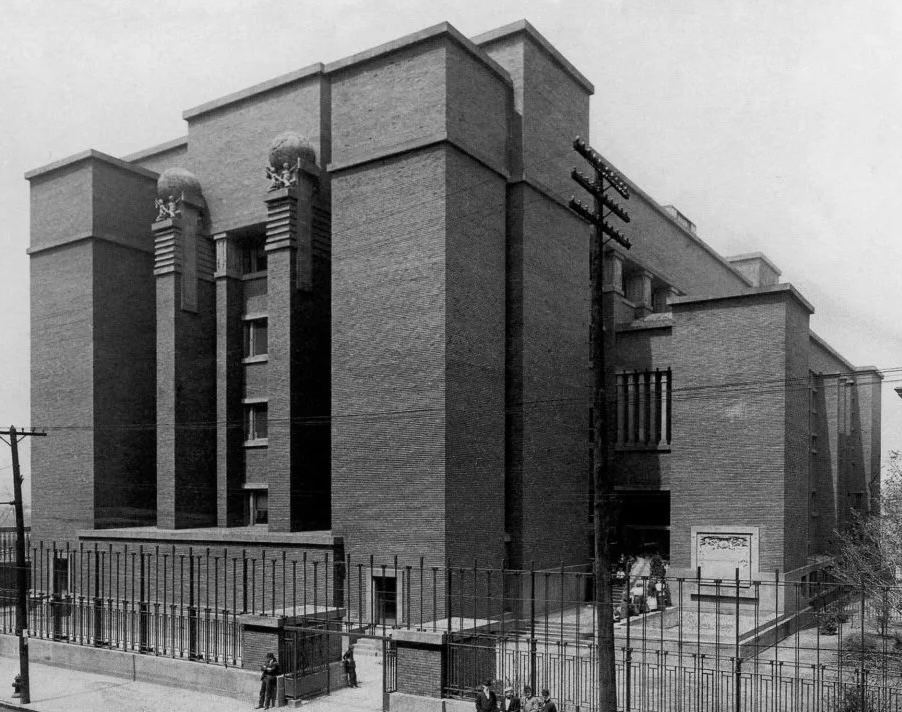
Winged Victory: The Larkin Building

She takes our breath even as she lifts our spirits, Winged Victory, Niké of Samothrace, once a votive offering from a now defunct religion, a memorial, perhaps, to a naval battle won long ago, long since forgotten. Or rather not all of her, not the full statue, but the assembled fragments we know and have known for well over a century, who still inspires us to think of flight, our imaginations, our spirit propelled by her incompletion, by how she might be made whole, by what might yet lie before her, might yet exist above, beyond.

ASPIRATION
TRUTH
NOBILITY

Frank Lloyd Wright’s Larkin Building, completed 1906, solid and firmly anchored yet energetic in its interlocking masses, takes us back a century ago to past enterprise, to values of another time, to maxims voiced to fortify our character and raise our spirits. It lifts us in a different way, engages us in, releases us from its ponderous and self-pondering mass, also encourages us to look forward, look up.

SIMPLICITY
TENACITY
STABILITY

But this corner pier of the surrounding wall is all that remains of the building today, and it had to be rebuilt.

ADVERSITY
REFINEMENT
SYMPATHY

Continue reading

Non-Monument #5/Per Kirkeby

The work that is both there and not there. That need not be circumvented all the while you can walk inside it. That is massive in appearance, and yet transparent. That looks like a building and yet is not, and which is not an oversized sculpture, but which does not merely shift its weight uneasily from one leg to the other. Because it is entirely what it is and does not even pose the question. Though perhaps other questions. About the measured sky. About the constancy of walls, and the fleeting nature of buildings. About human ingenuity liberated from intellectual vice.

Per Kirkeby

Continue reading

Per Kirkeby: Cabañera de la montaña/Plan

I have this memory, stronger in impression than detail, of hiking somewhere, likely in the Appalachians, after hours, after days of winding along the thread of a trail, the only human intervention, negotiating endurance and fatigue, working to find a rhythm through thick growth on either side beneath a cover of trees that blocked further sight, rising, descending on switchbacks along a ridge, only occasionally reaching a clearing where I could look out and see the rolling hills, mountains that stretched endlessly only to lose sight again at the next turn, rising, descending again, losing in the rhythm of climbing, in the motion of my thoughts any thought of destination that night, of any clear direction, of any ambition, of any larger self, instead absorbing the presence around me, indeterminate from my point of view but which had its own determination, its own motions, slower, imperceptible, a timeline that diminished me—I came upon in a clearing a stone building, or brick, its windows open, its roof gone but otherwise intact, likely a house, but its function was uncertain now, its use transcended by years of abandon, or made irrelevant, and I stopped and felt a shift, was moved to some understanding that had the force of revelation but not its speed, was profound but without depth, without extension, yet that still took me to a broader reflection that has stayed with me ever since. This was some fifty years ago.

Danish artist Per Kirkeby, who studied geology in college, talks of his experience on a field trip in southern Sweden where the class explored a stone quarry, then passed a Romanesque church nearby, isolated, abandoned, in decline.

The structure built by nature had been uncovered by people; the church built by men, however, had been gradually taken over by nature. As time went on. Where is the border between one and the other way to organize matter? For a brief moment I saw geology as a world view.

In a glimpse I saw geology as a philosophy, a vision extending far beyond any technocratic discipline. A huge stream of energy and materials, which now and then converges in crystalline structures, a mountain, a church, a brief moment, a breath, a morning mist over the ever-flowing river. The mountain-building energies were no less cultural than the energies of the church-builders. I saw the geologist’s curiosity, could not stop at the mountain and before the church. It was a dizzying feeling.

Revealed, a different way not just of seeing himself in the world, but living in it. Yet he only had a glimpse, and when he returned home he realized his reaction was just that, a feeling and not an insight. In what sense are the forces that made mountains cultural? Where is the border between the energies that built churches and those that build mountains? What is their relationship? Where is insight, what to make of feeling? He doesn’t answer, only raises the questions. The experience influenced his later art, where he raises them again, resisting answers, yet, viewing his work we feel a shift, perhaps wonder what kinds of answers we expect.

Continue reading

Claude-Nicolas Ledoux: Visions

Featured

The plans, the elevations of town and country houses must be as varied as the people; none are alike, yet they are all composed in the same way: the layouts differ only in the greater or lesser; they are relative to the fortune that dictates them. Nomenclature places them according to the order of needs: in an art where the planners have no rights other than those acquired by paying for the material, the discerning man must guide the Architect; but if he hinders his means, he robs posterity of productions that could have justified his expense by illuminating his century.

Exterior decorations come in large and small dimensions. We will not go into tedious details that could make the description languish; it is enough, to be in accordance with natural laws, to prove that decoration belongs to everyone; in vain have prejudices concentrated it exclusively in the class of those who occupy high positions, dignities, and public offices.

Anyone who seeks the care of a skilled artist has an equal right to a monument of taste. [130]

Claude-Nicolas Ledoux

The nineteenth century—to borrow the Surrealists’ terms—is the set of noises that invades our dream, and which we interpret on awaking.

Walter Benjamin

While in prison, Claude-Nicolas Ledoux, prodigy of the Enlightenment, architect of the ancien régime, who designed and built spartan neoclassical buildings for the monarchy, for the aristocracy, for the wealthy that captured the spirit of the times, who was arrested during the Reign of Terror, continued working on a book he had begun some years before that contained his thoughts on his work, on architecture itself, and more, along with prints of his projects, realized, envisioned, and plans for a whole town, partly built, wholly idealistic, from which I draw the image and text of one of his maisons de campagne, country houses, above. The book appeared in 1804 under the title L’Architecture considérée sous le rapport de l’art, des mœurs et de la législationArchitecture Considered in Relation to Art, Mores, and Legislation. The title and his opening words give a sense of his exalted belief in architecture, in himself, the range of his ambition, the scope of his desires:

Amidst the various occupations, which can be judged by the extent of the work I present to the nations; amidst the turmoil that has tested my perseverance; in the face of the persecutions inseparable from the public expression of great ideas, and the passions that have worn down my resolve; almost constantly subjected to narrow calculations, to timid ambitions, to fickle wills that stifle the impulses of genius, I will not offer my readers those projects that fade into the vagueness of imaginary schemes, or whose terrifying potentiality prevents any progress toward their execution.

Convinced that by condensing the annals of time, and by gathering together the models and principles that art has bequeathed to us, I can imbue it with a creative force that will allow it to produce great works, and thus expand its domain and its glory, I have gathered, in a few days of reading, all the riches of the centuries that preceded us. [1]

I have no idea what he is talking about and I’m not sure he does, either, though I wonder about the terrifying potential of the work he does not offer. Nor do I know what possessed me to make this model of his odd country house, designed, he tells us, to follow the laws of nature, to illuminate his century, long past, but which perhaps might yet shed light on my own.

Continue reading

Mies, the Dexel House, Artificial Intelligence: De Profundis, Flitting on the Surface

Featured

Out of the depths I have cried to You, O Lord
Lord, hear my voice!
Let Your ears be attentive
To the voice of my supplications.

.

.

The times are bleak, solutions appear beyond us, miracles lie around the corner. We live in an age of bottomless trepidation and unbounded wonder. Each is exhilarating in its own way, both are given equal play without resolution. The two can be related, one feeding the other: the greater our desperation, the greater our projection of hope. There is a kind of exhilaration in utter helplessness that propels us beyond ourselves, to faith. Of late our faith—along with vast computing resources and countless billions—has been invested in artificial intelligence, which we hope will save us, transform us in ways we cannot even fathom.

Mies van der Rohe’s Dexel House, commissioned by artist Walter Dexel, 1925, unbuilt, would have been his first modern construction. Not much is known about it and Mies left us almost nothing beyond a handful of quick, rough sketches. For my brief, tentative essay, Mies van der Rohe: Haus Dexel, I built a model based on the first image, above, shown in the second. I wanted to see what AI could do and went to ChatGPT with great anticipation, some fear. I simply entered the prompt “Mies van der Rohe Dexel House” and in seconds got a full, impressive-looking report that ended with this conclusion:

Mies van der Rohe’s Dexel House was a conceptual laboratory—critical stepping stone in his architectural evolution. Though never built, it encapsulates his shift from classical composition to modernist abstraction, from enclosed space to defined space. It is one of the clearest articulations of his exploration into how form, space, and modern life could converge—not through ornament or tradition, but through clarity, geometry, and logic.

Would you like a diagram showing how the spatial volumes interact in the design?

I said I did, and got the third image. The conclusion, for all its ambition, is wholly abstract, dubious, and borders on nonsense. The drawing fits it well. It makes no sense as a house at all and bears marginal connection to the Dexel House, to anything Mies ever designed or built, to architectural design itself.

Continue reading

Mies van der Rohe: The Brick Country House Revisited/Revised

I have long wondered what Mies van der Rohe’s Brick Country House might look like in actual three dimensions, wanting to make a model I could walk around and view from all angles, then see where that took me.

It exists only as a perspective drawing

and a ground floor plan, both made a century ago, both often presented together, both of which tell us little about the second floor, beyond what we see.

I thought if I analyzed the plan carefully enough, long enough, I might come up with an inspiration that would provide a central concept that, once applied, would reveal the structure of the rest, unseen. I discovered the opposite, that there is no central concept. Rather the design, as much of it as we are given, depends upon being active and unpredictable. Order is a point of departure. I also studied his other houses of the time to get ideas—the Concrete Country House, the Dexel House, the Eliat House, the Krefeld Villas, the Tugendhat House, still more, all in varying degrees of completion and conception—all of them similar only in how different they all are. Mies is experimenting with different sites, different programs, different ideas. The only conclusion I could make is that the closer he came to final, built versions of these, the more compromises he had to make. That is not a problem with the Brick Country House, which was never built. Mies had complete freedom.

Continue reading

Mies van der Rohe: Meditations on a Plan

Mies conceived of building as arising out of a field of tension that consisted of intrinsic lawfulness on one hand and creative freedom on the other. It should afford the “required privacy combined with the freedom of open room forms” and provide a “defining” but not a “confining space” suitable for contemporary living. Behind this concept of space and architecture that defined “building” in a philosophical sense as a “giving form to reality” stood for Mies the question of the “value and dignity of human existence,” namely: “Is the world as it presents itself bearable for man? . . . . Can it be shaped so as to be worthwhile to live in?”

Neumeyer

For decades I have been moved by Mies van der Rohe’s Brick Country House without knowing why. Not knowing why may be a large part of the attraction, along with a sense of release when I look again at the drawings, also without knowing why, or where, but without feeling I have left the ground. But it is open and direct about what it is, factual, honest, as Mies would have it. This honesty may be its greatest strength, its largest mystery.

Continue reading

Barcelona Pavilion, Meditations

The fact that here for the first time the Weimar Republic was given an opportunity to present itself outside its own borders as an equal partner within the community of nations explains the ambitious expectation officially accorded the project. Ten years after the end of the war the image of Germany as a presumptuously conservative state characterized by self-glorifying illusions of empire and a pathetic reverence for its Kaiser was still widespread abroad. The young democracy wished to counter this with a restrained expression of its progressiveness and distinctly international orientation. The government sought a new means of expression, untainted by historical allusions.

Tegethoff

That project was Mies van der Rohe’s pavilion for the Barcelona International Exposition, 1929, designed to put a new face on Germany, give an open look on the world.

can only guess how visitors might have received the Mies construction, the pavilion set off to the side of the ceremonial main axis of the fair, away from the rising pomp and elaboration of the other buildings, their articulation of past traditions, of local variations, those bearing assumptions that had conditioned the attendees’ vision all their lives.

Asymmetric, low lying, simple, close to nothing, really; surrounded by, placed within, beneath, not commanding the life ascending the hill behind; its roofs flat, not pitched, quiet planes suspended beneath an expanding sky—maybe it startled, perhaps it shocked, likely it perplexed. Yet the pavilion has completeness and composure, and its overall aspect is serene. And there is nothing difficult about the Barcelona Pavilion. Rather it goes against assumptions whose difficulty has been attenuated by use, by forgetting, by repression. It challenges more with what it is not as with what it is, raising questions about past assumptions, about what assumptions might take their place.

Continue reading

Battersea Power Station/The Wretched Boar

The wretched, bloody, and usurping boar,
That spoiled your summer fields and fruitful vines,
Swills your warm blood like wash, and makes his trough
In your embowelled bosoms—this foul swine
Is now even in the center of this isle

Richmond advances on Richard’s forces and reports the damage done, the boar King Richard III’s heraldic emblem. These lines were invoked after the election of our previous president.

In the 1995 movie version of Shakespeare’s play, the final battle is fought at the remains of Battersea Power Station, London. The movie, smart, engaging, rather flip, is set in thrityish fascist times, with anachronisms, but in manner and manners feels contemporary to our times—and is too familiar. As I write this, Ukraine battles Putin’s forces laying waste to its land.

At home, just over a year ago, this building was the setting for another siege.

Continue reading

Muzharul Islam/Bangladesh National Library (Borges/Babel)

The universe (which others call the Library) is composed of an indefinite, perhaps an infinite, number of hexagonal galleries, with enormous ventilation shafts in the middle, encircled by very low railings. From any hexagon the upper or lower stories are visible, interminably.

Borges/The Library of Babel

The comparison is extreme, but once Borges’s story came to mind, while building this model, I could not let it go.

The Library of Babel is wholly, maddeningly regular, vastly inaccessible, and, again, possibly infinite.

Continue reading