
Take an object. Do something to it. Do something else to it.
Jasper Johns


She takes our breath even as she lifts our spirits, Winged Victory, Niké of Samothrace, once a votive offering from a now defunct religion, a memorial, perhaps, to a naval battle won long ago, long since forgotten. Or rather not all of her, not the full statue, but the assembled fragments we know and have known for well over a century, who still inspires us to think of flight, our imaginations, our spirit propelled by her incompletion, by how she might be made whole, by what might yet lie before her, might yet exist above, beyond.
ASPIRATION
TRUTH
NOBILITY

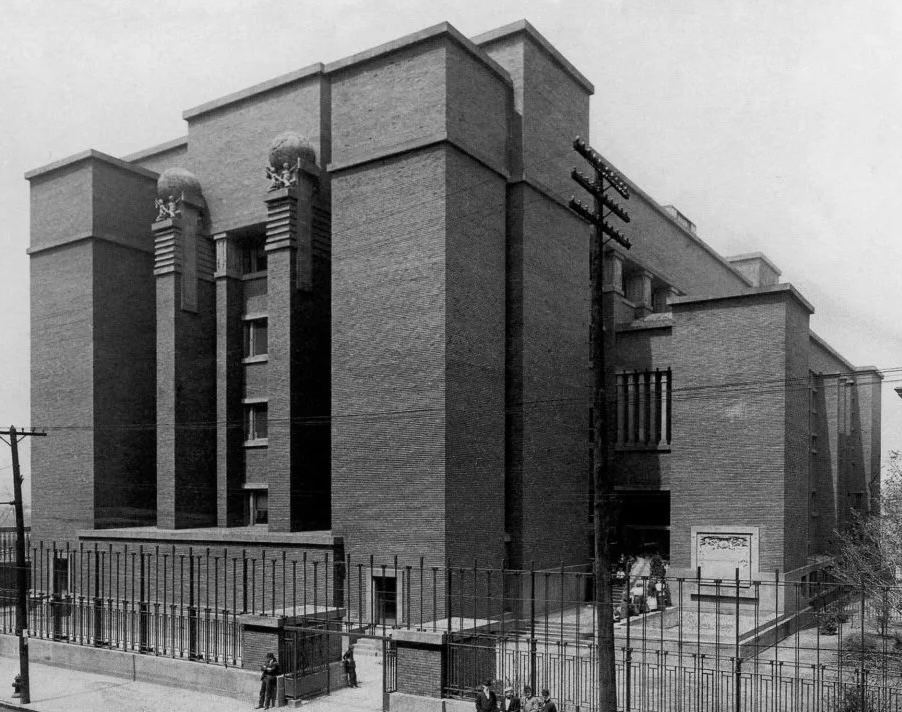
Frank Lloyd Wright’s Larkin Building, completed 1906, solid and firmly anchored yet energetic in its interlocking masses, takes us back a century ago to past enterprise, to values of another time, to maxims voiced to fortify our character and raise our spirits. It lifts us in a different way, engages us in, releases us from its ponderous and self-pondering mass, also encourages us to look forward, look up.
SIMPLICITY
TENACITY
STABILITY

But this corner pier of the surrounding wall is all that remains of the building today, and it had to be rebuilt.
ADVERSITY
REFINEMENT
SYMPATHY

The plans, the elevations of town and country houses must be as varied as the people; none are alike, yet they are all composed in the same way: the layouts differ only in the greater or lesser; they are relative to the fortune that dictates them. Nomenclature places them according to the order of needs: in an art where the planners have no rights other than those acquired by paying for the material, the discerning man must guide the Architect; but if he hinders his means, he robs posterity of productions that could have justified his expense by illuminating his century.
Exterior decorations come in large and small dimensions. We will not go into tedious details that could make the description languish; it is enough, to be in accordance with natural laws, to prove that decoration belongs to everyone; in vain have prejudices concentrated it exclusively in the class of those who occupy high positions, dignities, and public offices.
Anyone who seeks the care of a skilled artist has an equal right to a monument of taste. [130]
Claude-Nicolas Ledoux

The nineteenth century—to borrow the Surrealists’ terms—is the set of noises that invades our dream, and which we interpret on awaking.
Walter Benjamin
While in prison, Claude-Nicolas Ledoux, prodigy of the Enlightenment, architect of the ancien régime, who designed and built spartan neoclassical buildings for the monarchy, for the aristocracy, for the wealthy that captured the spirit of the times, who was arrested during the Reign of Terror, continued working on a book he had begun some years before that contained his thoughts on his work, on architecture itself, and more, along with prints of his projects, realized, envisioned, and plans for a whole town, partly built, wholly idealistic, from which I draw the image and text of one of his maisons de campagne, country houses, above. The book appeared in 1804 under the title L’Architecture considérée sous le rapport de l’art, des mœurs et de la législation—Architecture Considered in Relation to Art, Mores, and Legislation. The title and his opening words give a sense of his exalted belief in architecture, in himself, the range of his ambition, the scope of his desires:
Amidst the various occupations, which can be judged by the extent of the work I present to the nations; amidst the turmoil that has tested my perseverance; in the face of the persecutions inseparable from the public expression of great ideas, and the passions that have worn down my resolve; almost constantly subjected to narrow calculations, to timid ambitions, to fickle wills that stifle the impulses of genius, I will not offer my readers those projects that fade into the vagueness of imaginary schemes, or whose terrifying potentiality prevents any progress toward their execution.
Convinced that by condensing the annals of time, and by gathering together the models and principles that art has bequeathed to us, I can imbue it with a creative force that will allow it to produce great works, and thus expand its domain and its glory, I have gathered, in a few days of reading, all the riches of the centuries that preceded us. [1]
I have no idea what he is talking about and I’m not sure he does, either, though I wonder about the terrifying potential of the work he does not offer. Nor do I know what possessed me to make this model of his odd country house, designed, he tells us, to follow the laws of nature, to illuminate his century, long past, but which perhaps might yet shed light on my own.

The Dexel case then somehow became a standing expression for anything that gold old Mies had absolutely no desire to work on. . . . We do not want to have another Dexel!
Werner Graeff

It has always happened this way. I’ve made several models of Mies’s early work—the construction pieces I use accommodate it fairly well—and each time I was just looking for an idle diversion, a simple way to pass the time with structures that themselves appear direct and simple. We all need on occasion to nail down some certainty in our lives that doesn’t tax us. Or maybe we need to relearn what we too often forget, that simple, if it has any value, is never simple. At any rate, with each building I spent much time with questions and indecision, entering extended reflection that was meaningful, vitalizing, but that did not always land. Something similar may have happened with Mies in the Dexel House.
When a man rides a long time through wild regions he feels the desire for a city.
Calvino/Invisible Cities

.

.


Alberti is explicit about the character of the ideal church. It should be the noblest ornament of a city and its beauty should surpass imagination. It is this staggering beauty which awakens sublime sensations and arouses piety in the people. It has a purifying effect and produces the state of innocence which is pleasing to God.
Wittkower

For the struggle to express the inexpressible—to create what Le Corbusier called, in reference to his great chapel at Ronchamp, France, “ineffable space”—is one that has yielded few successful results in our time or in any other. The extraordinary balance between the rational and the irrational that characterizes Ronchamp, or Frank Lloyd Wright’s Unity Temple in Oak Park, Ill., or Louis Kahn’s Unitarian Church in Rochester, N.Y., or Bernard Maybeck’s Christian Science Church in Berkeley, Calif., to name four of the greatest religious structures of this century, is not something that can be made by formula, and it is not something that can be dictated by style.
Paul Goldberger

The fact that here for the first time the Weimar Republic was given an opportunity to present itself outside its own borders as an equal partner within the community of nations explains the ambitious expectation officially accorded the project. Ten years after the end of the war the image of Germany as a presumptuously conservative state characterized by self-glorifying illusions of empire and a pathetic reverence for its Kaiser was still widespread abroad. The young democracy wished to counter this with a restrained expression of its progressiveness and distinctly international orientation. The government sought a new means of expression, untainted by historical allusions.
Tegethoff
That project was Mies van der Rohe’s pavilion for the Barcelona International Exposition, 1929, designed to put a new face on Germany, give an open look on the world.

I can only guess how visitors might have received the Mies construction, the pavilion set off to the side of the ceremonial main axis of the fair, away from the rising pomp and elaboration of the other buildings, their articulation of past traditions, of local variations, those bearing assumptions that had conditioned the attendees’ vision all their lives.

Asymmetric, low lying, simple, close to nothing, really; surrounded by, placed within, beneath, not commanding the life ascending the hill behind; its roofs flat, not pitched, quiet planes suspended beneath an expanding sky—maybe it startled, perhaps it shocked, likely it perplexed. Yet the pavilion has completeness and composure, and its overall aspect is serene. And there is nothing difficult about the Barcelona Pavilion. Rather it goes against assumptions whose difficulty has been attenuated by use, by forgetting, by repression. It challenges more with what it is not as with what it is, raising questions about past assumptions, about what assumptions might take their place.

The wretched, bloody, and usurping boar,
That spoiled your summer fields and fruitful vines,
Swills your warm blood like wash, and makes his trough
In your embowelled bosoms—this foul swine
Is now even in the center of this isle
Richmond advances on Richard’s forces and reports the damage done, the boar King Richard III’s heraldic emblem. These lines were invoked after the election of our previous president.

In the 1995 movie version of Shakespeare’s play, the final battle is fought at the remains of Battersea Power Station, London. The movie, smart, engaging, rather flip, is set in thrityish fascist times, with anachronisms, but in manner and manners feels contemporary to our times—and is too familiar. As I write this, Ukraine battles Putin’s forces laying waste to its land.

At home, just over a year ago, this building was the setting for another siege.


We have little expectation of a warehouse other than it serve its intended purpose. When we get something extra—surface texture, a distinctive style, embellishment—either we are rewarded with an unexpected bonus for the eye, to the mind, a distinguishing mark in context, signs in history—or see standing in relief an attention that is unnecessary, out of joint, and insignificant before the largeness of the structure, meaningless against the bareness of its function. When the warehouse ceases to be a place of storage, we are left with those stranded efforts, a huge mass, and the vast, empty space within of halted function. One set of unanswered questions has been dropped to open up other sets with more questions, no more likely to be answered. Here there is potential that cannot be contained by structure or defined by style.

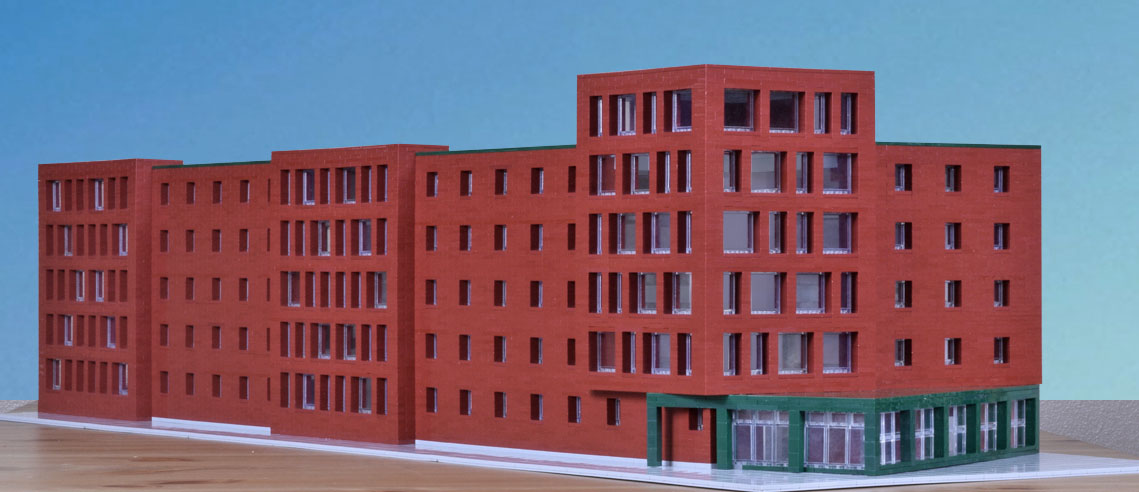
Another tribute to the Metropolitan Storage Warehouse in Cambridge, discussed in the previous post. Again, my interest is not to suggest a possible renovation or provide an alternative, but rather to experiment with its basic forms and work within an approximation of its site and program. And once more it is designed to provide a home to public or creative efforts—say an architecture department. I wanted a basic building that has some interest but, like the warehouse, appears rough and incomplete, that might invite completion, exploration, or reaction—as I argue for the warehouse in that post—and that doesn’t try to upstage or direct the work inside.

There is no substitute for the real thing. Age, wear, the historical style, the odd embellishments, the imperfections, the rough mass of the original—these cannot be reproduced in a model or an actual construction. Ensamble proposed a renovation that respects the integrity of the exterior of the original building while adapting the interior for the needs of the MIT SA+P. Their proposal can be found here.