
She takes our breath even as she lifts our spirits, Winged Victory, Niké of Samothrace, once a votive offering from a now defunct religion, a memorial, perhaps, to a naval battle won long ago, long since forgotten. Or rather not all of her, not the full statue, but the assembled fragments we know and have known for well over a century, who still inspires us to think of flight, our imaginations, our spirit propelled by her incompletion, by how she might be made whole, by what might yet lie before her, might yet exist above, beyond.
ASPIRATION
TRUTH
NOBILITY

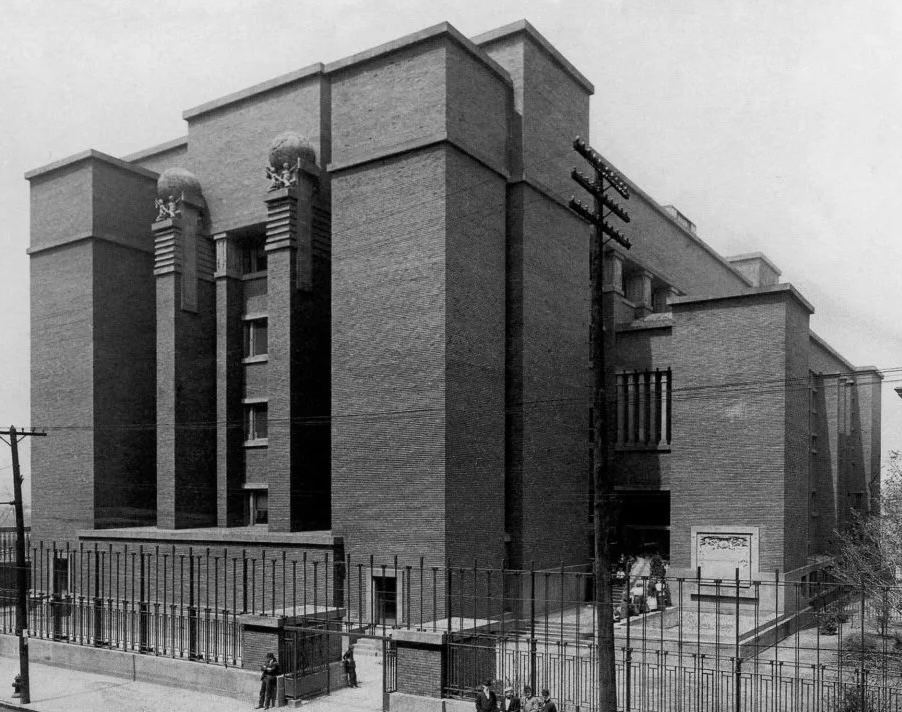
Frank Lloyd Wright’s Larkin Building, completed 1906, solid and firmly anchored yet energetic in its interlocking masses, takes us back a century ago to past enterprise, to values of another time, to maxims voiced to fortify our character and raise our spirits. It lifts us in a different way, engages us in, releases us from its ponderous and self-pondering mass, also encourages us to look forward, look up.
SIMPLICITY
TENACITY
STABILITY

But this corner pier of the surrounding wall is all that remains of the building today, and it had to be rebuilt.
ADVERSITY
REFINEMENT
SYMPATHY

The Larkin Company, founded in 1875, located in Buffalo, manufactured laundry and toilet soaps, plain and fancy, for our rapidly developing nation, offering a cleansing note to our gilded excess, our exponential industrial growth, the growth of exploitation, of corruption, of the fouling of our air.
 This was also a time of the growth of consumerism, a shift in national spirit, an intensifying focus on the individual, on the rightness of our ability to purchase the things we all needed, the things that made our lives easier, the things we had to have, regardless. The country was still largely rural, however, and most did not have the commercial centers to buy such goods or the cars or roads to get there easily if they did. Larkin shifted its operations to sell direct to the consumer by mail, cutting middleman costs, which enabled them to lower their prices and add a premium as inducement. For ten dollars, about a week’s pay for most, customers could buy the Combination Box, a year’s supply of soap—a hundred bars of Sweet Home Soap plus boxes of fine soaps and creams—and receive a bonus item. The Chautauqua lamps and desks Larkin offered were popular. By 1905, the catalog had expanded to over 115 products with a greater variety of soaps and other household items. The firm was tremendously successful.
LIBERTY
EQUALITY
FRATERNITY

Darwin Martin, one of Larkin’s officers, who created the extensive cataloging system for the mail-order system, was also instrumental in bringing Wright to design and build the administration building that housed the executive offices and managed all the sorting, routing, and processing of the orders, along with Larkin’s other correspondence. It stood at the head of the complex and was meant to serve as an image, a symbolic representation of the company, and figured in its promotion. Founder John Larkin was insistent that it be fireproof.

The design was largely a rectangular box that held the desks and filing cabinets, all arranged in logical, systematic order, four levels up.
INTELLIGENCE
ENTHUSIASM
CONTROL
To the right a small annex contained the lobby and reception desk, along with rooms that met the employees’ needs—toilets, lockers, showers—as well as served their elevation and ease—a library, a classroom, a room for the YWCA; a lounge with a fireplace. On the fifth floor, a kitchen and dining area that seated 600. On the sixth, indoor gardens, a promenade around them that opened to the outside. Larkin was a progressive company that promoted the wellbeing of its employees, in itself, for them, for their faith in and commitment to the firm. The company sponsored social events and allowed employees to share in its profits. Air within the building was cleaned and cooled with an extensive system. And Larkin itself talked to itself and thought about itself in its house publications Ourselves and The Larkin Idea.
PRUDENCE
LEARNING
WISDOM

Like Wright’s Unity Temple, under design about the same time, the Larkin Building had recessed entry, not visible at all angles from the exterior, and a similar two-part layout where once inside members of the church, workers in the office were presented with options. For Unitarians it was a matter of choice and decision, up to them, whether they went to the classrooms and social areas on the right or walked left to the auditorium for the service.
IMAGINATION
JUDGMENT
INITIATIVE
For the employees of Larkin, work had the dominant priority. They went right on their own time, where space was tight and access somewhat restricted.
INTEGRITY
LOYALTY
FIDELITY

As with Unity Temple, approach to the Larkin Building is an encounter with closed, imposing mass, pure geometric forms grounded, seemingly hermetic, seemingly lightless. Entry is a drama of blind peregrination, initiation, and revelation.

The towers and slender piers might encourage us to look up the broad, tall expanse of brick, its warm, dividing texture, the massive individuation, and if we do, we see resting on radiating plinths reference to the universe, the angelic children with interlocking arms easily bearing the weight of the world. The globes however, do not reach into the heavens but are held within the brick mass, as are we.

Look down, however, and a broad walk takes us directly to two flights of stairs, between which lie a pause from ascent, a walk beside a fountain where water, pure, clean, cleansing, flows endlessly from within the building, as if a product of its activity, into a rectangular basin where we might perform a mental ritual of ablution. Above the fountain a plaque where robed figures, echoed on the other side, male and figure, bearing emblems of virtue, of value—a scroll, a torch, a caduceus, a sprig for peace—raise their arms and frame another globe beneath which a motto reads:

that promises us independence in the tasks we are about to perform, if our efforts are honest, as well as invites us to participate in a larger world that is just, if that justice, like honesty, is simple and direct. This composition is repeated on the other side of the annex, the same ascent, the same fountain, a similar plaque with similar figures raising arms to another globe with a different motto beneath:
FREEDOM TO EVERY
MAN AND COMMERCE
WITH ALL THE WORLD
that extends our freedom and asserts Larkin’s global aspirations, its universal foundation. Both mottoes were devised by William Heath, another Larkin officer, a corporate idealist.

As at Unity Temple, when we turn left and pass reception, we enter suddenly, wholly into a vast, open space, skylit from above, where all is light and order. Filing cabinets line the walls, the balcony partitions, desks control the floor space, all arranged according to the organization and flow of the process. Some 1800 workers occupied this communal space, within sight of each other, of their place in the process, and Martin and Heath had desks on the main floor, directly beneath the light, masters at the heart of, integrated into the activity they directed all around, above them. I can only imagine the complex choreography of the above scene when set in motion, coordinated and harmonious, set to the staccato rhythm of lightly tapping keys.
As at Unity, we are inspired to look up and think of something higher. A line of women, at their typewriters in vestal white, divide the floor and hold the line of virtue while men in dark suits around them engage in various, active poses, all bathed in illumination. We have entered service in a temple, which, spatially, we have been asked to join.

Evangelist Billy Sunday made a stop here during his Buffalo tour.

And at one time the vestigial Winged Victory stood above the reception desk to reinforce the triumph and uplift echoed in the building and repeat the ancient call.
THOUGHT
FEELING
ACTION

Another was placed on the balcony at the fourth floor, up on high, closer to the light, where the flat columns receive active articulation, ritualized decoration, between which, on panels, appear invocations of three-word inscriptions in all caps, seven on each side, fourteen sets in all.
CO-OPERATION
ECONOMY
INDUSTRY
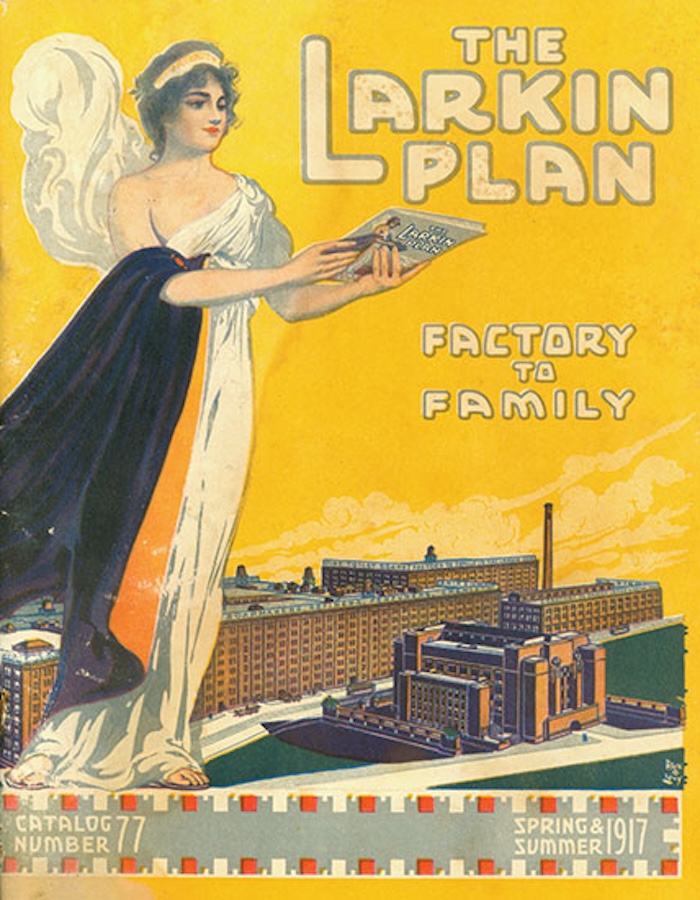
And in one catalog, The Larkin Plan, subtitled Factory to Family, a woman, also dressed in virginal white, soars upward, like Niké, rising above the complex, her gown flowing up behind her like wings as she lifts and makes an offering of the catalog, the same one we see in large, where her image reappears and, at least conceptually, extends infinitely before the open sky.
GENEROSITY
ALTRUISM
SACRIFICE
William Heath devised the inscriptions, believing the list of three words, like an incantation, one, two, three, sparked inspiration and allowed free and individual interpretation, construction to larger understanding. On the end panels at the fourth floor he selected these sayings in archaic dress:
ALL THINGS WHATSOEVER YE
WOULD THAT MEN SHOULD DO
TO YOU DO YE EVEN SO TO THEM
and
ASK AND IT SHALL BE GIVEN YOU
SEEK AND YE SHALL FIND KNOCK
AND IT SHALL BE OPENED UNTO YOU
He explains his choice:
The Golden Rule is there because to us it is the simplest, the wisest, the greatest rule of conduct, man to man, employer to employee, company to customer, customer to company, in all the world. . . . It is what those who work in our great buildings, offices and factories, want to do.
The other passage has been inscribed, because by its serene assurance it fosters self-reliance, because it is a demonstrable truth.
Self-reliance—an American virtue, and Heath was influenced by Emerson, as was Wright. Assumed by Emerson is that self-determination depends upon looking past external confusion and tapping the universal divine within us all, within all that surrounds us, transcendent, there for those who seek it. Paradoxically or not, at Larkin we accept our individual participation in the process willingly, and separately we join together to combine in an effort that moves us to higher things. Wright had similar views about the building:
In short, if the incentive that results from the family-gathering under conditions ideal for body and mind counts for lesser errors, cheerful alacrity and quickened and sustained intelligence in duties to be performed, we have created some very real values.
Family, morality, enterprise—it is all of a piece. Heath, however, when he got down to business, was direct and reductive in defining the building and its mission:
What is “The Office”? “The Office” is that branch of the Larkin business which merchandises its products.
What is “Force”? “Force” is power in action. Power is the ability to perform work and work is the overcoming of resistance.
Therefore, “The Office Force” is that power in action which overcomes the resistance of merchandising.
The ethical ideal is reduced to material process, the power of commercial force supersedes all, overcomes us, and holds us in its thrall. Our wings are clipped.
What is gilding, what is appropriation, what is naïveté, what is genuine aspiration nonetheless?

William Heath on the left, Darwin Martin four over. Between them, stern-faced and bearded, John Larkin, taking us to the century before, not looking at us but somewhere beyond, or not looking at anything at all.
.
SINCERITY
HUMILITY
COURAGE
.

The man who builds a factory builds a temple. . . . The man who works there worships there.
So Calvin Coolidge told us not long after clean water began flowing from the fountains of Larkin, typewriters clicked within. Samuel Parkes Cadman, a Brooklyn Congregational minister and radio pastor, called the Woolworth Building a cathedral of commerce. Wright made a similar statement about the Johnson Wax Building at Racine, another closed workspace, built a few decades later:
Organic architecture designed this great building to be as inspiring a place to work as any cathedral ever was in which to worship.
Not much later Bruce Barton declared Christ was an executive, a great salesman, the greatest, in his best-selling The Man Nobody Knows:
He picked up twelve men from the bottom ranks of business and forged them into an organization that conquered the world.
It was Coolidge who defined our identity, our mission as a collected people:
After all, the chief business of the American people is business
firming up a trend that has continued to this day, with intensifications and variations, with reductions and its own mystifications, whose language determines political and social discourse, or sets it aside. It was also a time when PR blossomed to define our reality, advertising filled our lives with the stories we tell about ourselves.
We grew up founding our dream on the infinite promises of American advertising.
Zelda Fitzgerald
And it was a time when Frederick Taylor devised a science that simplified our efforts to the minimum so we might attain maximum efficiency, thus diminishing our contributions and us to the smallest, basic units, ensuring the need for someone on high to coordinate and direct us:
In the past the man has been first; in the future the system must be first. This in no sense, however, implies that great men are not needed. On the contrary, the first object of any good system must be that of developing first-class men; and under systematic management the best man rises to the top more certainly and more rapidly than ever before.
This hierarchy followed by variations, intensifications, and reductions to this day.

Alienation as we find it in modern society is almost total. . . . Man has created a world of man-made things as it never existed before. He has constructed a complicated social machine to administer the technical machine he built. The more powerful and gigantic the forces are which he unleashes, the more powerless he feels himself as a human being. He is owned by his creations, and has lost ownership of himself.
Erich Fromm/The Sane Society
It is hard to look at the Larkin enterprise without critical detachment, without seeing it as another step in the reduction of the promises of the world and the diminution of our sense of self. Yet if you look forward from the time before you see advancement. While women held lesser roles—and most of the employees at Larkin were single women—the work gave them a material independence they would not otherwise have had. All employees were given a healthy, well-lighted place and their needs were recognized and met. They were provided a culture of sorts that had greater aspirations, with the culture, a sense of belonging. By their reports they liked working there. Directors and employees were brought together, on the same plane. Consumers across the country were invited to join the culture and think of themselves as part of an extended family, even formed clubs to buy the ten-dollar boxes collectively and share the premiums. Larkin soaps, I assume, kept us all fresh and clean.
CHEERFULNESS
PATIENCE
CONTENTMENT
When we look back from our present stance it is just as hard for us not to feel nostalgia, a sense of loss. At least values were voiced, and values upheld remain values held up, regardless of intent. Wonder always inspires the flight of wonder, whatever the intent, its source.

The building itself takes us back and forth as well. Today we might find it staid, dated. Squint your eyes, however, open wide, and it looks fresh and vital. The structure is basic, solid, and imposing, like an ancient monument, and we are humbled by its power, its heft, its face of authority. The front of the main structure is nearly or completely square, like a moral equation, unalterable, fixed for all time, but that statement has been devalued by structural function—it largely states and supports itself—and its reductive program—it’s only an office. Unlike the Woolworth Building, the whole building has been pared down to basic terms with little embellishment, only slight voicing from past architectural language, ancient thought.
But the design is anything but static, rather is reservedly yet emphatically active, and it both anticipates and escapes exact definition, or transcends it. The annex, set back, in foreshortened perspective promotes the square, the mass of its isolated tower reinforcing the sense of mass of the entire building and announcing the two towers in front.

The square does not have borders clearly delineated on a set plane, rather exists in a composition of varied, overlapping rectangles that hold complex tensions. The front horizontal wall and flanking towers suggest a U, open at the top, whose recessed space is lightened with windows, in which stands the narrow piers, isolated, as if detached. Like a temple, the whole mass rests on a thin, articulated base, but its light color makes it appear that the dark brick is suspended just above the ground, and the trim of the same material and color divides the mass in sections upward, as do the windows that run in continuous bands, without the support, the framing we might expect. Everything challenges our understanding of the square without our losing it.

The appearance of a divided, suspended mass is unified and held taut by the twin focal points of the two globes on either side of a projected but unmarked center, which, considered in relationship to the varied rectangles, suggest an anchoring upward triangle that unifies the planes, that both stabilizes and energizes the divisions and reinforces their lift.

My quick diagram is arbitrary—and confusing. Remove the lines and you see a coherent and convincing composition of assured clarity and quiet complexity. What any analysis won’t find is a system of internal relationships of sizes and proportions, of parts to a whole contained in a fixed system, rather that is what Wright’s design suggests in its geometric shapes yet from which it gently pulls away, upward, outside, beyond itself.
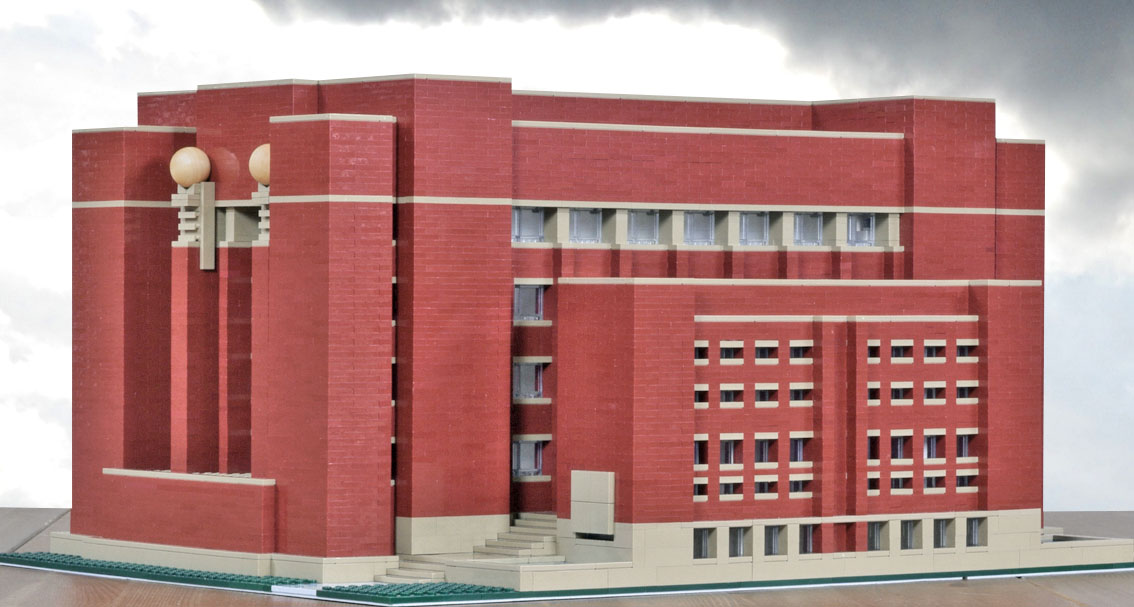
The front is symmetrical on a vertical axis, however, providing a moment of composure, but the symmetry is provisional. When you walk around, that symmetry disassembles itself into parts that reassemble on the side to construct another symmetry, another moment of composure, related, different.

Again the improbable base, the divided mass, the bands, the lift. Here the two largest towers on either side resemble those of a bridge, holding the long main structure above, across substantial distance. Especially here the narrow bands of windows create a tension within the mass they defy, asserting the power of the light to be found inside. The effect would be dramatic at night.

On this face countervailing triangles are suggested, upward and downward, neither dominant, both stabilizing the composition at same time opening up, beyond. Then the composition disassembles itself again to be reassembled into a face nearly identical to that on the front.

I think I first consciously began to try to beat the box in the Larkin Building—1904. I found a natural opening to the liberation I sought when (after a great struggle) I finally pushed the stair-case towers out from the corners of the main building, made them into free-standing, individual features.
Wright, from his lecture “The Destruction of the Box.” Freestanding—that is an appearance, not a material fact. The towers are connected and structurally integrated securely within the overall framework, and by strong implication they bear tight relationship to the box. Destruction is not the right word, either, as the sense of the large box still remains and dominates. Yet we are not exactly clear where to locate the box as it has no set determination. Liberation, however is apt and to the point. The building expresses freedom from its supports, from its constraints.

Since the symmetry of this face is active, since it is, like the other, provisional, we are not bothered by the repetition, as it bears restatement. Also the repetiion serves a purpose. The front facade was the face given to the public. This one spoke to the factory complex and gave the same message of active authority, joining workers and public in the same mission. Site, function, and program, in fact, determined the overall design. The end towers, while expressive, held the stairs, and placing them on the corners opened up the space within and allowed the light to spread unobstructed and freed circulation for the workers, the process. Those towers, along with the four larger inside, beside them, also contained air vents, thus had to be enclosed and covered. Again they are expressive: if we know this, we can see from outside the breathing apparatus of the building, given weight, prominence, and reassurance it is doing its job.
The arch fronts a raised basement, where, centered and small, it marks importance and bears great weight. It also allowed trucks to bring the correspondence that was moved up through the building and returned the basement so trucks could exit and deliver replies. The basement also held the system that cleansed and cooled air to be raised and circulated throughout, discharged above.

Filing cabinets lined the exterior walls, so the windows, placed above, had to be narrow. This side is the simplest and least dynamic. Wright was not going to add complexity where it was not needed.
Most, the building needed enclosure and protection. Views from all sides were rough, the site was noisy, the air unclean. The building was close to railroad lines—one reason it was located at this site—and other industries. As Wright tells us:
The design of the building derives its outward character from this circumstance perhaps more than from any other.

So relief had to come from the top, at the skylights. Still, glazing could have been added higher up with effect, where there would have been no issue of visual corruption. Though pitched, the skylights, in fact, are scarcely visible from the ground, and that was the vantage point Wright preferred in photographs. And adding windows at the top disrupts the dynamics of masses, as in fact happened in a later alteration, when windows were punched into the sixth-floor walls along the side and broke the composition.
As in his other work, there is the intuition that Wright, while listening to, opening us up to nature, at the same time protects us from the noise of the crowds of urban life, encasing something vital that animates us, that animates his buildings, a heart, a hearth, here, as in a temple, a central communal chamber that performs rituals of movement into the light, preserving mysteries, perhaps keeping something deep inside us secret.

Integration, or even the very word “organic” means that nothing is of value except as it is naturally related to the whole in the direction of some living purpose.
Yet however functional the design, however restrained its expression, what most impresses us with the building is its life, how much it speaks to itself, within itself, and looks beyond itself, beyond the Larkin program, any program, beyond its own order, any plan, into universal understanding that, like natural life, is never fixed, never static, an understanding that promotes life, that always must have room to grow, that always grounds itself in what is vital beneath us as it reaches upward. Our lives, our efforts, our constructions, all our efforts are significant and need weight, strength, and active voice.
The Larkin Building is not pretty; it was not intended to be. But it is not discordant and it is not false.
In the final assessment, however, above all else, or regardless, the building is honest. If it is not embellished it is because Wright wanted to let the purity of the geometric forms speak for themselves in active composition, without distraction or diversion. If a moral statement is made, that statement is complex and vital, poised and durable, yet flexible, yet open. More than a moral statement, we are given a framework in which such a statement might be made that might endure, that might be variable enough to adapt to whatever the future brings.
.

Martin and Heath left, the firm suffered internal dissolution; cars multiplied endlessly and roads spread across the land that took consumers in their cars to local commercial centers where they could buy soap and lamps and desks and so much else; the Depression landed—Larkin went bankrupt not that many years after the administration building opened its doors, light flowed into the chamber. The industries and site surrounding declined as well. The building stood vacant for years, its fountains dry, suffering deterioration from vandalism and neglect, and was finally razed in 1950. Demolition was a challenge.
.
FAITH
HOPE
CHARITY
.
How familiar, how dated all the sayings are, how stale the words. I grew up drilled in them incessantly, at home, at church, in school. Be honest. Above all, always be honest. Be honest, be honest, be honest. I thought the words were corny and boring, and they were. Really, the problem was they were repeated without examination, usually to bring acceptance, alignment, and conformity, not individual integrity, and often led to hypocrisy, or worse. But I doubt we learn anything without rote discipline, especially at an early age, followed by repetition as we mature. We forget too easily, there are too many temptations that make us stray. And I did I listen and the words influenced me. I don’t know where I’d be today if the culture hadn’t drummed a sense of rightness into me when a child. Really, the problem is that the words weren’t given life later, flexibility, application, extension. But compare those words, all the Larkin sayings, with those that come now from the movement to restore moral order, language that is rigid, narrow, and blind and coercive, often cruel. Read Project 2025.
Honesty—how much we miss it now.

It’s just the spark of an idea, but in the
quantum playground of your mind,
a single synapse can unfold a universe
of creative possibilities.
Enter Claude: your AI companion,
built by trust & safety experts.
We also live in an age of marvels, of towering, blank buildings that soar and capture and release the rising, setting sun without holding it. Of vast global enterprises of ever expanding size and complexity that move us to awe, to insignificance. Of faith in investment devices beyond belief, that defy comprehension. Of groundless abstractions from all fronts that dazzle us into submission. Of a mysterious technology that we do not understand, that we cannot understand because it has no understanding, that nonetheless takes us to voiceless wonder, whose only major material benefit may be to simplify our lives, simplifying us in the process, and reduce the costs of a workforce by replacing us.
Every day is a new day that puts the previous day behind it.
We have no context.

Meanwhile, for years we have been contemplating this innocent looking face, so open, so modest, so unassuming, even honest, along with that of her partner, not so honest looking, no longer with us, and with them the island enterprise that our time somehow allowed to flourish for decades.
Asked in a wide-ranging interview with The New York Times if there were any limits on his global powers, Mr. Trump said: “Yeah, there is one thing. My own morality. My own mind. It’s the only thing that can stop me.”
And we live in a time where wisdom and authority have been absorbed into a single voice. Trump is not alone here. We all think and act the same. Meanwhile our president has engaged us in a massively destructive war in Iran without clear purpose or defined conclusion. It’s not at all certain he knows where he is or what he’s doing there. He will end it, he tells us, when he feels the time is right.
The Project, the artificial marvels, the island horrors, the bombing in Iran, elsewhere—it is all of a piece as well, of parts overlapping, without reason, without coherence, self-reinforcing, self-destroying, destructive of the self. How can we decide anything feels right now? It is hard to assert we even exist. If ever we needed self-reliance, it is now.
If we can’t stand by ourselves, how can we stand at all?
If we can’t stand by ourselves, how might we stand with others?
Trust thyself: every heart vibrates to that iron string. Accept the place the divine Providence has found for you; the society of your contemporaries, the connexion of events. Great men have always done so and confided themselves childlike to the genius of their age, betraying their perception that the Eternal was stirring at their heart, working through their hands, predominating in all their being. And we are now men, and must accept in the highest mind the same transcendent destiny; and not pinched in a corner, not cowards fleeing before a revolution, but redeemers and benefactors, pious aspirants to be noble clay plastic under the Almighty effort, let us advance and advance on Chaos and the Dark.
Emerson/Self-Reliance
But where is the divine breath, what is the genius of our age? What can we find inside ourselves other than our beating organs, the buzzing in our heads? I only know that there is a heart beating, that hearts beat in others. Yet I also know that I can look, look within, without, and try to look forward. And I can look back, to others who once looked back, forward, knowing when I look back not to rest, stand still. And I can learn to look for answers, knowing not to expect them, knowing not to accept any if they come.
How powerful she is in her upward, spiraling lift, how graceful in the gently twisting folds of her flowing gown, this statue from an ancient age, how complete, how convincing in her incompletion. I always thought of her as at the point of taking off. Archeologists, however, from the position of her feathers, see her as landing. But not yet. Still her body rises, still she has her wings in the air, confirming the possibility of flight as she stirs the space around her, by herself, for herself, for all of us.
The archeologists have long debated what she stood for, where she once stood, what she faced. The war, the orientation, the representation—none of that has survived in words, in memory, none of that matters now. They reassembled her as best they could from pieces found in rubble, filling in with plaster, making their best guesses, not daring to go further than this reconstruction. Whether they got her right is beside the point. What they came up with has its own coherence and surpasses it, leaving us not with the thought of who she was but who she might yet be.
She does not need arms, she has wings. I do not want to know her face, only that she has one, that her gaze remains eternally, indefinably active, that it looks from within, beyond. In honest assertion and open expression there is hope, there is life.
.
Exhibits
.
What is there of the divine in a load of bricks? . . . Much. All.
Ralph Waldo Emerson
.
“Hope” is the thing with feathers—
That perches in the soul—
And sings the tune without the words—
And never stops—at all—
Emily Dickinson
.
In its essence optimism is not a way of looking at the present situation but a power of life, a power of hope when others resign, a power to hold our heads high when all seems to have come to naught, a power to tolerate setbacks, a power that never abandons the future to the opponent but lays claim to it.
Dietrich Bonhoeffer/After Ten Years
.
Wonderful means something that is transcendently beyond the common; something that is away beyond the ordinary. It means something that is altogether unlike anything else. We say that Yellowstone Park, Niagara Falls and the Grand Canon of the Colorado are wonderful because there is nothing else like them.
When David killed Goliath with his sling he did a wonderful thing, because nobody else ever did anything like it. It was wonderful that the Red Sea should open to make a highway for Israel, and wonderful that the sun should stand still for Joshua. Let us see whether Jesus was true to His name.
He was wonderful in His originality. The originality of Jesus is a proof of His divinity. The human mind cannot create anything in an absolute sense. It can build out of almost any kind of material, but it cannot create. There is no such thing as out-and-out originality belonging to man. You cannot imagine anything that does not resemble something you have previously seen or heard of.
Billy Sunday/Wonderful
.
Wonder was the grace of the country. Any action could be justified by that: the wonder it was rooted in. Period followed period, and finally the wonder was that things could be built so big. Bridges, skyscrapers, fortunes, all having a life first in the marketplace, still drew on the force of wonder. But then a moment’s quiet. What was it now that was built so big? Only the marketplace itself. Could there be wonder in that? The size of the con?
George W. S. Trow/Within the Context of No Context
.
I say you ought to be rich; you have no right to be poor. To live in Philadelphia and not be rich is a misfortune, and it is doubly a misfortune, because you could have been rich just as well as be poor. Philadelphia furnishes so many opportunities. You ought to be rich. But persons with certain religious prejudice will ask, “How can you spend your time advising the rising generation to give their time to getting money—dollars and cents—the commercial spirit?”
Yet I must say that you ought to spend time getting rich. You and I know there are some things more valuable than money; of course, we do. Ah, yes! By a heart made unspeakably sad by a grave on which the autumn leaves now fall, I know there are some things higher and grander and sublimer than money. Well does the man know, who has suffered, that there are some things sweeter and holier and more sacred than gold. Nevertheless, the man of common sense also knows that there is not any one of those things that is not greatly enhanced by the use of money. Money is power.
Russell Conwell /Chautauqua lecture/Acres of Diamonds
.
Stock prices have reached what looks like a permanently high plateau.
Irving Fisher, October 1929
.
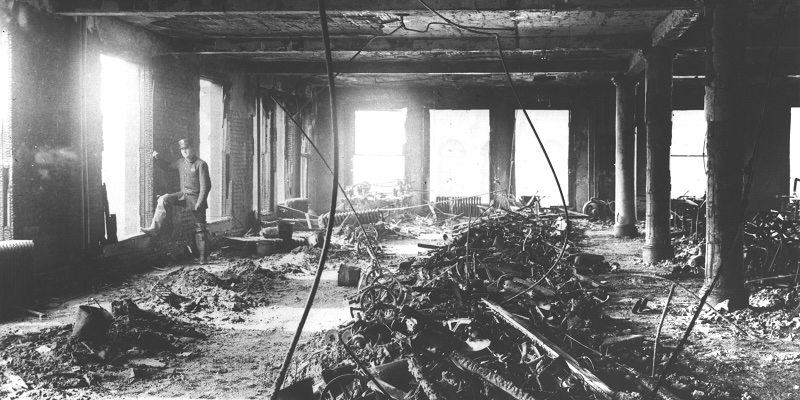
Triangle Shirtwaist Factory, 1911
.
Somebody built the pyramids. Somebody’s going to build something. Pyramids, Empire State Building—these things just don’t happen. There’s hard work behind it. I would like to see a building, say, the Empire State, I would like to see on one side of it a foot-wide strip from top to bottom with the name of every bricklayer, the name of every electrician, with all the names. So when a guy walked by, he could take his son and say, “See, that’s me over there on the forty-fifth floor. I put the steel beam in.” Picasso can point to a painting. What can I point to? A writer can point to a book. Everybody should have something to point to.
Mike Lefevre/Studs Turkel/Working
.
The veneer of ethics and moral behavior in the public square can be surprisingly thin. Human beings are easily swayed and enraptured; peer pressure and crowd behavior are powerful forces. We are used to living by a particular set of rules, values, and expectations of behavior, individually and socially, and it is often easier for institutions like the civil service, universities, businesses, and religious bodies to conform than to resist. When the rules change it can be difficult to find our bearings, let alone chart a new course that can address and if necessary challenge what is happening around us.
Victoria Barnett/“After Ten Years”: Dietrich Bonhoeffer and Our Times
.
The common element in both submission and domination is the symbiotic nature of relatedness. Both persons involved have lost their integrity and freedom; they live on each other and from each other, satisfying their craving for closeness, yet suffering from the lack of inner strength and self-reliance which would require freedom and independence, and furthermore constantly threatened by the conscious or unconscious hostility which is bound to arise from the symbiotic relationship. The realization of the submissive (masochistic) or the domineering (sadistic) passion never leads to satisfaction. They have a self-propelling dynamism, and because no amount of submission, or domination (or possession, or fame) is enough to give a sense of identity and union, more and more of it is sought. The ultimate result of these passions is defeat. It cannot be otherwise; while these passions aim at the establishment of a sense of union, they destroy the sense of integrity. The person driven by any one of these passions actually becomes dependent on others; instead of developing his own individual being, he is dependent on those to whom he submits, or whom he dominates.
Erich Fromm/The Sane Society
.
Artificial intelligence is not just about efficiency gains, it’s about opening up new possibilities, unlocking human potential and solving some of society’s biggest challenges.
Yoshua Bengio
.
I believe AI is going to change the world more than anything in the history of humanity. More than electricity.
Kai-Fu Lee
.
AI will probably most likely lead to the end of the world, but in the meantime, there’ll be great companies.
Sam Altman
.
He seemed to lose all control of his emotions and for the moment he was the caveman of prehistoric times, fighting to the last ditch for what he believed was right and just. . . . The curiosity-seekers in the audience who came to see Sunday’s antics got their fill. Suddenly the evangelist would leap forward like a boxer to take advantage of an opening. One second he was at one end of the platform and you just got your head turned to watch him when he was at the other end. Then in a second he was in the center and hitting the pulpit solar plexus blows which would kill an ox.
Buffalo Daily Courier on one of Billy Sunday’s Buffalo performances
.
Notes, Credits
At this scale, much was simplified in my model and parts were omitted. My quick visual analysis is based on the model, so adjustments are in order. I’m curious whether Wright had some proportional system in mind.
Most factual information and the Wright and Heath quotations from Jack Quinan, Frank Lloyd Wright’s Larkin Building, Myth and Fact. This is a tremendous resource, well researched, with full background, many drawings and photographs, and relevant primary sources.
I believe there are no color photographs of the original building and the existing black and white shots are somewhat rough. There is a marvelous virtual reconstruction by Razin Khan, which I consulted often. From it I drew the images of the front of the globes detail, the annex and the plaque.
William Leuchtenburg’s The Perils of Prosperity gives an insightful and readable account of this period. Several of my quotations come from there.
Photograph of Winged Victory from WikiMedia Commons.
Photograph of the building from WikiArquitectura.
Photograph of remaining pier from WikiMedia Commons. See also Larkin Center for more information and pictures of the demolition
Boraxine ad via Wikipedia.
Photograph of industrial pollution scene from Our Great American Heritage.
Postcard view of Larkin complex from WikiMedia Commons.
Larkin floor plan, interior photograph, Niké statue at ledge from INSinsideIDE.
Frank Lloyd Wright Unity Temple floor plan via ResearchGate.
Photograph of Winged Victory at the reception desk via The Buffalo History Gazette.
Billy Sunday at Larkin photograph via University at Buffalo Digital Collections.
Diagram analysis of Alberti, Santa Maria Novella, by L. W. Partridge via conservancy.unm. I don’t know if this image represents accurately Alberti’s design and intent at all, but it does represent a point metaphorically.
Woolworth Building photograph via ArchDaily.
Call center photograph via WikiMedia Commons.
Photograph of Larkin officers from History of Buffalo.
Demolition photograph via NEWCITYDESIGN/ Collection of The Buffalo History Museum.
Glass skyscraper via Dezeen.
Photograph of Ghislaine Maxwell via PBSNews.
“Asked in a wide-ranging interview. . .” from “Trump Lays Out a Vision of Power Restrained Only ‘My Own Morality’” New York Times, Jan. 8, 2026.
“It’s just the spark of an idea. . . .” from Anthropic/Claude ad in The New Yorker, April 14, 2025.
Triangle Shirtwaist Factory fire damage photograph via Workers Compensation.