
In the lives of emperors there is a moment which follows pride in the boundless extension of the territories we have conquered, and the melancholy and relief of knowing we shall soon give up any thought of knowing and understanding them.

There is a sense of emptiness that comes over us at evening. . . . It is the desperate moment when we discover that this empire, which had seemed to us the sum of all wonders, is an endless, formless ruin. . . .
Calvino/Invisible Cities
I see this non-monument in the middle of a large urban setting, perhaps occupying a block to itself. It gives those who walk by the sense of being in a city, within, by a city within a city. It is a non-monument because it doesn’t celebrate any event or person, only references our collective efforts over the years to build tall buildings in cities. It has no name. What relationship it has to the city of its setting, to cities elsewhere, to cities past—all of this is left open. We realize, though, how much we have given ourselves to building rising structures that still rise higher as the years pass, no end in sight, how much they have absorbed and overwhelmed us, a condition worth reflection in itself.

My model is based very loosely on Per Kirkeby’s Sketch for Copenhagen. I have visited him before, in other posts. Where Kirkeby negotiates flat space with openings and washed structures in a dreamlike space, rough, unsettled, asserting and blurring the massed, rising shapes, I made solid revisions for a concrete work, within actual three dimensions.
And it recalls his actual brick constructions, picking up the brick, its texture, its warmth, its suggestions, and the windowless openings, some of his motifs. But however complex and often asymmetric his structures, they follow a predictable order, ultimately intelligible, though that order doesn’t correspond to our received notions of order, and he designed unified, usually separate works, not collections.

The non-monument consists of nine, narrow structures, all about the same height, all with repeated elements, but is each different. They rest on a roughly determined grid of alleys and a main street surrounded by a walkway, on a base slightly raised. My only guiding principle was equal height with slight irregularity in placement and size and shape. There is no controlling order.
Though not high, the narrowness of each gives the sense of a skyscraper much taller. Their congestion reminds us of crowded spaces. Their openness might make them appear as ruins, remainders of some disaster or long term decay. But they are complete and intact, and look to stand intact for some time to come, though will weather with the passing years. Because of the material, brick, they might bring to mind older structures, still remaining, or long since demolished, and with their apparent age recall other times. But they are only partly buildings, without functional definition, and their design is modern. They more resemble not buildings but structures of them, rising frameworks. Or more abstractly, they appear as concepts of buildings, though what has been abstracted defies naming. There are other suggestions. None of them stick, not long. The buildings of the non-monument are what they are.

The Giacometti figures, scaled to average human size, give a sense of proportions.

When you stand close and look up, the buildings will fill your vision and appear towering. But step back and they present a more accessible total environment, more on a human scale when compared with the other buildings that surround. Maybe we perceive a city contained, but we don’t know what is contained within that containment or where that takes us.

From the side, or if we walk inside, the corridors might appear dark and cavernous, like Wall Street, depending on time of day.
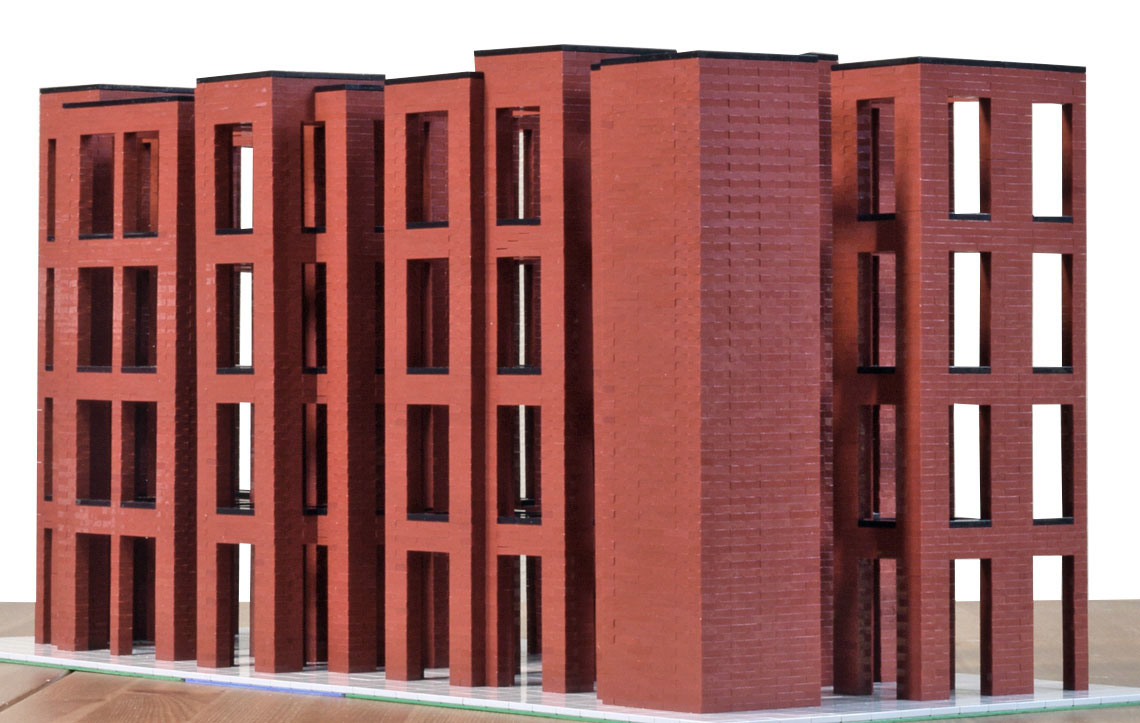
From other angles the assembly will appear as an unresolvable complexity of openings and shadows that shifts as we walk around, daylight fades.

When I designed this non-monument I realized I could have made any number of changes, could have made an undeterminable number of different designs, having no clear overarching idea to select one over the other.

Those who walk by, walk around, walk through might have a similar experience. Perhaps they will imagine revisions, realignments, project the desire to return the structures to a regular grid. Then again, they will have to decide what value there is to a grid, perhaps find resolution in resisting it.
Or maybe the non-monument will simply express in more immediate terms what they have known all along but never voiced, the inevitability, the incomprehensibility of our construction, our boundless, senseless ambition. There is mental relief in recognition, melancholy reminds us we have a heart.
The non-monument, modest, somber, sober, unassuming, supports no revelation, any decision.

The whitened skyscrapers loom in the gray mist like gigantic tombstones for a city of the dead, and seem to sway slightly on their foundations. At this hour they are deserted. Eight million men, the smell of steel and cement, the madness of builders, and yet the very height of solitude.
Camus/”The Rains of New York”

In a city we realize in the midst of countless souls we are alone.
At other times . . . but yes, of course, I loved the mornings and the evenings of New York. I loved New York, with that powerful love that sometimes leaves you full of uncertainties and hatred: sometimes one needs exile. And then the very smell of New York rain tracks you down in the heart of the most harmonious and familiar towns, to remind you there is at least one place of deliverance in the world, where you, together with a whole people and for as long as you want, can finally lose yourself forever.
There can be mixed virtue here. Cities, and models of cities, alienate us, depress us, lift our spirits, make them soar.
.
.
Notes
Sketch for Copenhagen, 2002, via Stanza. I’m not sure if this is an actual scene, a sketch for another project, or simply stands on its own as a free two-dimensional creation. There is much brick architecture in Copenhagen, which Kirkeby refers to. It is similar to some of his built projects there, such as this brick work.
Per Kirkeby himself spoke at the inauguration in 2004 about the “strange building”. He said of the location, ‘the sculpture stands right where nature flows in. If you come from Fælleden, you encounter the sculpture as a sign of the city.
Torsten Karlsson, from his site Per Kirkeby skulpturer.
See also:
Per Kirkeby: Cabañera de la montaña/Plan
.
.