
The work that is both there and not there. That need not be circumvented all the while you can walk inside it. That is massive in appearance, and yet transparent. That looks like a building and yet is not, and which is not an oversized sculpture, but which does not merely shift its weight uneasily from one leg to the other. Because it is entirely what it is and does not even pose the question. Though perhaps other questions. About the measured sky. About the constancy of walls, and the fleeting nature of buildings. About human ingenuity liberated from intellectual vice.
Per Kirkeby


Per Kirkeby’s work Plan, set in nature, resting on an open field before Spanish mountains, raises one set of memories, questions about relationships it does not answer, or puts aside. Opera per Torino—Work for Turin—placed among a grid of streets in an urban environment, inspires another set, raises still more questions. Both works, similar in many respects, provide a constant. We, viewing the work, walking through them, living with them, provide another. Constants for what equation, however, is another matter. How the two sets of questions, the urban, the natural might be related, where we might fit in with either, is left open. Our memories are allowed to roam. Also not certain with either is whether it is a sculpture or a building, a work of art or architecture, though we might pause and ask ourselves why that is a significant question. It is what it is.

Opera was to be part of an urban redevelopment project, Artecittà: 11 Artists for Turin’s Passante Ferroviario di Torino, that led to the creation of a narrow landscaped strip in Turin, where Kirkeby was to join ten other artists. Above, an early plan that shows the location of their works. As it was, only three projects, including his, were built. In the final placement it lies close to major roads of heavy traffic, before rising buildings all around. It does not command much space, and if you want to walk the path from one end to the other of the strip, you must enter and walk through Kirkeby’s construction. It will not be a quiet place for rest or contemplation.

In its length and orderly divisions, it suggests a number of buildings—a warehouse, a factory, office space, a commercial establishment, or several shops, or apartments, the central structure of a basilica, a forum for political decision, a monument of remembrance—without settling on any.

On the end, Kirkeby repeats the motif in Plan of a protruding vertical mass and indentation that only indefinitely has any functional reference—a chimney?—that gives Opera accent and the distinction of mass contrasting with its open sides, that serves no structural or thematic purpose.

As in Plan there is brickwork, what it represents, human handicraft, labored effort, what it stirs in our senses, with subtle arches that structurally take us back well into the past.

Opera might recall other brick structures in Turin, their colonnaded design, their history.
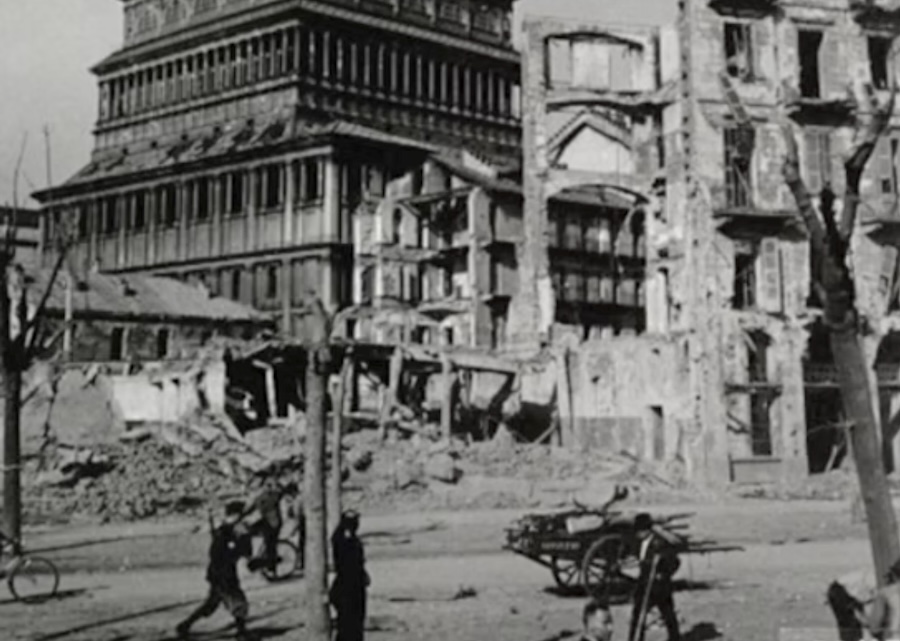
For some, with its vacant openings and missing roof, it might serve as reminder of the Allied bombing of Turin throughout World War II, which at one point became massive and indiscriminate. But Opera is not a ruin. It is structurally solid and intact.
Any number of associations linger about the building. None of them are anchored. We are encouraged to reflect, but again we are left on our own with our thoughts, our collective memories. It is a modern structure and stands apart as such, but it will age, with the changes become part of those memories, our sense of the past.

When we enter Opera, all thoughts of commerce, of layered residence, of monumental remembrance, of worship, of political force or correction, of any kind of assembly vanish. The building narrows at the other end, leaving little room for activity or gathering. Its triangular shape invokes geometry and might inspire orderly contemplation, but it would only lead to abstract thought without basis or larger understanding. It comes to a point without making any point.
There can be virtue in that displacement, or refusal. Too often we have become trapped in the structures of our ideas, the strictures of our gatherings, and not all our assemblies have brought together our better angels. Opera opens up, out and frees us. And it has a human scale against, amidst a rising city and shows a human touch. Modestly, soberly, in a world of closed grids and noise and traffic, it reminds us we exist and validates our desire to build with our hands, our hearts, our minds. That is something. Construction keeps us whole, keeps us sane.

My non-monument has fewer bays and I made it rectangular. I can see it standing alone in a city park, an open question among open fields.

Or it could occupy a small block among crowded streets, beneath rising boxes, our mad rush on the grid.

Maybe we will be encouraged to gather within, think about what lies without, where the past has left us in the present. Our thoughts will be mixed, our outlook uncertain. We will raise as many questions about our lives as answers. We need to live with that. Maybe its openness to the elements, to the world will intimidate us, keep us out, move us to despair. Then again, it might strengthen us and fortify our resolve.
.
.
Notes
See also Per Kirkeby: Cabañera de la montaña/Plan.
Both photographs of Opera from Wikipedia.
Photograph of Plan before the Pyrenees, Andres Ferrer, from Architecture Today.
Kirkeby quotation from Writings on Art, Per Kirkeby, Spring Publications, edited by Asger Schnack, translated by Martin Aitken.
Map of the Spina Centrale project from AtlasFor.
Photograph of Royal Castle of Pollenzo from Trip Advisor.
Photograph of Turin bombing from Epoch Magazine. The article gives a full, sobering history of the Allied bombing.
Torsten Karlsson has written a full essay on Opera, part in English, complete with diagrams and many photographs at Per Kirkeby skulpturer.