
The Dexel case then somehow became a standing expression for anything that gold old Mies had absolutely no desire to work on. . . . We do not want to have another Dexel!
Werner Graeff

It has always happened this way. I’ve made several models of Mies’s early work—the pieces I use accommodate it fairly well—and each time I was just looking for an idle diversion, a simple way to pass the time with structures that themselves appear direct and simple. We all need on occasion to nail down some certainty in our lives that doesn’t tax us. Or maybe we need to relearn what we too often forget, that simple, if it has any value, is never simple. At any rate, with each building I spent much time with questions and indecision, entering extended reflection that was meaningful, vitalizing, but that did not always land. Something similar may have happened with Mies in the Dexel House.

Mies was approached by Walter Dexel, a modern artist with reputation and influence, to design his house in Jena, 1925. Mies himself had gained considerable renown in avant-garde circles with his virtual projects a few years before—the Brick Country House, the Concrete Country House, his glass skyscrapers—but up to that point he had only built conventional houses. Dexel wanted modern, and the Dexel House would have been Mies’s first built modern structure. His Mosler house, under construction the same year, gives a sense of the leap he was going to make.
Mies, put on a tight schedule by a father-in-law who held the purse strings, stalled, missing deadlines, and Dexel ended the commission and turned it over to Adolf Meyer, whose modern design, below, perhaps influenced by Mies’s brief ideas, was turned down itself by the Jena building commission because they thought “it would appear as a foreign body in the landscape at this location.” The path from virtue to reality is often rocky.

The project has to be good, otherwise I won’t let it out of my hands.
Mies told his clients. He was under considerable pressure, much of it, apparently, self-imposed. Other modern work had recently been completed in Jena, such as the Walter Gropius and Meyer renovation of the municipal theater, against which his would be directly compared.

Not only would Mies be projecting himself as a modern architect among his peers, to the world, demonstrating how he fit in with the modern movement, how he distinguished himself, what defined his vision, he would also, with this house, be representing Dexel and his work in the visual arts.

Dexel had moved from work influenced by Cubism and Expressionism, here the fragment of House with Onion Tower, 1917

to work more abstract, more geometric, with Constructivist inflection, such as Construction, 1924.

Mies, familiar with and involved in contemporary trends in the building and visual arts, might be more difficult to locate. His Friedrichstrafáe skyscraper project, 1922, could be considered expressionist in its complex shapes and dynamic structure, its drama heightened by context, with its contrast to the darkened streets of past construction, to the brooding shadows of the past.

While his recent projects have abstract geometric character—above a representation of my model from the top—showing influence of similar trends in De Stijl, Cubism, Constructivism,
the Dexel House still is deeply expressive, at least in conceptual rendering. He made four quick perspective drawings on the spot when he first met the Dexels, similar to the one above in layout and outlook.

The drawing directly recalls that for the Brick Country House

more, the quick sketch used in the catalog of the Berlin Art Exhibition, 1924. It is a gesture, a flourish, quick, brief, energetic. Like the Brick Country House drawings, it emphasizes the horizontal, and the one I selected has a wall that extends beyond, relating the house to open space, indefinitely, infinitely. While its openings do not reach all the way to the floor, they do appear at the edges of walls and rise to the top, beneath flat roofs, breaking the sense of enclosure and dividing the overall composition into a play of separate planes and masses. It also has a large chimney, more formal than functional, around which the rest pivots, and that chimney is notched—in the Brick Country House beneath the large deck in the middle—without structural reason, creating an enigmatic figure. In all three drawings we look up from below, artificially, at the horizontally extending structure, the vast space above, and, as in the Friedrichstrafáe skyscraper project, we get a sense of forward projection, of announcement, a heralding of change, of progress, of the new, of something else, unforeseen.

Mies also made two sets of floor plans, similar, both with the attached studio and office, which don’t tell us much

except that it would have been a modest house, tightly packed. It’s hard to see how such a program, such a project could have met Dexel’s expectations or Mies’s ambition, his vision.
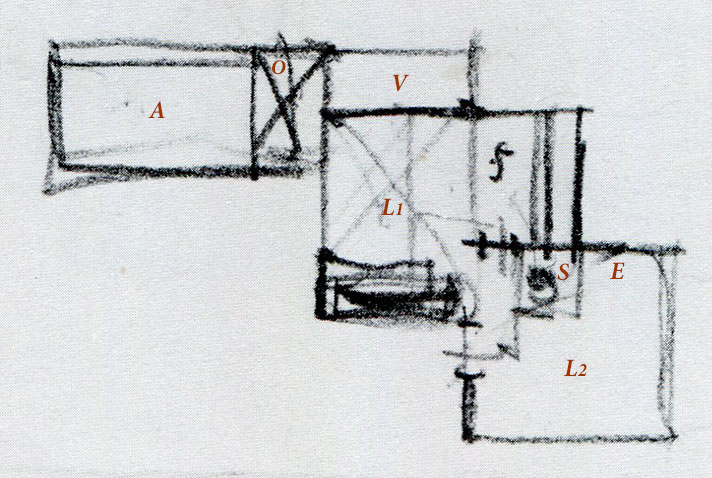
Among the four perspective sketches are other rough floor plans, most fragmented and difficult to read. I used this one as a guide, though it doesn’t fully match the perspective drawing in proportions or exact layout. A marks Dexel’s studio, O his office, which might have an entry hall. V is the veranda, and L1 and L2 would be living spaces, one perhaps dining. L2 appears to rest slightly lower in the perspective drawings, so there would be a few steps from one to the other, animating the living experience. And as in the Wolf House, completed a few years later, one room opens diagonally into the other. There may have been the desire to create a flowing, open interior, as suggested in the Brick Country House floor plan. S might locate the stairs to the second floor, E the main entry, unassuming, partly hidden. As for a kitchen, utility rooms, we have to guess. Likely there would have been a basement.

The perspective sketch, exaggerated for effect, is inconsistent—and my photo of the model at the top has been distorted. The second floor walls are too short for the rooms above and they lack the windows they’d need. I adjusted proportions following my own best sense, my only guideline being that I would not find precise, regular relationships. Mies followed his own intuition of proportion, impossible to define.
There is no indication, either, that it might have been built of brick, but brick, substantial and expressive, would reflect a trend that extended from the Brick Country House to the Wolf House and Krefeld Villas, built soon after, as well as the influence of Dutch cubic brick houses such as Dudok’s, which Mies knew. Also the chimney is the central, most significant element, and it is best expressed formally, expressively, and conventionally in brick.

Compare with the perspective drawing. If my model has any validity, we see what a composed and unassuming construction it might have been, without the tension, the drama, the reach.

I remade the model with windows. My only rule was that windows meet the roof and edges of walls, where possible, as in the windows of the drawing. The house was to be built on a terraced site, where I assume there was a view that extended out into a distance. The studio is lower than the main floor, thus has a high ceiling. Dexel would have been given space and separation for his work. The living area on the right, again, is slightly lower. The Dexels were to have separate bedrooms on the second floor and they would have wanted a substantial light and view as well, so I placed them on this side.

Note the chimney would only serve one living area and not the other, perhaps Dexel’s bedroom as well.

I kept this side almost entirely brick, though at least one window is needed on the second floor, providing contrast with the glass on the other side, reinforcing the sense of a composition of rectangular masses. There may also have been a street on this side—I’m basing that on the Meyer site drawings—so privacy is in order.

And privacy would have been in order for the rear. On the second floor, a window at the stairs on the corner and more windows for the guest room.

Again, the main entrance is understated and partly hidden. Mies pursued a similar solution of openness and closure, front and back, in the Krefeld Villas.
 Two bedrooms for the sons, glass before the veranda, an office window. I’m guessing there would be a garden and landscaping on this side, thus the need for more exposure. Space is tight and the bedrooms are small, but I see room on the second floor for five bedrooms, a bath, and stairs, a narrow hallway.
As Mies said a few years later, he wanted “a building where the way of life is not determined by the arrangement of the house, but the house follows the process of dwelling.” That certainly was his intent with the Brick Country House, at least conceptually, though the opposite case could be made, that an arresting, irregular exterior design was a priority that determined the layout inside as well as established an open, active relationship with the space beyond, also a priority. With the Dexel House, however, there wan’t much to work with either way.
I won’t defend any of my decisions. I just wanted to come up with something I could look at. I go back and forth. If I’m right about enough, I’m struck by the house’s distinct, simple elegance. I must confess, however, that the more I tried to fit the program and add the necessary openings, the more prosaic the house became for me.
Then there’s the problem of concessions that would have been made had it been built once the details were fleshed out, the program fully realized. If Mies pursued any degree of openness in the first floor, there would have been structural challenges. And I doubt thin, flat roofs directly above windows would have been possible.

Compare an early drawing of the Esters House

with the house as built, with sacrifices to glass openness, which, despite appearances, required complex and involved structural solution.

Months later Mies told the Dexels he finally had a breakthrough with the house, but his contract had already been cancelled and the Dexels were not interested. No evidence of that breakthrough exists.

Mies collaborated with artist Werner Graeff in the avant-garde magazine G. I don’t think it is known what he meant by “another Dexel!”
.
.
Notes
See also Mies, the Dexel House, Artificial Intelligence: De Profundis, Flitting on the Surface, where I attempt to visualize and analyze the Dexel House using AI—ChatGPT—with odd and disturbing results.
Most background material and all quotations from Dietrich Neumann, Mies van der Rohe: An Architect in His Time. Also consulted, his Ludwig Mies van der Rohe: Villa Wolf in Gubin History and Reconstruction—a marvelous resource.
Drawing for the Brick Country House in the Berlin Art Exhibition from Fritz Neumeyer, The Artless Word: Mies van der Rohe on the Building Art. As Neumann points out, it resembles Erich Mendelsohn’s expressionist drawings in its sweep, perspective, and quick rendering. Compare with his sketches for the Einstein Tower. I make the casual suggestion that a modest home cannot carry the freedom and import of such a work. Mies may be overreaching. The Brick Country House gains extension through the long walls that reach into space. The other drawing from Wolf Tegethoff, Mies van der Rohe: The Villas and Country Houses.
Mies drawings of Dexel House, Meyer elevation from Canadian Centre for Architecture. The other drawings by both can be found there, along with Meyer’s detailed site map.
Wolf Tegethoff, Mies van der Rohe: The Villas and Country Houses, provides much of the Dexel correspondence with Mies. This from Grete, Dexel’s wife, fairly early in the process:
In any case extreme haste is essential. Otherwise the whole thing will come to naught.
Mies, Mosler House, via Mies van der Rohe Society.
Meyer, Stadttheater Jena via Wikimedia Commons.
Dexel, House, with Onion Tower via Sammlung Staedelmuseum.
Dexel, Construction via Kunstkontor Basel.
Mies, Friedrichstrafáe skyscraper project via Phaidon.
Mies, Esters House via Wikiarquitectura.
Mies, cover for G, 1923, via ResearchGate.