
The plans, the elevations of town and country houses must be as varied as the people; none are alike, yet they are all composed in the same way: the layouts differ only in the greater or lesser; they are relative to the fortune that dictates them. Nomenclature places them according to the order of needs: in an art where the planners have no rights other than those acquired by paying for the material, the discerning man must guide the Architect; but if he hinders his means, he robs posterity of productions that could have justified his expense by illuminating his century.
Exterior decorations come in large and small dimensions. We will not go into tedious details that could make the description languish; it is enough, to be in accordance with natural laws, to prove that decoration belongs to everyone; in vain have prejudices concentrated it exclusively in the class of those who occupy high positions, dignities, and public offices.
Anyone who seeks the care of a skilled artist has an equal right to a monument of taste. [130]
Claude-Nicolas Ledoux

The nineteenth century—to borrow the Surrealists’ terms—is the set of noises that invades our dream, and which we interpret on awaking.
Walter Benjamin
While in prison, Claude-Nicolas Ledoux, prodigy of the Enlightenment, architect of the ancien régime, who designed and built spartan neoclassical buildings for the monarchy, for the aristocracy, for the wealthy that captured the spirit of the times, who was arrested during the Reign of Terror, continued working on a book he had begun some years before that contained his thoughts on his work, on architecture itself, and more, along with prints of his projects, realized, envisioned, and plans for a whole town, partly built, wholly idealistic, from which I draw the image and text of one of his maisons de campagne, country houses, above. The book appeared in 1804 under the title L’Architecture considérée sous le rapport de l’art, des mœurs et de la législation—Architecture Considered in Relation to Art, Mores, and Legislation. The title and his opening words give a sense of his exalted belief in architecture, in himself, the range of his ambition, the scope of his desires:
Amidst the various occupations, which can be judged by the extent of the work I present to the nations; amidst the turmoil that has tested my perseverance; in the face of the persecutions inseparable from the public expression of great ideas, and the passions that have worn down my resolve; almost constantly subjected to narrow calculations, to timid ambitions, to fickle wills that stifle the impulses of genius, I will not offer my readers those projects that fade into the vagueness of imaginary schemes, or whose terrifying potentiality prevents any progress toward their execution.
Convinced that by condensing the annals of time, and by gathering together the models and principles that art has bequeathed to us, I can imbue it with a creative force that will allow it to produce great works, and thus expand its domain and its glory, I have gathered, in a few days of reading, all the riches of the centuries that preceded us. [1]
I have no idea what he is talking about and I’m not sure he does, either, though I wonder about the terrifying potential of the work he does not offer. Nor do I know what possessed me to make this model of his odd country house, designed, he tells us, to follow the laws of nature, to illuminate his century, long past, but which perhaps might yet shed light on my own.

Ledoux also designed and built barrières—tollgates—connected by walls that would eventually encircle Paris. His desire was to bring unity and ceremonial focus to the city. Their purpose was to collect taxes on incoming goods for the ferme générale, the tax machine for the lavish and financially struggling state. When the Revolution broke out many were soon looted and set on fire.
The first rays of the dawn play over the heap of stones soiled by vandalism; Nature weeps amidst the debris of politics. [Prospectus]
Nature’s distress is personified, made personal, but upon whom do the tears fall?
Like his country house, like his prose, the barrières are blocky and ponderous, disproportionate, open-ended, absurd.
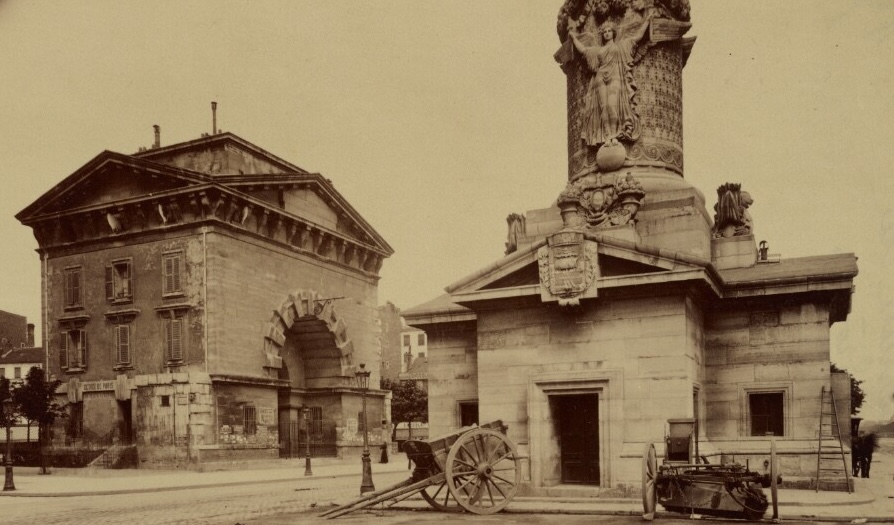
But by 1798 they were again used to collect taxes—the Revolution was running short of cash as well. Two that survived were captured years later in their existing state by Atget at the site of some thousand executions prior, by guillotine, those occurring around the time of Ledoux’s arrest, 1793, by the comité révolutionnaire of his quarter. He was tried for his ties to the monarchy, his affinity for the wealthy, his connection to the ferme générale. He argued his work was Republican in spirit, and I suppose his comment above on his house is somewhat democratic. This was the time, after all, that focus shifted to the common man or woman. It is still not clear, however, what what he means by nature, nor what his terms for distribution are, how we might fit in with the new order, with each other, what might be the value, the validity of his taste. We look awfully small in his picture. He also offered designs for public works during the trial to gain his freedom, but the committee rejected his argument and turned his offer down. It is not known how he escaped the lightning descent of the blade, and he was freed only because of the fall of Robespierre, his execution, the end of the Terror. Later, Napoleon showed no interest in Ledoux’s work either.

What could have been his frame of mind as looked out on the courtyard of La Grande Force, a prison for debtors and those suspected of civil disobedience, his thoughts about what was happening outside its walls

when he contemplated his likely fate? Not only was he fading in public memory, there was the real risk of immediate extinction. Louis XVI had already been beheaded along with Ledoux’s former clients and patrons, those who hadn’t fled. His isolation, that enclosed space without vista, the violence spreading beyond the walls must have shaped unconsciously the book he was working on, leading to distorted projection, remote construction, groundless speculation, monstrous rationalization.
One way to look at his work is as a logical extension of the Enlightenment, an unknowing reduction to absurdity. I want to read it as an example of Ledoux, of the eighteenth century losing his, its mind. I’d better be careful here, however. I also exist in a time of widespread turmoil, our lives shaken by forces real and imagined. I feel trapped and am trying to make sense of the present world, of myself, pull myself together, but my own thoughts may be groundless and corrupted.
Everything we need to know lies plainly before us, it is impossible to see clearly.
The earth isolates itself; terrified man recoils at the sight of this dreaded vault that will cover the ruins of humanity: hideous politics becomes familiar with crime, piles up poisons and daggers; vengeance, injustice, ambitious passions, and immutable order are agitated; vices piled upon vices stifle virtues; the driving forces weigh on both poles; murderous shocks stir the mire that unleashes its contagion. Everything here merges, nature is shaken; moral man is no more. [195]
Things were falling apart then, they are falling apart now.
Yet as I built the model I became enthralled with his country house, not for its design, though I fell in love with it, but for all it marvelously did not make me think about, how much it freed me to explore, to sail within, above notions of order. Building it gave me unexplainable joy. And his prose, winding and unwinding in piled phrases, straining argument, soaring into abstraction, is infectious. Skim it, let it wash across your thoughts, take a deep plunge. Get lost in his digressions, his incantatory voice, the tumble of his words.
I may have a few things to sort out myself. Still, it will be a sad day when I tear the model down to build something else. And there’s another way to look at his work. At least he kept his head, literally, perhaps even figuratively.
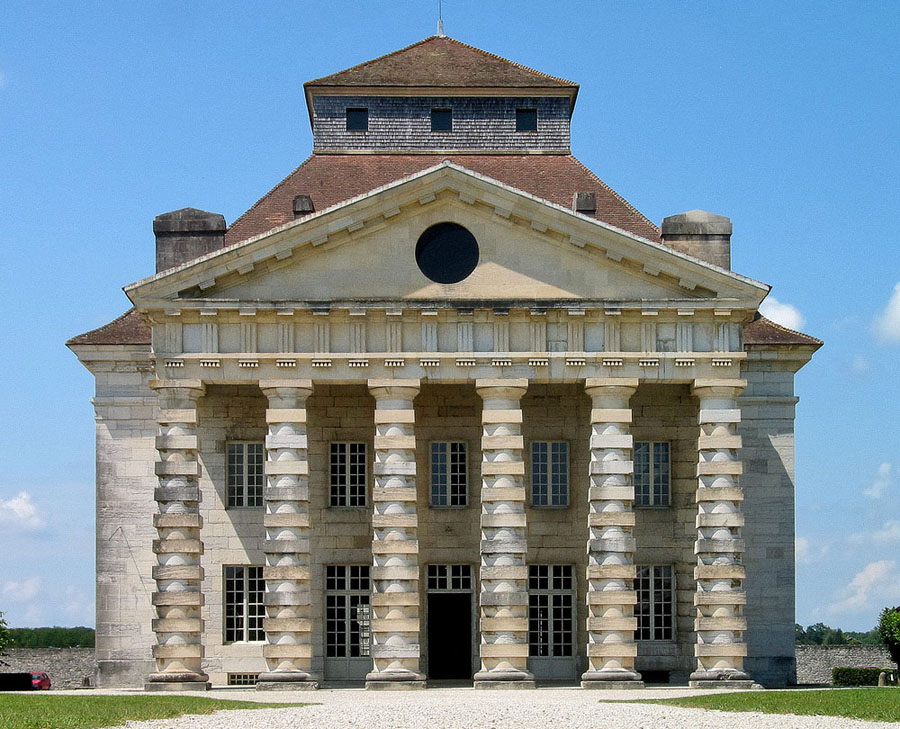
Ledoux did break ground, 1775, on his largest ambition with the Saline royale d’Arc-et-Senans, eastern France, a self-contained complex where wood from the nearby forests of Chaux was burned to boil the saline water brought from springs flowing from beneath the beds of the Jura and lower Alps, the emerging salt then compressed into cakes, sold by the ferme générale, used to season food, preserve it—and gather tax. The gabelle—salt tax—was a significant source of revenue for the state.
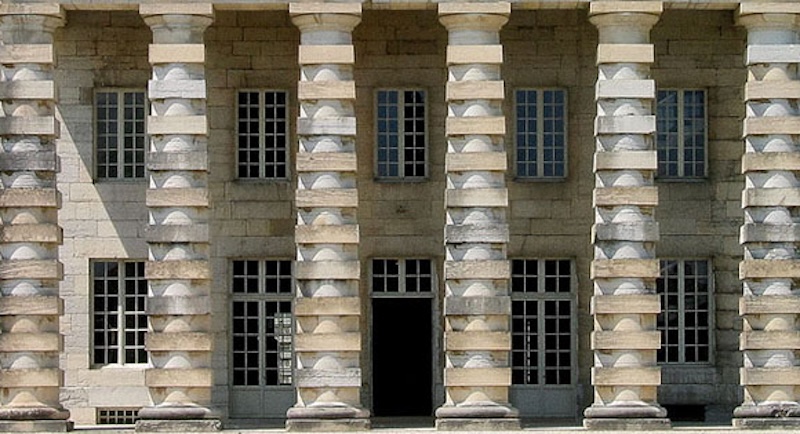
Above, the director’s house. The columns alternate squares and rounds of near equal measure, symbolic ideal shapes for Ledoux. But the squares break the sense of a column and reinforce the horizontal character of the house, giving it a massive, hypnotic energy. The authority of the director, that of the king above him, is unsettlingly palpable.

Above the columns in the pediment peers an oculus, behind which there once was a gallery from which all could be observed.

The director’s house stood at the center of the base of a semicircular plan, in line with the gatehouse, commanding the space. The whole complex was walled in, the gatehouse providing the only entry for the workers. Flanking the director’s house on either side, the salt workshops, then the tax office and another administrative pavilion. Before it, across a communal lawn, placed around the perimeter on either side of the gatehouse, buildings for various functions, then the pavilions that housed the workers in small apartments where they shared a communal kitchen. In the space behind their homes and before the wall, land for their gardens.
We can go two ways here. A rational and efficient plan was realized by an enlightened regime to produce a vital resource and provide meaningful employment, this in an esthetic site where workers were protected, their needs met, they were given a sense of purpose and community under the beneficial eye of the state.
Or the saltworks was a place of systematic suppression and exploitation. They worked twelve-hour shifts in hellish conditions for little pay, ever mindful of the director, of their king. Their lives were carefully regulated, night and day, and they were closely watched. Ledoux himself called the inspector’s house a temple of surveillance, adding, when commenting on the overall plan:
Here the present speaks to the centuries: placed at the center of the rays, nothing escapes surveillance, it has a hundred open eyes when a hundred others sleep, and its ardent pupils relentlessly illuminate the restless night. [77]
Even if no one was standing behind the all-seeing eye of the oculus, the workers knew someone could be there and might have been. The eye never rests, and at night they must have had troubled sleep, as did, I’m guessing, Ledoux in his cell.

There was thought to develop the area and build a town, a plan to complete the circle and reach out into the country, but it was put aside during the Revolution. Instead, Ledoux continued to develop the ideal city of Chaux at the site of the saltworks, on his own, in his book, within his boundless imagination, behind prison walls.
What! In a country where inconstancy prevents the outline of a village, you want to build a city?
Yes, undoubtedly. By conceiving everything that can be executed, one awakens personal interest, values increase every day, and one calculates the results in advance. Conviction, surrounded by its enlightenment, presses the measure and realizes in a day the abandoned views of a carefree century. Everything resumes the imperious trace of nature; new circumstances develop new interests.
Even if the world were turned upside down by ideas that are not at all attractive; when the most profound ignorance trampled underfoot the debris of all knowledge, the line of demarcation that fixes the destiny of peoples brings them back to the point where their interest awaits them. It is the steep rock that descends from the high mountains and ends at a common center, guided by an imperative ravine. It is a torrent that carries away everything it lifts by the irresistible movement of its rushing waters. [75]
Abstractions carry the day. Despite the corruption of the times, his city will be brought into existence and thrive by the logic of its conception, the power of conviction, the inevitability of enlightenment, of reason. Nature, within, without, reigns benevolent, unleashes itself with cataclysmic force.
That he included the saltworks in his plans for Chaux suggests he had cause to hope his ideal city might yet be developed with a regime change since it was already built and the area would need to grow. Yet why put the saline in the center? Salt was the complex’s raison d’être and would have been the city’s mainstay. Seasoning, preservation, its crystalline form—salt may have held symbolic associations as well. And a plan was already established that would determine the layout of future construction. The circle, now complete, would also have larger meanings. Yet you have to wonder how much larger Chaux could have grown without losing coherence, how much further it could have spread before its inhabitants lost sight of the director’s eye at the center of that circle.
Awake, mortal slave of luxury, rise from your bed of softness, and come enjoy, at the dawn of a fine day, the treasures that the morning accumulates for your pleasures. Do you see the rough troop leaving the shore; the proud mule raising its head and pouring out in abundance the varied and delicate dishes that the fisherman’s nets snatch from the empire of Amphitrite? The bull brings with belated steps the winter’s provisions, on rustic carts, and the spoils of the forests rise in pyramids to fill the vast construction sites where the city dweller comes to protect himself against the rigors of the cold. These docile animals drag the flowering trees, the fruit trees, the evergreen oaks, and sweep with their keen tops the avenues that precede this edifice. [165]
Chaux was to be a thriving center of trade amidst natural splendor and abundance, self-contained, self-regulated, self-assured, where all requisites would be met. It is there and in Ledoux’s expansive prose I’ve spent the last few weeks, trying to get my bearings.
He designed buildings for the common good that promote comity among its citizens, a church and a stock exchange in the strict classical form of a Greek temple, the church massive and imposing, a public bath that makes further use of the brine that continues to flow from beneath the mountains.

La Cénobie, a house for communal living, where sixteen families live peacefully by the woods in a hash-shaped structure symmetrical on both axes, with identical faces, around a central area for administration and communal assembly. Sixteen is an ideal number for such a plan. Nature meets geometry:
[T]hey each had a complete apartment; all the needs of isolated life: vegetable gardens, others intended for common and medicinal plants; orchards, meadows, cultivated fields, others reserved for pastures; vineyards, presses; the commons, the assembly hall, the dining room; all the accessories that ensure comfort and convenience were combined. The heads of the family governed by trust; sentimental piety, good example, rather than schools of morality, propagated the lessons of wisdom. Religion attached them to the laws of the country; they found in its consoling exercise the sweet and tranquil life, the hope of good and the alarms of vice. Worship was that which reason leaves to our own lights; they expressed their gratitude to the Creator, and lived in fulfillment of the duties imposed by the Divinity: surrounded by all the virtues, they had no idea of evil.
Virtue, untainted, speaks for itself, ensuring well being in this perfect grid, or used to, until—
A modern philosopher, an economist appears: happiness flees, anxiety begins, everyone becomes agitated; the reading of a new social system occupies minds: ideas intersect, multiply due to different conceptions, and since men who are not yet affected by corruption are easy to mislead when presented them in the best possible way under specious appearances, they mistake the art of reasoning for reason itself. [181]
—and the residents are corrupted by external, dubious thought. Apparently La Cénobie, like France, has succumbed to disruptive reason.

The Market, with a similar square and symmetrical plan, receives and distributes the natural abundance. Grain is stored in the central towering structure around which, at corners, are the poulterer, slaughterhouse, fish market, and dry goods store, between those open air stalls that would draw on the abundance and manage orderly wellbeing.
The pyramidal form sparkles in the middle of the muffled roofs that emphasize it; masses offer constant effects; the light strikes the conserving center of subsistence, and the Architect has diluted his shadows to blacken the part of the walls that must make the other shine. It is there where one sees the property and the hope of nations; it is the reef where famine comes to break; it is the beloved child of the earth; it is an impenetrable sanctuary that no one approaches. It is entrusted to public surveillance, supervised by auxiliary consumption; it is sheltered from distractions that are not directed by the spirit of exchange or distribution. This precious repository receives the favors of the east, which preserve it from the corrupting breaths of the west and the south. [164]
The central structure is as much a temple, sacrosanct, inviolable. Again the need for isolation, a barrier against corruption. I’m not clear what blows from the west and south, whether the references are mythical or historical—west of Chaux lies Paris.

La Maison d’éducation, The House of Education, a study in symmetry, of mass, of openings and closure, of light and shadow. Classical elements—a base, arches, colonnades, a pediment—have been pared down to simple solids, for Ledoux ideal forms, Platonic essences.
The artist who designs a monument of education will offer you simple forms and tranquil exteriors; he will place worship at its center, the inestimable gift of the god of health, a necessary restraint on concentrated desires and nascent passions; he will promote, through uninterrupted lines, the surveillance that ensures morality; he will bring together all studies, exercises, and communications. Inspired by the innocence of springtime, he will offer, through precaution, a faithful copy of the purity of his soul; he will compel the heart with the imperceptible attraction that inscribes it within the circle of goodness; and as health constitutes physical and moral strength, it will invite, in turn, the passing airs to refresh the senses that the sun, in the profusion of its benefits, would have overheated. [204]
Like Plato, Ledoux reveals, relies on the purity of his thoughts. Yet the shadows, like the openings, are nearly or completely opaque, mysterious, impenetrable. The building stands aloof, starkly, oddly so, its mass more imposing than lofty, before which diminutive figures approach leaning, maybe in anticipation, maybe in submission. Once more, the necessity for surveillance, for restraint of desires that need to be kept in check.

Structure is pared down further to essential forms in the Pacifère, the House of Peace, where the rectangular volume, on a base, is dominant, above which rests a cylindrical assembly room on top. Here the citizens of Chaux go to settle minor disputes.
The nascent city whose every building I wish to motivate, I have said, will perhaps be inhabited by less criminal men, over whom reason and their own interests will have some influence. Before leading them to happiness, let us make them worthy of enjoying it: on the road that will lead to its temple, let us build a monument to conciliation; there will come not those who, agitated by violent passions, wish to extinguish them only in the tears or blood of their fellow men, but those who, led astray by some slight impulses of jealousy or self-interest, await only the advice of a wise and conciliatory arbiter to return to the bounds of duty, who preaches peace and harmony to them.
Assumed, the inhabitants’ reasonableness, their good nature,
On its walls will not be engraved the bloody articles of the Draco code, but the principal maxims of ancient and modern moralists; the names of Socrates, Plato, Marcus Aurelius, will be inscribed in letters of gold. On the tribunal will sit a judge beloved by men. There, with a kind and gentle voice, he will reconcile their mutual interests, force them to embrace each other before him, and recommend to them the love of justice and peace. [114]
and the good nature, the kindness of the judge, the wisdom of the past. Fighting is left outside, tension to be resolved within.

The structure is repeated with variations in the cube of the Panaréthéon, the House of Virtue, a public place of instruction for all the citizens of Chaux, more a monument than a school. Its name, recalling the Pantheon, is Ledoux’s creation.
When a city is built; when lasting monuments are erected, the principle that guides the artist cannot be indifferent; if he is instructed, he calls for the purification of morals through examples that strike the multitude; he surrounds himself with every means to give the various establishments he conceives the character of utility that honors the present and perfects the future.
Again, the focus on an elemental form, again a call to wisdom from the past, again rites of purification.
Here, you see a school of morality where the duties of man are taught. Plato, Socrates, Lactantius, and Augustine all worked on this vast edifice. The enthusiasm of each depends on the time in which they lived; all walked by different paths to arrive at the same goal. [184]
Just as those who approach the Panaréthéon by different paths find resolution, virtue, common understanding. All roads lead to the center of a circle.

And repeated again in the La Temple de mémoire, the Temple of Memory. This monument is dedicated to women and is distinguished from the others by columns at the corners with minarets on top, the cube softened by their slender, rising forms. Into the columns are cut bas-reliefs that illustrate accomplishments of women, their moral guidance.
By placing this house at the top of the promontory that ends the viewpoint of the park, the father will be able to say to his son: the virtues of your mother are traced on these tall columns, by the chisel of the philosopher-sculptor who captures the honorable features that characterize her; she was as beautiful as she was virtuous, and although she was born under the planet Venus, her purity was never altered, her virtue never equivocal, her piety never painful. [160]
Purity finds another container. It is here Ledoux wished to be buried.
In all three, and elsewhere, Palladio is an influence in Ledoux’s paring down, the centering of basic forms, the control of symmetry, his motives similar. The interiors, rooms whose layout and size are not apparent from the outside, maintain the symmetry across the axes and are arranged around a central space where motion comes to rest, those entering stand and contemplate the order, the messages on the walls, receive mediation, or ascend to a higher level. His simplification is not a reduction of classical order but a clarification that reveals essential truths, like the boiling down of water to salt crystals, perfect forms that speak volumes. We are impressed by all that is not there, what remains eternal. And like Palladio he uses stairs that divide and return, providing a ritual of ascent and centering. Wittkower, summarizing Palladio in his Fourth Book on Temples:
To ascend to a temple by steps inspires us with devotion and awe. Such places of worship should be of the highest perfection; they ought to be built so that nothing more beautiful could be imagined and those who enter should be transported into a kind of ecstasy in admiring their grace and beauty.
Later Ledoux’s work was derisively referred to as architecture parlante—speaking architecture—but what are we being told? Ledoux’s temples speak for themselves—and leave us speechless. We are transported, are absorbed in the massive, simple forms, by their transcendent message, our voiceless awe.

Other of his buildings bear more direct relation to their function, the Atelier des cercles, for example, a workshop for coopers.
The workshops placed on the ground floor, on the first floor, overlook the vast roads of the forest. The living rooms are far from the ground to obtain the desirable salubrity; the combined voids, placed in the center, at the ends, allow a glimpse of pines whose masses correct, in winter, oaks, sycamores, acacias which are renewed every spring and produce oppositions which calm the surfaces of the stone; traced and not deepened splits extend the indefinite lines of the circles, and link them with the azure vault of which they adopt the form and the marvels. [179]
The circles resemble barrels, or perhaps the metal rings that bind them. But we are also allowed to see through them, and beyond. The concentric circles, like the columns in the director’s house, are hypnotic.
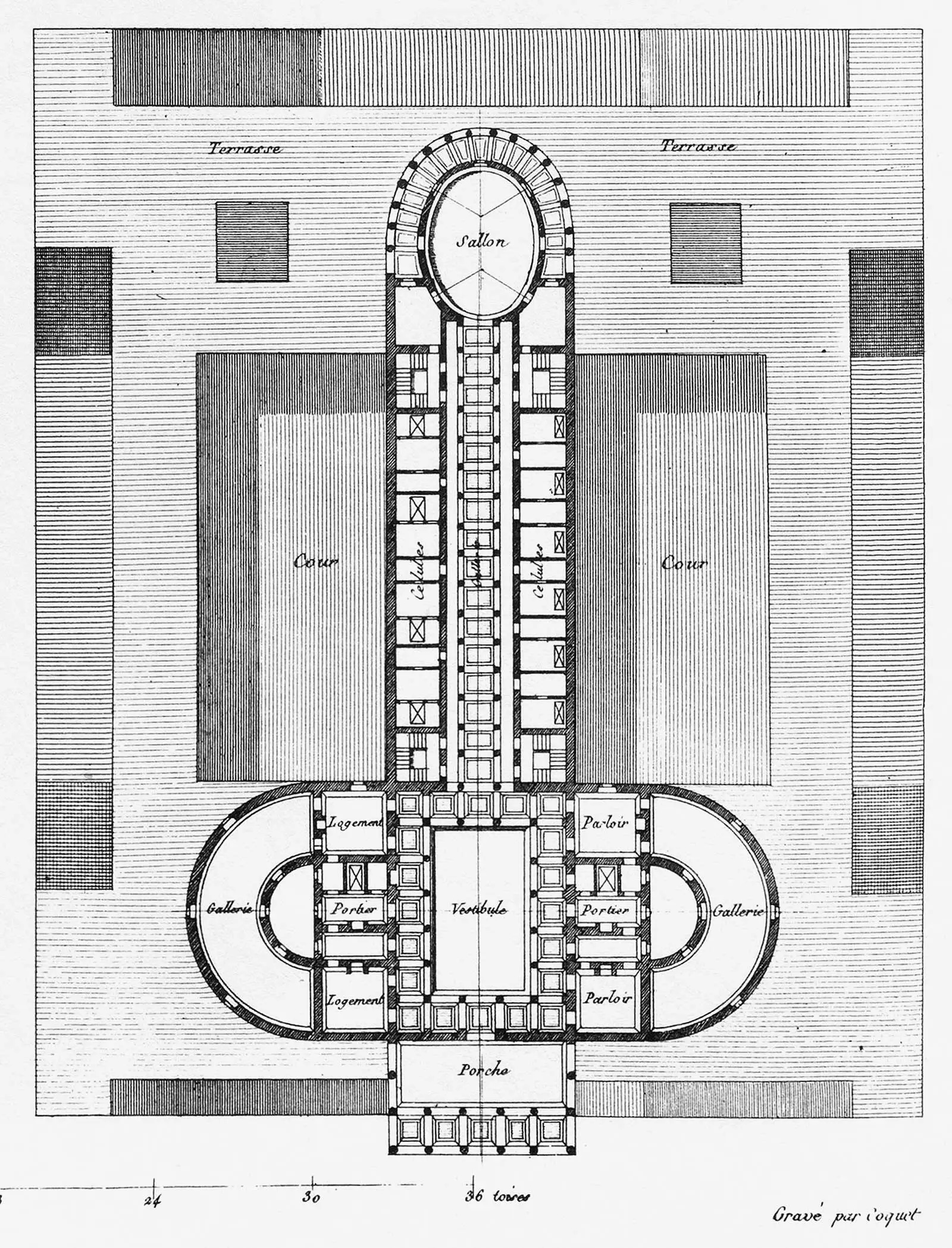
In the Oikéma, the House of Pleasure, the message is direct and unambiguous. Above, the ground plan.
Up close, vice influences the soul no less powerfully; by the horror it imprints on it, it makes it react towards virtue. The Oïkema presents to the fiery and fickle youth it attracts depravity in its nakedness and the feeling of the degradation of man, rekindles dormant virtue, and leads man to the altar of virtuous Hymen who embraces and crowns him.
It is a brothel, in whose subterranean level, or maybe elsewhere,
The Workshop of Corruption, beneath its dark and deep caverns, reveals to him the poisoned sources which alter the vigor of morality, undermine thrones, overthrow empires, and it only brings it to light with hatred of everything which can corrupt morals. [2]
We can learn by descent as well, by being lured and captured in a structure where virtue is fed by degradation.

Ever at the center of Chaux, commanding the town, remains the director’s house of the saltworks with its all-seeing eye. But inside the building, before the vibrant columns, is largely open space, dedicated to a place of worship, to ascending stairs where the workers gathered before a priest for Sunday service.
Here, the features of the god of light disappear; the altar is at the center, the reserved day is radiant; the minister is the only one seen, the only one illuminated; one would think that the divinity itself, descended from the heavens, occupies the place in all its majesty, in all its splendor. [142]
Where there is another eye that sees and illumines. From the light above, we assume the minister’s inspiration, God’s power, his surveillance.
Do you know how much you owe to the One who tirelessly watches over your pleasures, to the One who prepares new ones for you? [205]

The gods of Olympus look down on us as well, sending rays of benediction. In his Abri du pauvre, The Shelter of the Poor, he only shows a tree in the open space, but for Ledoux it is enough, it is everything.
Well then, this vast universe that astonishes you is the house of the poor, it is the house of the rich who have been stripped; it has the azure vault for a dome, and communicates with the assembly of the gods. Child of the same father, it is heir to the same heritage; the Architect of the rich is his. It is a common gift from the divinity thrown onto the earth that only takes it away from those it curses. Consider all that nature has done for the poor. Do kings, emperors, even the gods themselves have grander palaces? [104]
Under a tree, before the gods, closer to nature, we are blessed, we are better off, though we may not know it.

Beyond, with the gods, with God, the heavens. Ledoux locates us in the universe, setting the geometry of Chaux in divine, cosmic oder.
The intellectual world for which this one was made offers you a graduated scale that receives the influx of beings electrified by the celestial flame; it offers you these divine geniuses who rise to the summit of the ethereal vault: the Architect is there, surrounded by whirlwinds, by clouds that dispute with him the preeminence of the heavens; he sees beneath his feet shadows that darken the earth and burden it with the mourning of the seasons. [195]
Where the architect has a place and ultimate authority.

There are no hospitals or formal prisons in Chaux because it does not need them. The residents are kept healthy and safe by the natural environment, their essential character, their honest lives, their moral guidance. At the edge of town, however, Ledoux placed a hospice, a center of rest and security for passers by.
Philanthropy has prepared a shelter for [the traveler] against the storm, the harmful animals, and the imaginary dangers. Here the good and the wicked are equally received for the first night; but the next day the good calmly continue their journey; the others are questioned, divined, condemned to assist our work. Their evil will is chained, and they return to society what they wanted to steal from it. The day of repentance will come, for God made repentance the virtue of the guilty. Well! on that day, forgiveness, forgiveness returns to him, on the shining wing of hope; the one whom your tortures or your criminal laws would have forever snatched from society will return to it unsullied, with the will to serve it.
It is also a processing center, which has this purpose:
The goal of this establishment is to purify the social order, through the attraction of benevolence; to change vicious inclinations, through the example of work; and to subject licentiousness to the laws of subordination. [64]
The hospice, in fact, is a temporary detaining center, a prison, and since the corrupt are forced to work in town, all Chaux becomes their prison. The House of Pleasure is also a correction house—oikéma is the Greek word for a room, a dwelling, but also a prison cell—where visitors are trapped until purified of their corruption. One has to wonder when the workers in Chaux might be released, on what terms, whether the licentious will ever leave the Oikéma at all.

And there is a cemetery, another kind of prison, from which there is no escape. Galleries of crypts where corpses rest are presided over by a dark sphere that the light of heaven scarcely enters.
Enter this dark labyrinth, an awful lake appears before your eyes; the vents of the infernal empire open in all directions; the vapors of the abyss rise up and spread their contagion through the vast expanse of air. Do you see these doves crossing, flapping their wings, and coming to alight on the lawn; these eagles, these tyrants of the ether, which astonish with their fall these tranquil vaults where hatred and vengeance slumber?
How dreadful it is to think that nothing escapes destruction; that this stepmother of nature gathers her sinister tools to dig her nothingness. Follow the paths worn into these rocks, you will see religious ceremonies occupying the center of the edifice, the sky illuminates them, and its dazzling gaze pursues the shadows and attaches them to half the globe to announce the dark abode where greatness ends. [193-4]
The dark side of nature, a sublime and eternal terror, prevails

and erupts in fiery terror from the human heart in his Forge à canons, a foundry for war machines.
The mind does not exert great effort in the search for truth, when it observes the rule of reason, and the rectitude that guides it.
You who set in motion the universal movement, you who create beings, warm them and temper the burning rays of knowledge, do you see the evils contained within this edifice? Here Thetis occupies immense underground chambers, a hundred mechanisms summon the rivers of industry; the scourges of humanity leap forth from the banks, flooding us from all sides; they are about to afflict the world.
The god of the arts adjusts his bellows; twenty forges, set in motion stir the metals within their depths. The impetuous winds agitate the raw bronze; gold, silver, lead flow in great torrents. Already the tubes prepared by the goddess are filled with an expansive force. Already the thunderclap shakes the lofty mountains, strikes terror into the hearts of mortals at immeasurable distances, on wings a thousand times faster than the wind. The temples of the Divinity are in ruins, the palaces of kings are shattered, the empire of the god Pan is destroyed, and the mere force of the air overturns all that opposes it.
There, the saltpeter, compressed in a sphere, explodes, shattering, tearing, destroying everything around it. Death, with rapid steps, follows this deadly phenomenon. Further on, the divine science guides the thunder of battle, piercing it, and illuminates the fiery path of conquest; steel, in the form of spears, accumulates; the gleaming bronze shines from all sides, the silvery clatter of weapons resounds; helmets pile up, the fluttering plumes arrange themselves naturally upon ancient trophies; art adorns the scene with resplendent armor. One can discern the haggard features of the vanquished, mingled with the golden sashes of the victors. [235]
A mythical world lies in shambles, victors emerge uncertainly. However orderly the structure, symmetrically arranged around a central core, his prose vents chaos and gives no spatial understanding. Chaux itself has become a prison of confusion beneath a cloud of infernal smoke.
At once as far as Angels kenn he view
The dismal Situation waste and wilde,
A Dungeon horrible, on all sides round
As one great Furnace flam’d, yet from those flames
No light, but rather darkness visible
Serv’d onely to discover sights of woe,
Regions of sorrow, doleful shades, where peace
And rest can never dwell, hope never comes
That comes to all; but torture without end
Still urges, and a fiery Deluge, fed
With ever-burning Sulphur unconsum’d
His description recalls Milton’s vision of Hell, but you will not find Satan. Ledoux’s hell is not tethered to spiritual belief, rather is based on unruled darkness and disorder, assumed, unexamined, inscrutable, that vies with, complements the order of his vision. Nor does he give us any reason to hope that the paradise of Chaux might be regained, restored to its light and purity. The book ends with this note, this structure, this vision, the rising smoke.
Nor is it clear what wars he refers to, whether they are mythical or imagined. While he was in prison, European major powers joined to defeat the Revolution and restore the monarchy, though he offers no specific reference or alignment. Or he may been influenced by the general disturbance on the streets. Or he could have had in mind any number of French wars over the past centuries, enough to make one think war was a perpetual state, though again he gives no reference. In fact throughout the book there is little specific reference to any realities of his day in Chaux or times before. Even the saltworks, isolated but actually built, existed in its a world of its own.
Here, night lowers its dark veils and envelops the earth in its darkness; the order of nature is suspended, the lovely variety is nothing more than a deluge that confuses space and covers the earth; well! what then does the Architect do to create sustained effects? He surrounds his edifice with pale phantoms; the flame of a volcano rises, illuminates the masses and makes us forget the details. It is there where study summarizes and renounces everything that can tire the sight with idle research. Yet this is what meditation can offer; what magic! what wonders! It seems that the night vies with the power of the Architect, to resurrect the day. When the sleeping world rests, it alone watches, it alone stirs the delicious dreams, wanting to perpetuate its empire. Woe to the artist who does not feel all that presents itself to thought; he who does not appreciate the value of the purity of a line set in motion, is very close to corrupting it. [205]
Ledoux is talking about the House of Education, but here, as above, as elsewhere, he digresses and we lose orientation. The undercurrent of dark thoughts shades his designs and enters his words throughout, like a subterranean stream. What emerges from the darkness is what the architect can draw from within while the rest of us are asleep, what he adds, the phantoms, a volcano that makes us forget the details. Tout est cercle dans la nature [223] he tells us, he runs around in circles. When the architect looks down from the heavens to the altar in the director’s house, through the oculus and out over Chaux, where everywhere darkness seeps, he is looking at himself, trapped in the prison of his imagination.
This is madness.
I do not know Ledoux’s private thoughts. I only have his words and images and have to try to see where they take me, where they leave me stranded, wondering what desires, which fears lie beneath that he has not recognized or suppressed. He has a created a world in which tiny figures without identity or power appear like characters in a distorted dream, puppets whose assumed good nature only makes them malleable to his vision of some larger moral order, whose existence is vouchsafed by repetitive ritual behavior. Nature and its assumed abundance itself is a deus ex machina that solves all problems without recourse to economic history, to any system of distribution and regulation, oblivious to the realities of shortages that plagued France throughout its history into the Revolution. His vision, Chaux’s order, depends on a strict division of light and dark, a projection of impossible perfection and impenetrable abstraction pitted against disorder and corruption, an opposition that defines it, from which it cannot escape. The only way to maintain sanity and keep Chaux intact is through constant vigilance and surveillance, which can only lead to exhaustion, to nightmares where it is hard to distinguish the monstrous creations of reason from the terrors of our worst internal fears.
But Ledoux inherited a mindset, notions of reason from a world not of his creation, that could not look at itself or what it covered. The Enlightenment painted a picture of orderly nature in which our lives should fit, at odds with the reality of social and economic life, oblivious to the raw motive of power and social control, against which Burke projected a dark sublime. The Age of Reason has its nightmares. Reformer Jeremy Bentham, who believed what made the greatest number of us happy should decide what is right, what is wrong, also designed a rational structure for surveillance and control, the Panopticon, a prison.

A single officer at the center could observe the entire prison. He didn’t even have to be inside, as the inmates would never know if they were being watched but were always aware there was that possibility, day and night. Foucault takes the Panopticon as a metaphor for the surveillance state that succeeded kings and assumed their power, which has emerged in various forms in the years since, so much so that we have to wonder if it has any purpose other than to maintain itself in perpetual vigilance and keep the rest of us restless, in the dark.

And the desire for total order has also persisted into our times. The further we reach, the less we enclose, the more we lop off. The purer our thoughts, the more we exclude, the more that lies buried, dark, unseen. Reason has its limits.
There is ancient precedent. Plato envisioned a republic projected from shadows in a cave. Like Ledoux, he proceeds from darkness to light, to reason. Like Ledoux, he focuses on a central figure, the philosopher king, who benignly rules and brings order—another deus ex machina—though Ledoux cannot let the shadows go.
Then you will establish in your state physicians and judges such as we have described. They will look after those citizens whose bodies and souls are constitutionally sound. The physically unsound they will leave to die; and they will actually put to death those who are incurably corrupt in mind.
From The Republic. As with Ledoux, so with Plato, the need for division, separation, and exclusion. We have to wonder what determines mental soundness, whether any of us can achieve it. At least Ledoux gave the unfit a chance to work off their transgressions and offered forgiveness. Mumford on Plato’s Republic:
When Plato turned his back on the disorder and confusion of Athens, to rearrange the social functions of the city on an obsolete primitive pattern, he also turned his back, unfortunately, on the essential life of the city itself, with its power to crossbreed, to intermingle, to reconcile opposites, to create new syntheses, to elicit new purposes not predetermined by the petrified structure itself. In short, he rejected the potentiality—not unrelated to what Plato would have regarded as inadmissible confusion—of transcending race and caste and overcoming vocational limitations. He saw no way of unifying the divided selves of man without freezing them into so many fixed, graded, and classified parts of the polis.
What he did not suspect apparently was that this geometric heaven might, in terms of man’s suppressed potentialities, turn out to be a living hell.
Behold, somewhere in Chaux, from Ledoux’s imagination, amidst a picture of nature where tiny people approach like pilgrims, fugitives from a revolution, this bizarre country house.

Other of Ledoux’s country homes are similar in their simplicity, symmetry, and three-part structure, base, body, head. Above, the design is closely repeated on four corners around a central court. It is a house for a father and his two sons and daughter, each unhappy in his or her own way, the family in discord.
What to do? The Architect embraces Minerva’s knees and says his prayer; he is listened to; he is inspired. Similar to our modern Aesculapius, he feels the vein which carries blood from the heart to the extremities, consults it before administering the remedy. What! must we separate forever, when an innocent stratagem can consolidate knots tightened by nature? [98]
Each is to get a separate structure on a corner. The common space at the center will bring them peacefully together. Rational order is the doctor’s cure—and obsession. The plan shows the repetitive gestures of a neurotic. You sense that with time, given the chance, the order will spread across the grid in geometric sequence ad astra, ad infinitum, ad nauseam—

The model has been sitting on my table for months. Most of the time, while passing by, I glance at it and smile, marveling at how ridiculous it is. But sometimes I just sit and contemplate it and let my thoughts go and feel a spreading warmth. And on rare occasion I look at it and stare, thinking that there but by the grace of God go I.
I assume the four faces are identical, that the house gives the same look to its inhabitants, to nature, to us around. Scale is hard to read. In its simplicity and modesty it looks small, but compared to the people approaching it looms large. There is no sense of front or back, major or minor entry, as the colonnaded sections are all the same, equally formal and emphatic. If one walked around and got distracted, one might wonder if he or she were at the right door. The structures at the top corners—turrets?—emphatic as well, cannot be accessed and serve no purpose. The awning that surrounds at the midriff provides little cover for the walk below. It looks like a short skirt.
Stylistically, the house is not much more than a cube, albeit with some distinction. The small windows promote its mass and encourage us to ponder its significance. While there is classical influence in the columns, the arches, that influence is diluted and slight, without articulation, as if Ledoux is pulling away, looking elsewhere. One critic has claimed Ledoux anticipates modernism in his paring down of details and focus on geometric forms, but that ignores what Ledoux invests in his cube, how much he wants us to look back to larger, ancient meanings, out of step with modern times. Just as physical orientation might be uncertain, it is possible to lose track of time as we try to place the house in history’s currents, perhaps conclude it exists outside it.

Inside the inhabitants might establish orientation by the different views from the windows, the passing shadows from the arcing sun. Order is maintained with symmetrical layout and even rooms arranged around the central stairs, a nine-square base, three by three. At the top, a skylight, but with all the partitions and small exterior windows, the house would be dark. At ground level, various domestic functions and an office without openings for natural light, except at the stairwell. On the main floor social and dining rooms, the cabinets, a bedroom, maybe for a guest, a large toilette. On the top floor eight more bedrooms. That’s a sizable family, and I’m trying to imagine the traffic.

Then there are the stairs outside, at the base, that rise and fall in levels around the house, leading to landings at the central entries, that serve no clear functional purpose, or duplicate it without need. Why have external entries to the rooms when they can be accessed from the central hall? Would anyone leave the guest room, go outside and walk around the corner to go eat?
What the stairs accomplish, however, is reinforce behavior at the public structures of Chaux, the ritual of ascent and contemplation. The house, as Ledoux says in his description, is a “monument of taste,” and it keeps the structure and basic form of those buildings, their meanings. What the residents experience at the Pacifère they repeat physically at their home. They will remember what they saw on its walls, the maxims of ancient and modern moralists, the names of Socrates, Plato, and Marcus Aurelius. They will remember the beloved judge with a kind and gentle voice. And when they ascend the stairs from the dark ground floor and make their way to their bedrooms, the stairs lit only by the skylight, they will remember the priest within the director’s house beneath a single beam, the open eye of the oculus in the pediment, knowing they are guided by a higher light—and are being watched. I wonder if they can sleep.
From an angle the columns look like a dense forest where they might get lost. I can see the residents rising inside, descending, going up and down the levels of stairs outside, endlessly, pointlessly, like figures in an Escher. What on earth was Ledoux thinking?
Still—
The house is self-contained and compelling on its own terms, memorable in fact, and lively. The colonnades at the central entries are reinforced by the turret columns at the top, which balance the composition and give it energy. Cubes themselves, they reinforce the central theme and suggest division within the main cube, nine smaller squares on each face within the larger to complement the floor plan, completing a cube three by three by three. Without the turrets, the house would have been unrelievedly bland. And that central skirt divides the house with another accent while adding presence and energy, making a curtsy, offering a note of grace.
It is ridiculous, but it has its charms.

As with other projects, I built the model because I was looking for a break, a distraction from our fractured times. The house looked like something I could complete easily and convincingly, without complication or anxious indecision. But once I got started I was taken by accelerating absorption. Everything fit together, everything worked out. I always knew where every piece should go and what would come next, never losing sight of or doubting how it would turn out on completion. There is a joy in seeing parts come together, regardless of how they add up. Every morning I woke up looking forward to the construction, and when I finished I felt not revelation but something that has its lightness. My head was clear, I felt refreshed. I had wiped the slate clean of troubled thoughts, at least for a while. Maybe its residents sleep well after all.
I, too, feel trapped and sense that the world has gone mad, that I am in a prison with all eyes on me. They are—cameras and robots of online surveillance are everywhere, and I do know who or what is behind them. There has been an concerted push across the globe for a return to order, to a moral purity based on strict definitions, unexamined, that bury dark motive, an order that can only exist by separation, opposition, and exclusion. Wars have erupted across the globe that have no rational motive. At home, hulking masked warriors, armed and clad in black, suddenly appear and forcibly remove people who live here to remote places. The military patrols our city streets. A center for the homeless is planned outside of a city where they will be forced to receive treatment for their addictions, their supposed mental illness, and there is a desire to build more along the same lines. The power of money has made itself manifest, unqualified, unchallenged, unstoppable, yet cloaks itself in virtual devices and artificial incantations. Our past has been reinvented in ways that exceed recognition. Mysteriously, magically, a golden ballroom, classically inflected, monstrous, has appeared. There are days when I have trouble believing what I hear and wonder if I have made it up.
Before going over to new governments, let us see what the old ones were: all governments are good when the people are happy. [181]
I suppose Ledoux meant well, however incomplete his experience, his perception. If you look back not from our present vantage point but from his, at what preceded him in France, it might be said his ideal city was an improvement over monarchial disarray and indifference. Given the turbulence and uncertainty of the Revolution, it would have been hard if not impossible for him to look forward and consider an alternative system, not yet tried, not yet tested, barely conceived. When I look back from my perspective, I doubt where I stand, what I know, what I see, what came before me. We live now in a world too similar to his before the Revolution, and the thought and practice of the last two centuries have not proved durable. If you look across the continuum of all time, you wonder if peace is a transitory state, if all notions of order are illusions. History all too often has not been orderly or kind, things have always fallen apart. In which case our best shot and only hope is to take a flying leap.
History is the subject of a structure whose site is not homogenous, empty time, but time filled by the presence of the now. Thus, to Robespierre ancient Rome was a past changed with the time of the now which he blasted out of the continuum of history. The French Revolution viewed itself as Rome reincarnate.
Walter Benjamin
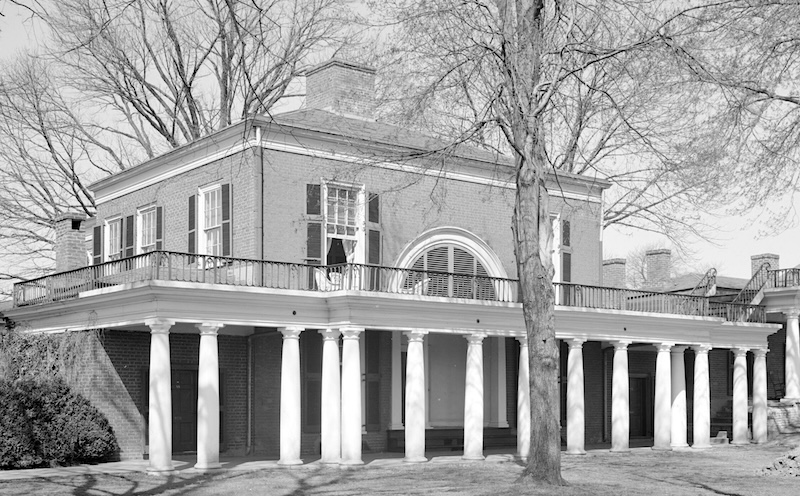
Robespierre, however, took his cues from Ancient Rome, its virtues, its republican government, or the way he saw them. Inasmuch as the Revolution built, some of its architects followed a neoclassical line as well. After our revolution, Ledoux did have influence on those who built for our new republic. Latrobe knew Ledoux, as did Jefferson. Pavilion IX of the University of Virginia was strongly guided by his Hôtel Guimard.
There’s contentious debate today about the value of classical style, left and right, as to what it might mean, what’s behind it, whether it has validity. Let it come. Wholesale rejection has as limited use as blind acceptance and mindless repetition. Recognition of a tradition, nor its rejection, cannot not be rote, rather is a process that involves critique, reevaluation, and redefinition and revision, deciding what to keep, what to throw out. The process of rejection and reevaluation itself in a longstanding tradition. And we have to start somewhere. Recognizing the past anchors us in time. To know ourselves we have to know what came before us, if only to understand where we stand and where to take the next step. The notion we have to jettison the past and recreate ourselves from scratch leaves us stranded.
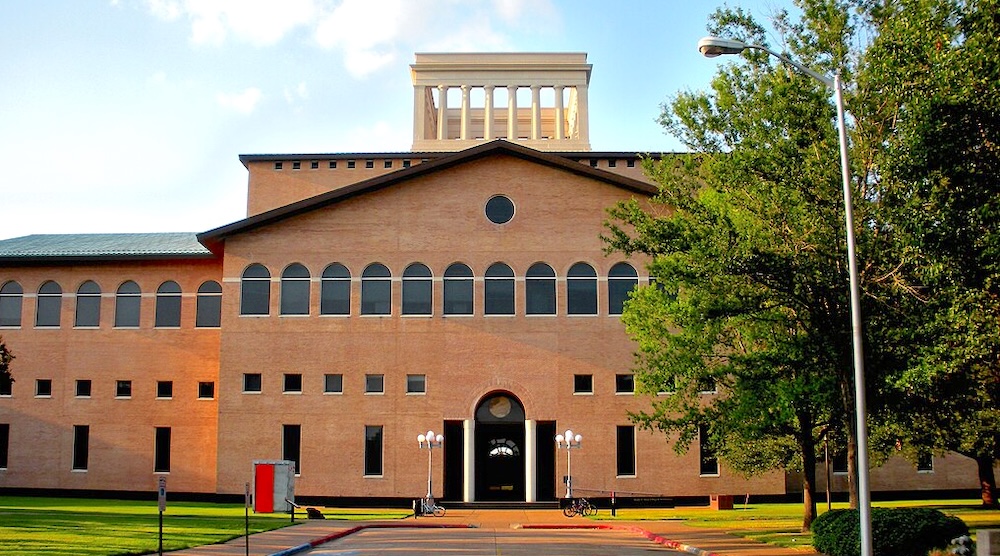
Postmodernists also took interest a century and a half later. Philip Johnson closely followed Ledoux’s House of Education in his School of Architecture Building at the University of Houston. But he largely copies Ledoux with only minor alterations, and he has literally stuck to a theoretical design without qualifications necessary for actual construction. A concept has been rendered flatly, only literally. Ledoux would have made adjustments had he ever built his House, certainly in surface treatment and articulation. Lost are Ledoux’s aspirations, his shadows, his wildness, the violence of his times, nor is there recognition of ours in Johnson’s. It is not out of context, but rather has no context. It feels like an inside joke.

Michael Graves, however, took to Ledoux early on and looked back convincingly. The Portland Building follows the same essential structure of a cube on a base, suggesting whatever meanings a cube might carry. The small windows reinforce its mass and presence (to the city workers’s dismay—interior lighting is poor). The classical elements—the closely spaced pilasters supporting the protruding keystones, the huge keystone at top, flat, structurally pointless but visually essential, the grace of garlands on the sides—give the building coherence, stability, and upward lift. Their large size not only shifts our understanding of classical support and embellishment, it also makes their signs visible in a city where communication is lost in the massive abstractions of towering glass boxes. The treatment is not ironic but lighthearted and playful, more in keeping with our times, certainly with the laidback mood of Portland. The building is lively, it is human. The past lives on, we take it on our own terms, we look ahead.
Spirit in will to express
can make the great sun seem small.
The sun is
Thus the Universe.
Did we need Bach
Bach is
Thus music is.
Did we need Boullée
Did we need Ledoux
Boullée is
Ledoux is
Thus Architecture is.
Then there is Louis Kahn. I have no idea what he is talking about, either, but we are moved by a spirit that reaches beyond us yet which we would again be hard put to locate or define. The reference to music takes us away from literal expression, allusion to Bach to think of inventions and counterpoints from the past.
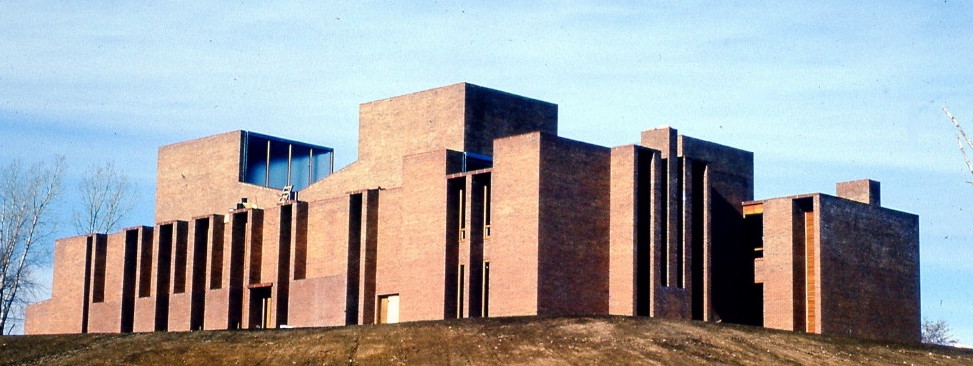
Nor do I know what we are supposed to understand from his assertion about Ledoux and architecture, yet his existence, and that of architecture, is established, somehow.

When we look at Khan’s work we remain speechless but become convinced of its expression. Like Ledoux’s house, his First Unitarian Church in Rochester is built around the basic cube, but symmetry has shifted in irregular ways that defy exact formula. Essential meanings have been reduced not to a system of order but to undefined relationship, to varied rhythms, to movement, not stasis, to a sense of the universal that cannot be rationalized. Coming to terms with the ineffable, in fact, may be our oldest tradition, certainly in religion. Here belief is kept uncertain, open, and flexible, a position appropriate for Unitarian practice. The rest of us might learn from the building as well. And the church has a monumental cast that looks back at monuments past, that tells us it is meant to endure into the future, but, like the Portland Building, it is realized in our time, with human understanding.

Walter Benjamin argued that in order to understand any form of paradigm shift, it is necessary, in a sense, to reawaken history.
Peter Eisenman, quoting Benjamin, also comes to mind, who takes notions of order, of Cartesian coherence, and challenges them in ways that defy precise definition or spatial understanding. In his Palladio Virtuel project through graphic analysis of the villas he reveals volumes that pull away from symmetry, centrality, harmonic relationship of parts to wholes.
Instead there emerges a new typology: a villa plan in which the abstract geometry of the nine-square diagram gradually dissipates, replaced by a sense of topological relationships; it loses its volumetric discreteness, revealing spaces that are superposed over one another or transposed from some unstable base condition, which is no longer Platonic and ideal, but rather involves a series of potentially disarticulated and disaggregated relations of some presumed normative state.
Whether Eisenman is right in his analysis, whether he reveals Palladio’s intentions, or his unconscious contradictions, or the buried tensions of his culture may all well be moot points. Volumes have been brought to light that now linger, and what matters is how reconceptualizing tradition might influence the structures of present architecture.

That is certainly the case in his own work. House II, a country house, isolated, standing alone on a hill like a proposition, most reminds us of Ledoux’s. Both are based on a basic cube, both have a nine-part floor plan, both make us think of Palladio. But where Ledoux divides with regularity, Eisenman avoids set patterns. Each face is different, unpredictable, brings surprise. As with Kahn we sense coherence, but its definition is complex and open.
And neither house is especially practical or livable. I prefer to think of both as conceptual works that make us think about being, about structuring ourselves in the world, about the structures of essential meanings. A platonic form is invoked in both, providing a plan for variations in the Ledoux, a stage for transformations in the Eisenman. This is the value of Plato’s thought, the reason we still read him, that he has provided, over the millennia, a core around which to maneuver. Meaning itself, we realize now, is not fixed but shifts and holds contradictions and buries other meanings, but to realize that we still need to ground ourselves in the possibilities of order, no matter how much we challenge or reject them, whether or not they exist. That recognition might provide one way to face our tensions, our conflicts now, our complexities, along with the understanding of the need to be flexible, to learn to adapt, especially in a society that is not built on hierarchies and a division of classes, or shouldn’t be. Yet that way is grounded, and it gives us means to express ourselves without losing track of where we are, to protect, to inoculate ourselves from the viruses of our teaming inner demons, from the hells we have created for ourselves, to avoid the prisons of our delusions, of our ideologies. Plato set us on this course.

The design is unstable, and the more you look at the Ledoux house and try to contain it in understanding, the more it pulls away from Cartesian certainty and takes us to unknown space. If it suggests a 3x3x3 cube, the inner cubes are not even, nor do they or the suggested cube that holds them have satisfying formulaic proportion. It is not even certain where the larger cube sits in the base, nor, from the faces, where the inner squares might find delineation. The skirt that surrounds does not come where we expect to find a pitched roof, at the top, but rather at the middle, and in effect provides a second base for the upper floor and the turrets above, which themselves take us up and out, away from the central colonnades at entry, from the larger cube, heavenward. Against their lift, the motion of the surrounding stairs in the grounded base, rising, falling, rising, falling endlessly, literally, figuratively moving us around in circles. The house takes us everywhere, it takes us nowhere. It is pointlessly, profoundly exhilarating, it sings with unanswered questions.
To articulate the past historically does not mean to recognize it “the way it really was.” It means to seize hold of a memory as it flashes up at a moment of danger.
Walter Benjamin
Benjamin intended to seize the dangerous moment to open fissures and wrest control of our perception of history from the hands of the ruling class and free it for the proletariat. Ledoux envisioned architecture at a moment of crisis, a pivotal juncture of world views, the idealism of the ancien regime, along with its internal contradictions, unvoiced, its latent violence, its dark, infernal regions pitted against the release of the manifest violence of the Revolution all around him, uncontained, seemingly without end, its unsettled vision. Whether he realized it or not, his work was determined by this tension, in which he sought esthetic control and ideological empire, yet at the same time release. Ledoux’s work must have offered him a degree of consolation, the partial joy that comes from creation, that transcends motive. A visual language can have a life of its own, especially when it frees itself of literalness and strict reference, and can take us to expression all of us would be hard put to understand or explain yet which has physical presence and ensures us life.
History is unstable for monarchists and materialists alike. One set of misinterpretations will inevitably follow another, bringing fresh crisis that reveals new cracks. Art has always had to manage impossible transitions, and whatever the case for Ledoux in his time, or in Benjamin’s, when we look at Ledoux’s work today we see the value in pushing an idea from within itself out past its limits and seeing where that takes us. The sky clears, our minds open, if only for a moment, we can think of something else, of keeping on going, of starting over. With Ledoux we are left with the fleeing outlines of past ideas and the ghost of something else we cannot grasp, or an angel.

Klee’s new angel, with its outstretched, winglike arms and upward lift, seemingly ineffectual, seemingly unassuming, like Leroux’s country house, is monstrous and ridiculous. In its grotesqueness it looks as if the artist has taken a spiritual icon and blasted it with derision and sardonic rendering. Yet his figure transcends ridicule, or does not care, and the marks and scratching can as much be seen as the result of Klee’s pushing through the seraphic sheen of angels past, beyond visions of celestial realm in some hereafter to see what might remain, what might yet last, here, before us, 1920, just after a global war had shattered our illusions. Regardless, it is still an angel, still it hovers above the scene, impossibly weightless, still it takes us somewhere, somewhere else.
A Klee painting named “Angelus Novus” shows an angel looking as though he is about to move away from something he is fixedly contemplating. His eyes are staring, his mouth is open, his wings are spread. This is how one pictures the angel of history. His face is turned toward the past. Where we perceive a chain of events, he sees one single catastrophe which keeps piling wreckage upon wreckage and hurls it in front of his feet. The angel would like to stay, awaken the dead, and make whole what has been smashed. But a storm is blowing from Paradise; it has got caught in his wings with such a violence that the angel can no longer close them. This storm irresistibly propels him into the future to which his back is turned, while the pile of debris before him grows skyward. This storm is what we call progress.
Benjamin takes Klee’s angel as a figure to launch a vision of history using simple, direct, yet oblique prose that jars with ironic slashes and rough juxtapositions. Progress is a cataclysmic storm, an undifferentiated pile of trash mounting towards the heavens. We, in our blindness, have deluded ourselves into seeing it otherwise, as orderly steps, a chain of events that moves us forward in some inevitable and ultimately desirable way. The angel lifts the veil and shows the dislocations, the repressions we have buried, the violence we have left in our wake, turns its back, looks forward, or somewhere. He is referring to a variety of misprojections about progress, some by those who considered themselves liberal and just, most of which most of us have accepted in some form. Specifically he challenges Marx’s linear view of history as a play of forces and material facts moving towards a new society, utopian, celestial in some grounded way.
But it is the storm that pushes the angel to look outward, not spiritual resolve or ideological resolution, and once more I am not sure what is being said, what picture of the future or of history Benjamin, a Marxist, however eccentric, might put in its place. There is another possibility, that he includes himself with the we, that he doubts his own vision and does not know what will happen, even what is desirable, is blind himself. At any rate he will not settle for easy answers, certainly not in 1940 when the Nazi march appears absolute and unstoppable, when, Jewish, he is trying to escape France to avoid being sent to extermination at a concentration camp. Yet caught in a moment of crisis, consciously or not, he pushes from within, out beyond himself, still projects an angel, still it looks, somewhere, still it rises.
I don’t know what anyone is saying today, if anyone believes in anything. We live in a culture that at its very best, in its brightest moments, can only raise itself to bathos. We have moved past royal revelations, our revolutions, past Lenin’s vision of the Republic, into some noise that I don’t think is even called progress anymore yet has its inevitability, the ineffable lightness of delirium, a glow where the infernal cannot be distinguished from the heavenly.
I exaggerate, I go too far, I don’t go far enough. I don’t know anything, I am giddy. Still I sit at my table and look at this ludicrous house that yet seems to look beyond itself, and I try to imagine living there, wandering among its four turrets, looking up, try to capture what has escaped us for millennia, seeing myself as a spastic angel, flitting above the turrets, looking elsewhere, looking—
Who knows what rough beast might yet emerge?
There is always hope.
.
.
Notes
“The first rays of the dawn play over the heap of stones. . .” from Ledoux’s Prospectus, translated by Vidler. The rest of the Ledoux quotations and all his images from L’Architecture considérée sous le rapport de l’art, des mœurs et de la législation, 1804. I have put the page numbers of my quotations in brackets. I don’t think there is an English version. I used Google Translate for the translations, which, while flat, look to be serviceable. I adjusted some of its excursions. Expect some slippage. The images in the book are engravings by others after Ledoux’s work. I’m not clear what was the original medium of the country house. The engraving of the interior of the director’s house is of the first version, later revised, but as built it still had that space and function.
This is a literary, not a scholarly essay, where the credibility of the narrator is put at risk. As in my other essays, I am interested in the filtering through a contemporary sensibility, doing so, in part, with the juxtaposition of texts, voices, and images, the patterns they suggest, the questions they raise. For a scholarly source, read Anthony Vidler, Claude-Nicolas Ledoux, whose second edition I used for most of my background information, along with his other work. He develops a parallel between Ledoux’s utopia and Plato’s Republic.
Emil Kaufmann provides a detailed and well-illustrated review of Ledoux’s work, favorable and less critical, in Three Revolutionary Architects, Boullée, Ledoux, and Lequeu.
In no way should we derive the cubic inventions of Ledoux from Oriental models. Instead of looking around for fortuitous analogies, let us attempt to grasp the formal ideals of the architect. Even when he used some model, he had a definite reason for choosing it to accord with his artistic goal. What is important is not where his work comes from, but where it leads. Contrary to general opinion, the late eighteenth century in the arts cannot be considered altogether as the last stage of a great tradition. Its true significance, in fact, is that it was a most significant beginning. This is how Ledoux himself understood his era and sensed the great awakening in his time: “Deja l’aurore s’empare du monde ; . . . les arts se reveillent ; un nouveau jour commence.“
His argument that Ledoux influenced modern architecture looks casual and superficial. In From Ledoux to Le Corbusier he draws a line of development that runs that course, and Walter Benjamin provides several excerpts in The Arcade Project.

The model is close to the image, with minor adjustments. I doubt Ledoux would have faced the house with red brick. Perversely I gave it Georgian accent. But also I wanted to distinguish the elements so they would stand out and highlight the design’s structure and tensions.
I was late finding the floor plans and elevations, long after I completed my model using only the first image. I saw the central colonnades as fronting shallow porches. I didn’t make changes because they wouldn’t have shown in my photographs. I’m not at all clear how to read the main floor—would he have put full-height glazing and doors between the columns at each landing? The doors don’t show in his engraving, but this is an abstract, conceptual work and we can’t expect full detailing. The arrangement of the stairs around the base is still odd and challenges any sense of practical function. I also don’t know how to read the three separate hallways, at the top entryway in the above plan. I would like to see a full study of Palladian and later floor plans to see how Ledoux’s compares, along with discussion of domestic practice during this time. Old customs, I’m sure, survive in his country house, but there is suggestion, perhaps, of an attempt at communal living.
A study of how Ledoux’s ideas fits into Enlightenment thought is also in order, though I suspect it would be problematic and Ledoux’s ideas, often received, often personal, wouldn’t fit neatly. Rousseau might have shaped some of his thoughts about nature, but we won’t find the Social Contract. From a literary point of view his classical allusions appear more decorative than penetrating and illuminating. Still, there is engagement in both, which has to be factored in.
“The nineteenth century—to borrow the Surrealists’ terms. . .” from Walter Benjamin, First Sketches, The Arcades Project. What he says here applies to other times. All other Benjamin quotations from “Theses on the Philosophy of History,” Illuminations.
Rudolf Wittkower, Architectural Principles in the Age of Humanism. I have been here before.
John Milton, Paradise Lost, Book I, 59-69.
The Republic of Plato, Cornford translation.
Lewis Mumford quotation from The City in History.
Louis Kahn’s words introduce the book and exhibition catalog Visionary Architects: Boullée, Ledoux, and Lequeu, de Ménil and Lemagny. I’m curious whether Ledoux influenced his Unitarian Church and other work. This book, which got me started, mislabels the country house as “House of a Man of Letters.”
“Walter Benjamin argued that in order to understand any form. . .” and Palladio analytical drawings from Peter Eisenman in his preface to Palladio Virtuel, also his site.
The homeless complex is planned for Salt Lake City. See “In Utah, Trump’s Vision for Homelessness Begins to Take Shape,” New York Times:
State planners say the site, announced last month after a secretive search, will treat addiction and mental illness and provide a humane alternative to the streets, where afflictions often go untreated and people die at alarming rates.
They also vow stern measures to move homeless people to the remote site and force many of them to undergo treatment, reflecting a nationwide push by some conservatives for a new approach to homelessness, one embraced and promoted by Mr. Trump.
Critics of the new plan say that confining people to a site on the city’s outskirts threatens civil liberties and warn that the promised services may not materialize. The efforts coincide with deep cuts to Medicaid, which could thwart the project’s financing.
“Just kill them”—also see Fox & Friends’ response to homeless issues.