Centering a Town: 4th. Effort/Building to Endure

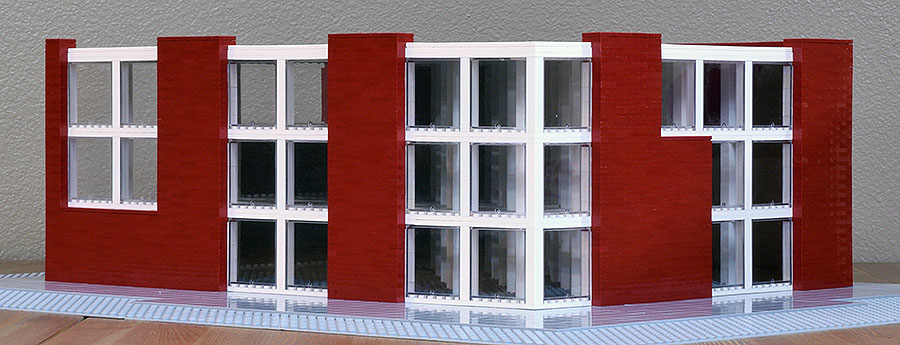
Brutalism meets industrial revolution grace—another design for a community center to replace the Central Hotel in the St. Johns neighborhood of Portland. This version has the same program as my previous designs, a black box theater and museum/art exhibition space on the the first floor and classrooms on the second and third. See my previous post Centering a Town: St. Johns/First Efforts for background, site, plans, and concept, along with links to resources and my other rough designs. As always with my models, adjust proportions and imagine detailing, especially in the windows.

Continue reading

Centering a Town: 3rd. Effort

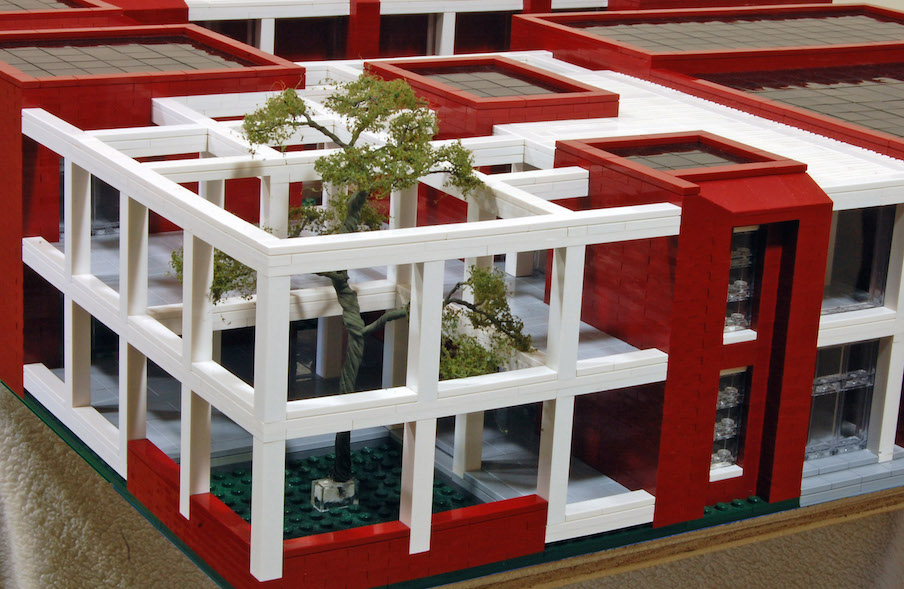
This is a variation on the two versions of a possible replacement for the Central Hotel in the St. Johns neighborhood of Portland, reviewed in my earlier entry Centering a Town: St. Johns/First Efforts. That post sets the location, has rough floor plans and program, and explains the concepts behind the design. Above, the front corner view, at Philadelphia and Lombard, looking out on the plaza. In this version the grid is more exposed and fully exposed at the corner, distinguishing its intersection there as a corner, announcing its openness and signaling entry. Also see Site: St. Johns, Portland for maps and pictures of the area.

As in the previous versions, I’m limited by what scale, 1/60, and the plastic pieces allow me to do. Proportions need fine tuning and the elements of the grid should be thinner. And again, they could be painted the color of the St. Johns Bridge or made of timber, unpainted to show the colors of the wood.

Continue reading

Centering a Town: St. Johns/First Efforts

A mixture of uses, if it is to be sufficiently complex to sustain city safety, public contact and cross-use, needs an enormous diversity of ingredients. So the first question—and I think by far the most important question—about planning cities is this: How can cities generate enough mixture among uses—enough diversity—throughout enough of their territories, to sustain their own civilization?

Jane Jacobs, The Death and Life of Great American Cities

Site

The Central Hotel in St. Johns used to be, in fact, a three-story hotel, constructed around the end of the 1800s. A fire in the 1920s destroyed the upper floors, and the building has undergone a series of renovations and uses over the years resulting in its current form. The style grows on you.

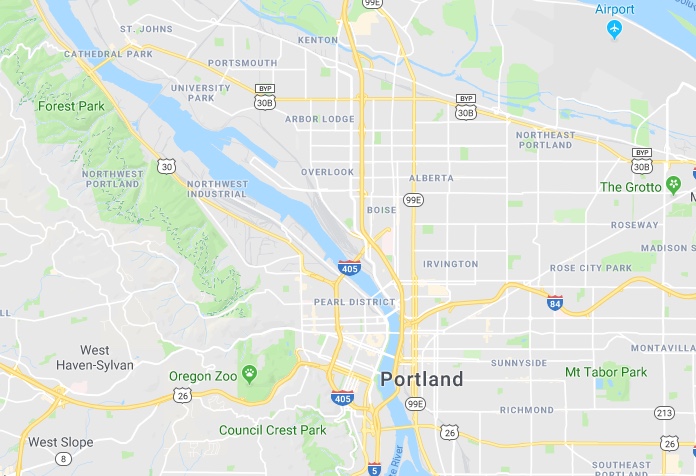
St. Johns was once a separate city, incorporated into Portland a century ago, and the neighborhood still looks like and functions as a small town, with considerable diversity of small commercial concerns. The Central Hotel is located in its heart, on the corner of Lombard, the neighborhood’s main street, and Philadelphia, which leads a few blocks away to the St. Johns Bridge. There is a sizable plaza surrounding, and over the years the site has provided the locus of much activity. The St. Johns Parade has passed by for over half a century, and festivals and an open air market have their home there. Bobby Kennedy once spoke before one of the hotel’s incarnations to a crowd in the 1968 presidential campaign.

The intersection is a central place, and a building there could be a point of focus, of gathering, of identity and definition, one that reflects and interacts with the rest of the neighborhood. Now, however, the Central Hotel lies vacant and represents only indecision and decay.

Continue reading

Cultural Center

1

This is a revision of the writing center, whose design ideas I explain below. I kept the front parts of the building but changed the back. Again, its general purpose is to provide a variety of rooms to support the arts in a community—classrooms, studios, a gallery, a screening room, lecture rooms, with possibilities for administrative and still other uses along with space for informal gathering.

Really, such a project provides an opportunity to test out several ideas beyond commercial or residential uses and gives a chance to explore, my main interest. My general design principle is to combine various styles without attempting to integrate them, yet still keeping a sense of a whole. Here you see Greek Revival, with the split temple front and odd use of columns, a restrained postmodern glance. Other parts of the building I suppose are slightly gothic, along with modernist presences—glass walls, geometric solids in the brick walls, and the open grid at the back, absorbed into the rest of the building. I had Sol LeWitt’s cubes in mind with the grid but have just discovered Peter Eisenman’s Wexner Center for the Arts that does something similar. I repeat here, however, my reservations about art centers that call too much attention to themselves, perhaps at the expense of the functions they contain. This is still a modest attempt, even self-effacing.

Click on all images to enlarge.

Continue reading