Centering a Town: 3rd. Effort

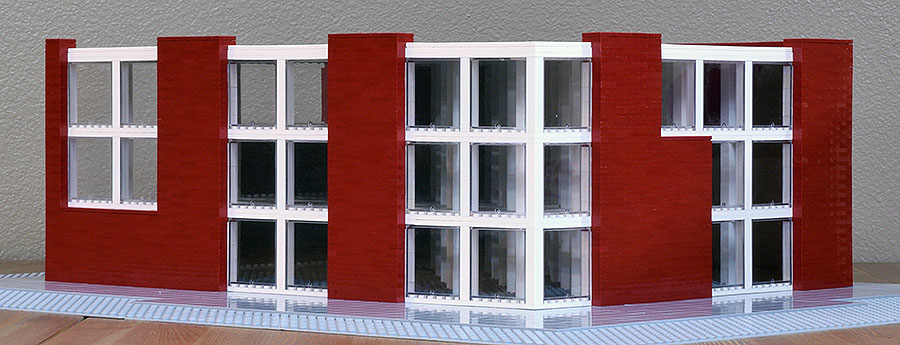
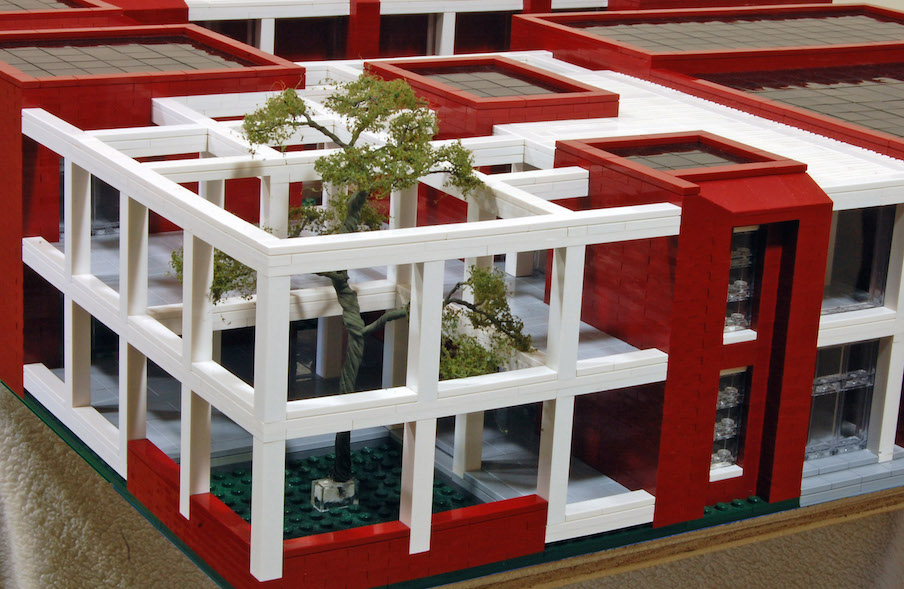
This is a variation on the two versions of a possible replacement for the Central Hotel in the St. Johns neighborhood of Portland, reviewed in my earlier entry Centering a Town: St. Johns/First Efforts. That post sets the location, has rough floor plans and program, and explains the concepts behind the design. Above, the front corner view, at Philadelphia and Lombard, looking out on the plaza. In this version the grid is more exposed and fully exposed at the corner, distinguishing its intersection there as a corner, announcing its openness and signaling entry. Also see Site: St. Johns, Portland for maps and pictures of the area.

As in the previous versions, I’m limited by what scale, 1/60, and the plastic pieces allow me to do. Proportions need fine tuning and the elements of the grid should be thinner. And again, they could be painted the color of the St. Johns Bridge or made of timber, unpainted to show the colors of the wood.

Continue reading

Centering a Town: St. Johns/First Efforts

A mixture of uses, if it is to be sufficiently complex to sustain city safety, public contact and cross-use, needs an enormous diversity of ingredients. So the first question—and I think by far the most important question—about planning cities is this: How can cities generate enough mixture among uses—enough diversity—throughout enough of their territories, to sustain their own civilization?

Jane Jacobs, The Death and Life of Great American Cities

Site

The Central Hotel in St. Johns used to be, in fact, a three-story hotel, constructed around the end of the 1800s. A fire in the 1920s destroyed the upper floors, and the building has undergone a series of renovations and uses over the years resulting in its current form. The style grows on you.

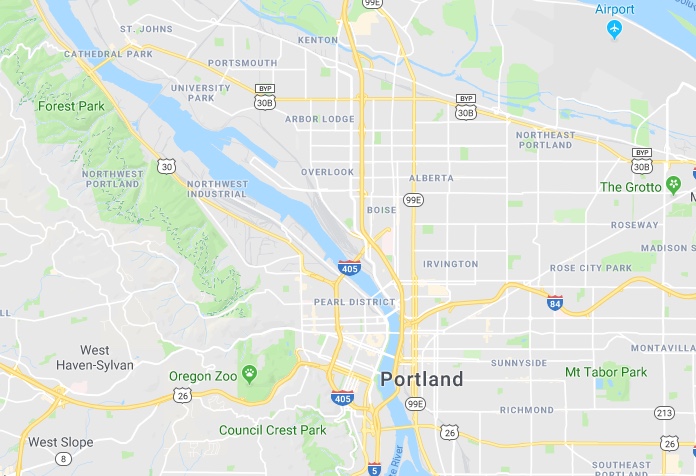
St. Johns was once a separate city, incorporated into Portland a century ago, and the neighborhood still looks like and functions as a small town, with considerable diversity of small commercial concerns. The Central Hotel is located in its heart, on the corner of Lombard, the neighborhood’s main street, and Philadelphia, which leads a few blocks away to the St. Johns Bridge. There is a sizable plaza surrounding, and over the years the site has provided the locus of much activity. The St. Johns Parade has passed by for over half a century, and festivals and an open air market have their home there. Bobby Kennedy once spoke before one of the hotel’s incarnations to a crowd in the 1968 presidential campaign.

The intersection is a central place, and a building there could be a point of focus, of gathering, of identity and definition, one that reflects and interacts with the rest of the neighborhood. Now, however, the Central Hotel lies vacant and represents only indecision and decay.

Continue reading

House II

Building a model offers a way to experience the physical presence of a work of architecture close hand, over time, to examine its structure, the relationship of its parts, as well as engage in the practice and ritual of construction. It also provides a platform to contemplate structures and relationships in general, what might be suggested analogically, what might be applied elsewhere.

I had no particular reason for choosing Peter Eisenman’s House II, but once I started I became wholly engaged in the process of understanding, planning, and building, and tearing down and revising and rebuilding, and with the construction and destruction came a host of thoughts that hovered but landed nowhere, returning me only to House II, its structure, the relationship of its parts, which sent me flying into thought once again.

Eisenman, in fact, intended his project to look like a model:

Built of plywood, veneer, and paint, it lacks traditional details associated with conventional houses. Viewed without the external, scale-specific referent, House II becomes an ambiguous object, which could be a building or a model.

From the PDF linked on his site. The effect is less apparent in my model. This ambiguity makes us aware of the process of design and construction, of process itself, leaving us with questions that can be answered in several ways—or can’t be answered at all. We can look forward and contemplate the final project, brought to completion and perfection. Just as much we realize neither will ever come, that finality was not the goal. Ambiguity most characterizes the house, and we have to contend with the tentative, the provisional. Perhaps we are left with the realization that perfection itself is an illusion, or if apparently obtained elsewhere has questionable value and reference.

Then we have to decide what to make of Eisenman’s comment:

The “real architecture” only exists in the drawings. The “real building” exists outside the drawings. The difference here is that “architecture” and “building” are not the same.

And think where we’re left when we take all the terms out of quotation.

Continue reading

Heart of Darkness

hodcloseup

I’ve wanted to make a city in Legos, or a section of one, and this is a first effort. But it is an architectural model of a novel, Joseph Conrad’s Heart of Darkness. The project was inspired by Matteo Pericoli’s work in his Laboratory of Literary Architecture. The model tries to capture the transparency and corruption of the western world in Africa at the time of the novel, in a city-like form. Matteo’s laboratory and my project are explained in full at Numéro Cinq here.

hod6

I started with a 10 inch base and divided it into a grid of 6×6 streets for 36 blocks, and took it from there.

Continue reading

Pruitt-Igoe/Housing for the Rest of Us

PI1 blog

Building a model of a building you are planning to destroy and that has caused so much controversy is an odd and sobering project. The hours spent building it gave me time to contemplate an essay I was writing, “Housing for the Rest of Us, A Non-Manifesto,” which can be found here. I revisit Pruitt-Igoe to take on issues of housing, many still relevant today, as revealed in these two graphs.

Income Disparity

us_home_prices_vs_rents

Opening paragraph:

It is Minoru Yamasaki’s misfortune that the two works he is best known for, the World Trade Center and the Pruitt-Igoe public housing complex, are best known for their collapse. The World Trade Center, or its site, has attained the status of a shrine, so reflection upon its design and influence will have to be postponed for another time. Postmodern apologist Charles Jencks hailed the demolition of Pruitt-Igoe as the death—prematurely—of Modernism, and critical smoke from that debate still lingers. In both cases, however, the major factors that led to their destruction came from structural tensions outside the buildings, not within, from design flaws in the larger world. And many of the same forces that shaped Pruitt-Igoe, social and economic, direct the design of homes for most of us today and determine where we live and how well.

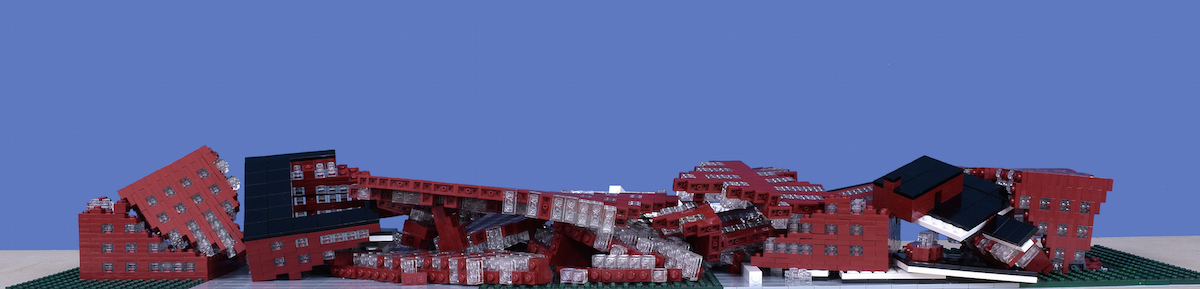
Unfortunately, I built it too well. The model was difficult to demolish, and I couldn’t simulate accurately the pictures we have come to know so well. More pictures of the model and the actual photographs come after the break.

PI2 blog

******

PI3 blog

*****

PI4 blog

*****

PI 5 blog

*****

Continue reading

Mies van der Rohe: The Brick Villa

1

For Mies, architecture was neither a technical problem nor applied sociology but rather, as he wrote in 1928, using words that are as ambiguous as they are emphatic, “the spatial implementation of intellectual decisions.”

—Christoph Asendorf, “Ludwig Mies van der Rohe—Dessau, Berlin, Chicago”

The full essay, “Completing the Mies van der Rohe Brick Country House, An Odyssey” can be found at Numéro Cinq here. It is a literary essay that I hope adds some extension and insight. It looks back to the Greeks and forward to recent architecture, adding reflections on Modernism and raising questions about current work along the way.

This is my first attempt. Pictures of the model can be found after the break. For more recent models, go here.

Continue reading

The Bauhaus: S/M/L

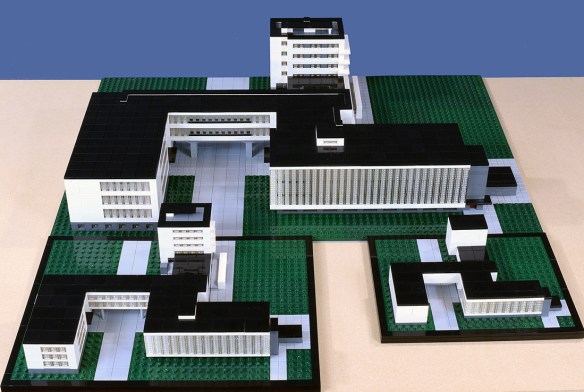
AllThree2b

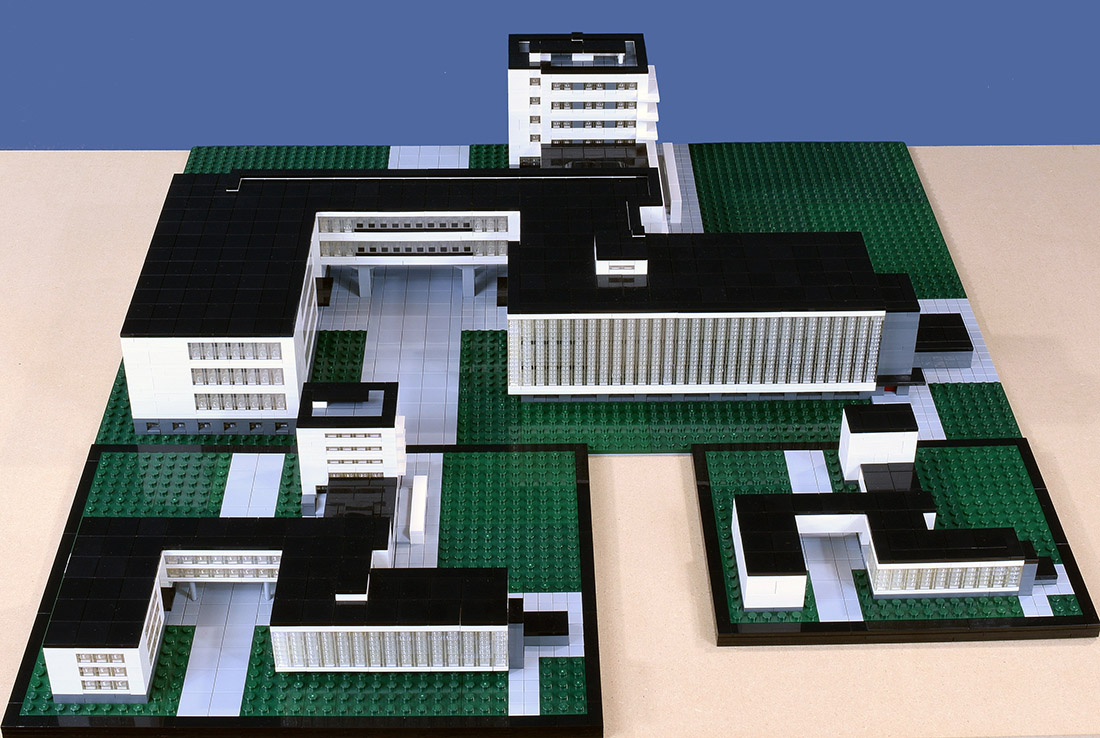
Click on all images to enlarge

A few quick thoughts

Johannes Itten, one of the early instructors of the preliminary course at the Bauhaus, who was influenced by diverse spiritual leanings, some esoteric, built his rules of form around these assumptions:

Square: calm, death, black, dark, red;
Triangle: intensity, life, white, bright, yellow;
Circle: infinite symmetry, peaceful, always blue.

It is impossible to know what to make of such a theory. It cannot be grounded in the actual world or fit in any scheme, rational or spiritual, and contradicts the esthetic evidence of art before and after. And yet anyone who knows the theory will see work that follows such rules charged with significance, that it has a presence that, while difficult to pin down, is complete and undeniable. Even if the rules aren’t known, a viewer will still find the work to have a coherence that is more than formal, that it is suffused with—something.

Similarly, Walter Gropius, in the manifesto he wrote when he created the Bauhaus school, concludes:

So let us therefore create a new guild of craftsmen, free of the divisive class pretensions that endeavoured to raise a prideful barrier between craftsmen and artists! Let us strive for, conceive and create the new building of the future that will unite every discipline, architecture and sculpture and painting, and which will one day rise heavenwards from the million hands of craftsmen as a clear symbol of a new belief to come.

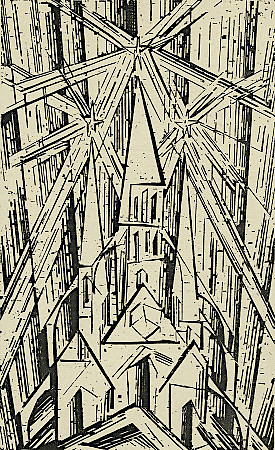
The manifesto was published in a pamphlet, and to reinforce the heavenward aspirations Lyonel Feininger’s woodcut Cathedral was placed on the cover, a black and white image, expressionist and cubist, of a seemingly transparent church placed within a dynamic of lines of light and other buildings that rise upward to a point, above the spire. Gropius’ desire was to create work that brought art, industry, and society together in some meaningful form, this at a time the western world, especially Germany, was recovering from the mass destruction of World War I and suffering economic distress and political upheaval.

CourtDetailb

Continue reading

Cultural Center

1

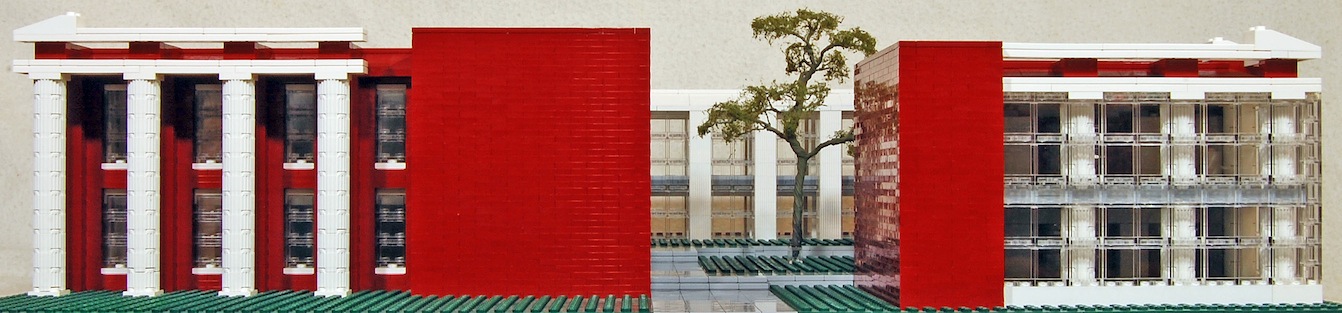
This is a revision of the writing center, whose design ideas I explain below. I kept the front parts of the building but changed the back. Again, its general purpose is to provide a variety of rooms to support the arts in a community—classrooms, studios, a gallery, a screening room, lecture rooms, with possibilities for administrative and still other uses along with space for informal gathering.

Really, such a project provides an opportunity to test out several ideas beyond commercial or residential uses and gives a chance to explore, my main interest. My general design principle is to combine various styles without attempting to integrate them, yet still keeping a sense of a whole. Here you see Greek Revival, with the split temple front and odd use of columns, a restrained postmodern glance. Other parts of the building I suppose are slightly gothic, along with modernist presences—glass walls, geometric solids in the brick walls, and the open grid at the back, absorbed into the rest of the building. I had Sol LeWitt’s cubes in mind with the grid but have just discovered Peter Eisenman’s Wexner Center for the Arts that does something similar. I repeat here, however, my reservations about art centers that call too much attention to themselves, perhaps at the expense of the functions they contain. This is still a modest attempt, even self-effacing.

Click on all images to enlarge.

Continue reading

Second Construction: Writing Center

 (click on all images to enlarge)

.

To chart a place on earth—that is the supreme effort of the built environment in antiquity. Shelter, of course, always takes precedence. But its issue transcends self-preservation and comfort. Shelter engages human alliances and rank, and so it becomes the task of residential architecture to advance the pattern of collective existence. From family to empire, the stages of social and political gradation affect the scope and intricacy of this extendable pattern. But in the end organization only tidies up; it cannot satisfy darker anxieties of being afloat in a mysterious design which is not of our own making. To mediate between cosmos and polity, to give shape to fear and exorcize it, to effect a reconciliation of knowledge and the unknowable—that was the charge of ancient architecture.

It is a charge that is no longer pressing, that no longer has meaning. Geomancy had no place in the laying out of New York or Teheran; Buckingham Palace was not planned to be the pivot of the cosmic universe. At some point we chose to keep our own counsel, to search for self close at home.

from Spiro Kostof, A History of Architecture

Continue reading