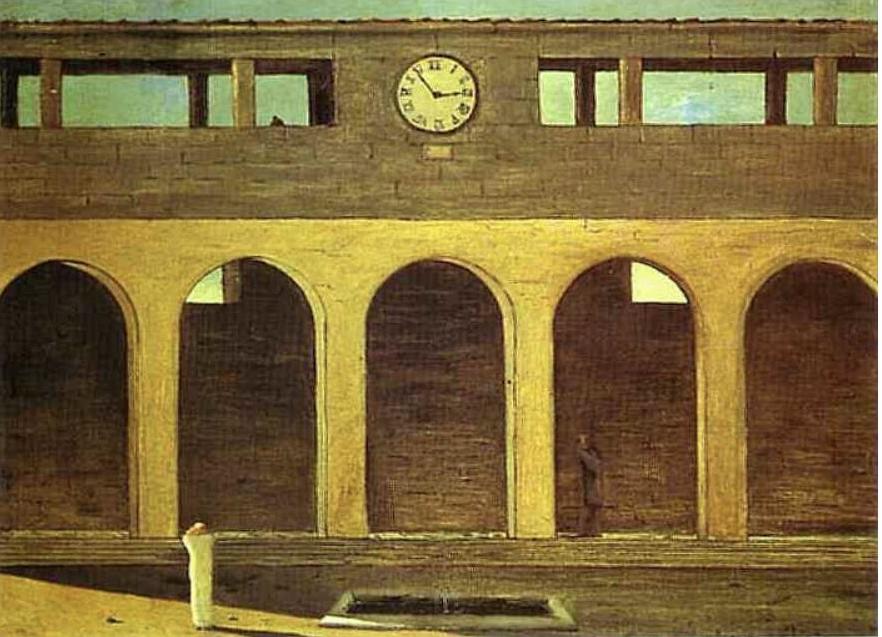
I have this memory, stronger in impression than detail, of hiking somewhere, likely in the Appalachians, after hours, after days of winding along the thread of a trail, the only human intervention, negotiating endurance and fatigue, working to find a rhythm through thick growth on either side beneath a cover of trees that blocked further sight, rising, descending on switchbacks along a ridge, only occasionally reaching a clearing where I could look out and see the rolling hills, mountains that stretched endlessly only to lose sight again at the next turn, rising, descending again, losing in the rhythm of climbing, in the motion of my thoughts any thought of destination that night, of any clear direction, of any ambition, of any larger self, instead absorbing the presence around me, indeterminate from my point of view but which had its own determination, its own motions, slower, imperceptible, a timeline that diminished me—I came upon in a clearing a stone building, or brick, its windows open, its roof gone but otherwise intact, likely a house, but its function was uncertain now, its use transcended by years of abandon, or made irrelevant, and I stopped and felt a shift, was moved to some understanding that had the force of revelation but not its speed, was profound but without depth, without extension, yet that still took me to a broader reflection that has stayed with me ever since. This was some fifty years ago.
Danish artist Per Kirkeby, who studied geology in college, talks of his experience on a field trip in southern Sweden where the class explored a stone quarry, then passed a Romanesque church nearby, isolated, abandoned, in decline.
The structure built by nature had been uncovered by people; the church built by men, however, had been gradually taken over by nature. As time went on. Where is the border between one and the other way to organize matter? For a brief moment I saw geology as a world view.
In a glimpse I saw geology as a philosophy, a vision extending far beyond any technocratic discipline. A huge stream of energy and materials, which now and then converges in crystalline structures, a mountain, a church, a brief moment, a breath, a morning mist over the ever-flowing river. The mountain-building energies were no less cultural than the energies of the church-builders. I saw the geologist’s curiosity, could not stop at the mountain and before the church. It was a dizzying feeling.
Revealed, a different way not just of seeing himself in the world, but living in it. Yet he only had a glimpse, and when he returned home he realized his reaction was just that, a feeling and not an insight. In what sense are the forces that made mountains cultural? Where is the border between the energies that built churches and those that build mountains? What is their relationship? Where is insight, what to make of feeling? He doesn’t answer, only raises the questions. The experience influenced his later art, where he raises them again, resisting answers, yet, viewing his work we feel a shift, perhaps wonder what kinds of answers we expect.
Continue reading →