Classical order has been with us for millennia in one form or another, exerting extensive cultural influence on our lives. Our language itself is built to great extent on Greek and Latin roots. As an order it is not just a style but a system of controlling space and relationships within that space, having its own language and references, that, by extension, regulates our place within that space, our relationship with the powers who deploy it, with each other, even shapes our ways of thinking about space itself. The order has also proliferated in diluted interpretations that at best are merely sentimental as well as been distorted to create monsters.
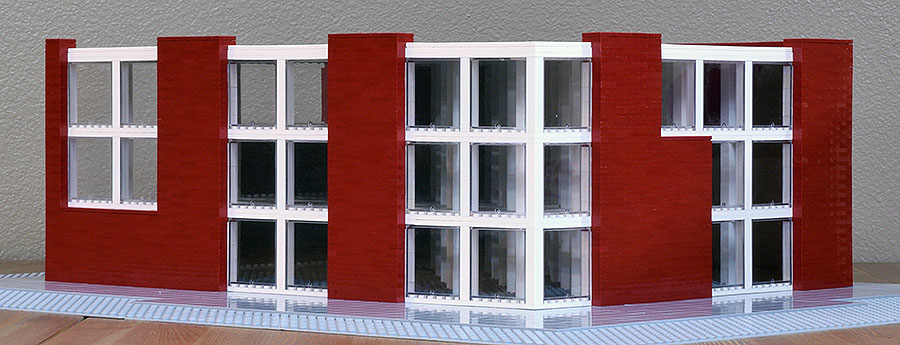
But it is the order of demos as well as empire. In the United States, since its early history, various classical revivals have been used not only to structure the growth of political institutions and represent their power but also to build independent homes, schools, churches, and civic buildings, large and small, giving them presence, balance, and ceremony. These contain and support the American spirit, housing its energies and contradictions. They are a vital part of our heritage. White columns and accents are often combined with red brick walls, and I have always found the contrast attractive. The brick gives the mass of the buildings body and texture, bringing them down to earth literally, touching our substance figuratively.
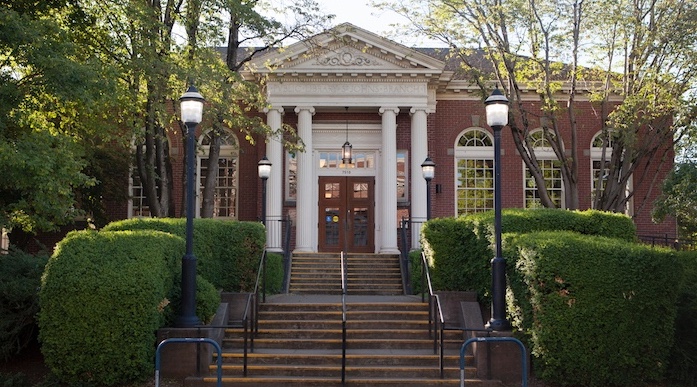
St. Johns has several such buildings, including its branch of the Multnomah County Library, above, picture via its site. Built over a hundred years ago, the library is a modest building that has stood up well and continues to contribute to the heterogeneous complexion of the neighborhood. For this effort I wanted to give bricks and columns a shot in another version of my mixed-use community center project, one that references those buildings as well as distinguishes itself as a place of significance yet remains on our level. See my first post Centering a Town: St. Johns/First Efforts for site, plan, and program.
Modern construction technology rendered columns obsolete; modernist reactions relegated them to archaism; postmodernism only referred to them with irony and whimsy. Yet none of those have given us a common language full enough to express our desires and complexities. The first two have cut us off from our past, the last trivialized it. I wondered if there weren’t some way to reinterpret classical order for a building that might still speak to us now. This won’t be it—I’m just experimenting.