Cultural Center

1

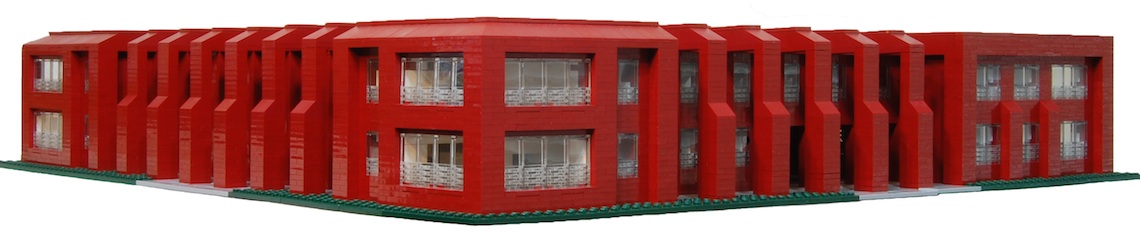
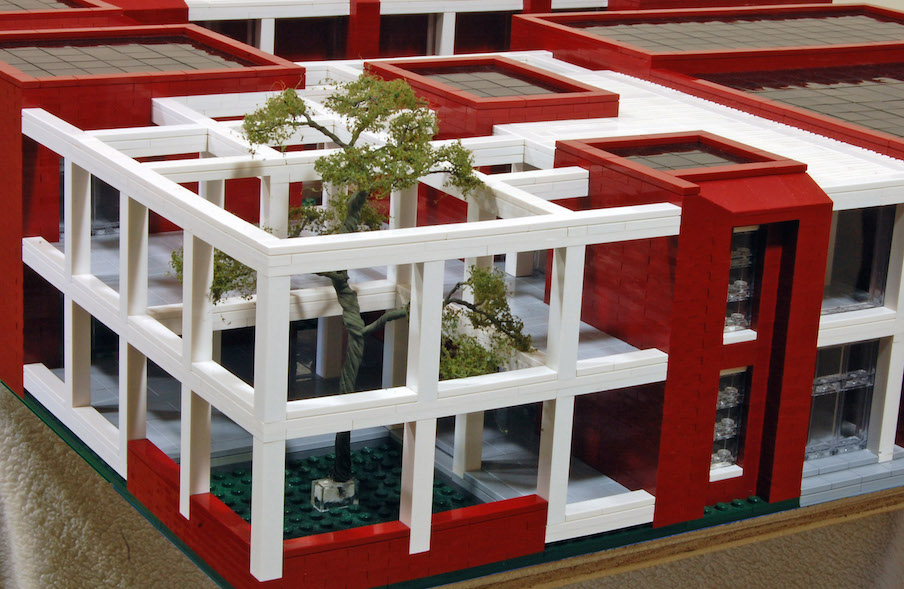
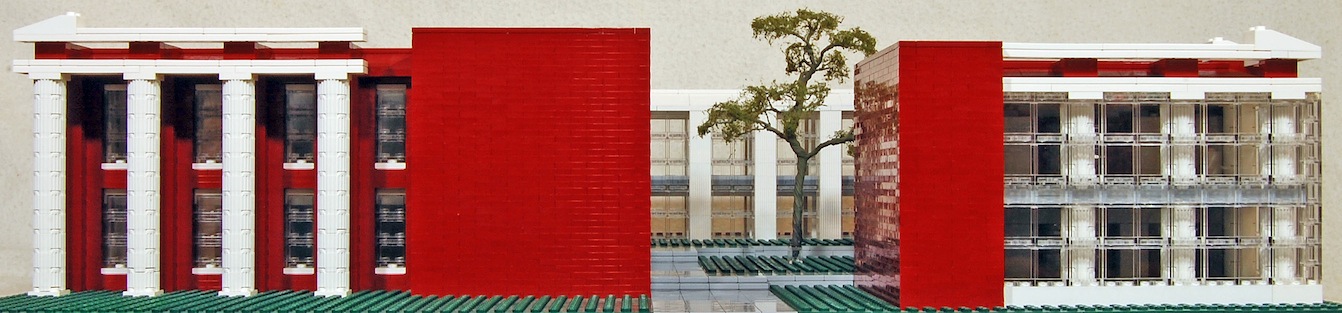
This is a revision of the writing center, whose design ideas I explain below. I kept the front parts of the building but changed the back. Again, its general purpose is to provide a variety of rooms to support the arts in a community—classrooms, studios, a gallery, a screening room, lecture rooms, with possibilities for administrative and still other uses along with space for informal gathering.

Really, such a project provides an opportunity to test out several ideas beyond commercial or residential uses and gives a chance to explore, my main interest. My general design principle is to combine various styles without attempting to integrate them, yet still keeping a sense of a whole. Here you see Greek Revival, with the split temple front and odd use of columns, a restrained postmodern glance. Other parts of the building I suppose are slightly gothic, along with modernist presences—glass walls, geometric solids in the brick walls, and the open grid at the back, absorbed into the rest of the building. I had Sol LeWitt’s cubes in mind with the grid but have just discovered Peter Eisenman’s Wexner Center for the Arts that does something similar. I repeat here, however, my reservations about art centers that call too much attention to themselves, perhaps at the expense of the functions they contain. This is still a modest attempt, even self-effacing.

Click on all images to enlarge.
Continue reading

Second Construction: Writing Center

 (click on all images to enlarge)

.

To chart a place on earth—that is the supreme effort of the built environment in antiquity. Shelter, of course, always takes precedence. But its issue transcends self-preservation and comfort. Shelter engages human alliances and rank, and so it becomes the task of residential architecture to advance the pattern of collective existence. From family to empire, the stages of social and political gradation affect the scope and intricacy of this extendable pattern. But in the end organization only tidies up; it cannot satisfy darker anxieties of being afloat in a mysterious design which is not of our own making. To mediate between cosmos and polity, to give shape to fear and exorcize it, to effect a reconciliation of knowledge and the unknowable—that was the charge of ancient architecture.

It is a charge that is no longer pressing, that no longer has meaning. Geomancy had no place in the laying out of New York or Teheran; Buckingham Palace was not planned to be the pivot of the cosmic universe. At some point we chose to keep our own counsel, to search for self close at home.

from Spiro Kostof, A History of Architecture

Continue reading

First Construction: A Multiple Use College Center

.

Ritual is the transcendence of function to the level of a meaningful act.

Public architecture at its best aspires to be just this: a setting for ritual that makes of each user, for a brief moment, a larger person than he or she is in daily life, filling each one with the pride of belonging.

Spiro Kostof, A History of Architecture

.

Preliminary

I have taught college English for over thirty years at eight different schools. Add my own education and most of my life has been spent in an educational institution of some sort. With the schools’ programs comes their architecture, their buildings, their classrooms, the designs and functions of those. Little has left a lasting impression and most has diminished what should be a memorable experience.

Most schools where I’ve taught have been places of division and isolation, both physically and psychologically. There are few places for informal gathering, while departmental and administrative conflicts make interchange difficult. Disciplines and governance are kept separate without meaningful integration, even without casual personal contact. Their architecture itself often exerts mass control, based on hierarchies that lack vital priorities, on a process divorced from real purpose. Their design is simplistic and standardized, if not sterile. Everything looks the same, making a walk across campus monotonous.

So I thought I’d try to design my own school. This is a conceptual study, really a diversion, and a great many details have not been worked out. One consideration that needs to be made in any effort to start afresh is why good ideas often go wrong, and mine may well prove to be no exception. Any plan must not only be grounded in a substantial set of ideas but also tested by extensive use and practice.

Continue reading