Mies van der Rohe: Meditations on a Plan

Mies conceived of building as arising out of a field of tension that consisted of intrinsic lawfulness on one hand and creative freedom on the other. It should afford the “required privacy combined with the freedom of open room forms” and provide a “defining” but not a “confining space” suitable for contemporary living. Behind this concept of space and architecture that defined “building” in a philosophical sense as a “giving form to reality” stood for Mies the question of the “value and dignity of human existence,” namely: “Is the world as it presents itself bearable for man? . . . . Can it be shaped so as to be worthwhile to live in?”

Neumeyer

For decades I have been moved by Mies van der Rohe’s Brick Country House without knowing why. Not knowing why may be a large part of the attraction, along with a sense of release when I look again at the drawings, also without knowing why, or where, but without feeling I have left the ground. But it is open and direct about what it is, factual, honest, as Mies would have it. This honesty may be its greatest strength, its largest mystery.

Continue reading

Barcelona Pavilion: Plan I

I got curious. I ran across an early plan for Mies van der Rohe’s Barcelona Pavilion and wondered what it might look like in three dimensions, thus this model. I entered the project with expectations of discovering a trace of some buried idea unknown to us all these years that, once unearthed, might lead to full structural understanding of the Pavilion as built, to larger insight into the mind of Mies, revelation into the mind of architecture, the mind of the world itself, all of which, of course, is absurd.

We do that too much, think we need to look beneath the surface and raise what most of us cannot see and fit it into some critical structure within which we should align ourselves, without which we cannot understand ourselves and move forward.

Really, the differences between the plan and the final construction are not great. Then again, I make this tentative conclusion, that our salvation depends on attention to small things, to what lies obvious before us, once seen clearly, felt within, once absorbed. Mies said similar. More tentatively, I suggest there are no great revelations and we need to find ways to manage that fact, which the Pavilion does marvelously.

The evidence for the process of planning and construction, about a year, up to its opening at the Barcelona exposition in 1929, is sketchy. Models, drawings, and notes were lost or discarded; Allied bombing destroyed official German records of the exhibition. Some of Mies’s own recollections decades later do not fit the available evidence, and the plan Werner Blaser used in his seminal monograph, Mies Van Der Rohe: The Art of Structure, 1965, created around that time in Mies’s Chicago studio, is inaccurate in several key aspects. A few original sketches have survived, however, along with three floor plans perhaps in sequence that bear the German workshop’s stamp. These give close attention to layout and proportions, of which the above is the first. Along with them, a final plan, created after 1929, widely circulated, its accuracy later questioned as well. And once the exhibition was over, the Pavilion was demolished and scrapped for parts. I take Plan I—Wolf Tegethoff’s designation—and almost all factual information from his careful and thorough study in Mies van der Rohe: The Villas and Country Houses.

Continue reading

Winged Victory: The Larkin Building

She takes our breath even as she lifts our spirits, Winged Victory, Niké of Samothrace, once a votive offering to now defunct gods, a memorial, perhaps, to a battle won long ago, long since forgotten. Or rather not all of her, not the full statue, but the assembled fragments we know and have known for well over a century, who still moves us and takes us to the point of flight, our imaginations, our spirit propelled by her incompletion, by what is missing, by what might yet lie beyond.

THOUGHT
FEELING
ACTION

Frank Lloyd Wright’s Larkin Building, solid, firmly anchored yet energetic in its interlocking masses, raises us in a different way, taking us back a century ago to past enterprise, memories left behind, to values of another time, maxims designed to fortify our character and lift our spirits.

SIMPLICITY
TENACITY
STABILITY

But this corner wall is all that remains of the building today, and it had to be rebuilt.

More coming. . . .

Continue reading

Louis Kahn: First Unitarian Church/Ineffable Space

Alberti is explicit about the character of the ideal church. It should be the noblest ornament of a city and its beauty should surpass imagination. It is this staggering beauty which awakens sublime sensations and arouses piety in the people. It has a purifying effect and produces the state of innocence which is pleasing to God.

Wittkower

For the struggle to express the inexpressible—to create what Le Corbusier called, in reference to his great chapel at Ronchamp, France, “ineffable space”—is one that has yielded few successful results in our time or in any other. The extraordinary balance between the rational and the irrational that characterizes Ronchamp, or Frank Lloyd Wright’s Unity Temple in Oak Park, Ill., or Louis Kahn’s Unitarian Church in Rochester, N.Y., or Bernard Maybeck’s Christian Science Church in Berkeley, Calif., to name four of the greatest religious structures of this century, is not something that can be made by formula, and it is not something that can be dictated by style.

Paul Goldberger

Continue reading

Barcelona Pavilion, Meditations

The fact that here for the first time the Weimar Republic was given an opportunity to present itself outside its own borders as an equal partner within the community of nations explains the ambitious expectation officially accorded the project. Ten years after the end of the war the image of Germany as a presumptuously conservative state characterized by self-glorifying illusions of empire and a pathetic reverence for its Kaiser was still widespread abroad. The young democracy wished to counter this with a restrained expression of its progressiveness and distinctly international orientation. The government sought a new means of expression, untainted by historical allusions.

Tegethoff

That project was Mies van der Rohe’s pavilion for the Barcelona International Exposition, 1929, designed to put a new face on Germany, give an open look on the world.

can only guess how visitors might have received the Mies construction, the pavilion set off to the side of the ceremonial main axis of the fair, away from the rising pomp and elaboration of the other buildings, their articulation of past traditions, of local variations, those bearing assumptions that had conditioned the attendees’ vision all their lives.

Asymmetric, low lying, simple, close to nothing, really; surrounded by, placed within, beneath, not commanding the life ascending the hill behind; its roofs flat, not pitched, quiet planes suspended beneath an expanding sky—maybe it startled, perhaps it shocked, likely it perplexed. Yet the pavilion has completeness and composure, and its overall aspect is serene. And there is nothing difficult about the Barcelona Pavilion. Rather it goes against assumptions whose difficulty has been attenuated by use, by forgetting, by repression. It challenges more with what it is not as with what it is, raising questions about past assumptions, about what assumptions might take their place.

Continue reading

Battersea Power Station/The Wretched Boar

The wretched, bloody, and usurping boar,
That spoiled your summer fields and fruitful vines,
Swills your warm blood like wash, and makes his trough
In your embowelled bosoms—this foul swine
Is now even in the center of this isle

Richmond advances on Richard’s forces and reports the damage done, the boar King Richard III’s heraldic emblem. These lines were invoked after the election of our previous president.

In the 1995 movie version of Shakespeare’s play, the final battle is fought at the remains of Battersea Power Station, London. The movie, smart, engaging, rather flip, is set in thrityish fascist times, with anachronisms, but in manner and manners feels contemporary to our times—and is too familiar. As I write this, Ukraine battles Putin’s forces laying waste to its land.

At home, just over a year ago, this building was the setting for another siege.

Continue reading

Metropolitan Storage Warehouse/3rd Transformation: A-B-C-D-E

We have little expectation of a warehouse other than it serve its intended purpose. When we get something extra—surface texture, a distinctive style, embellishment—either we are rewarded with an unexpected bonus for the eye, to the mind, a distinguishing mark in context, signs in history—or see standing in relief an attention that is unnecessary, out of joint, and insignificant before the largeness of the structure, meaningless against the bareness of its function. When the warehouse ceases to be a place of storage, we are left with those stranded efforts, a huge mass, and the vast, empty space within of halted function. One set of unanswered questions has been dropped to open up other sets with more questions, no more likely to be answered. Here there is potential that cannot be contained by structure or defined by style.

Continue reading

Metropolitan Storage Warehouse Revisited

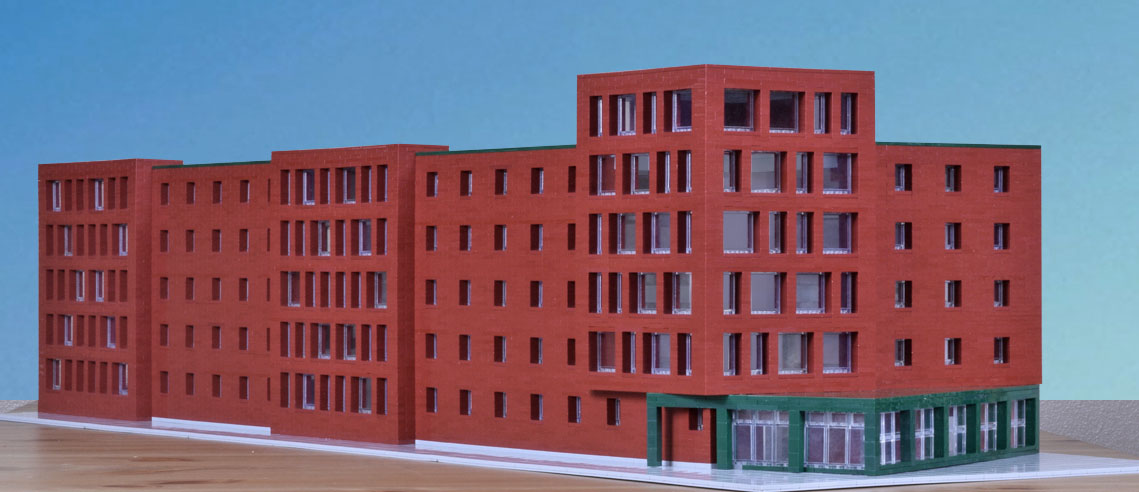
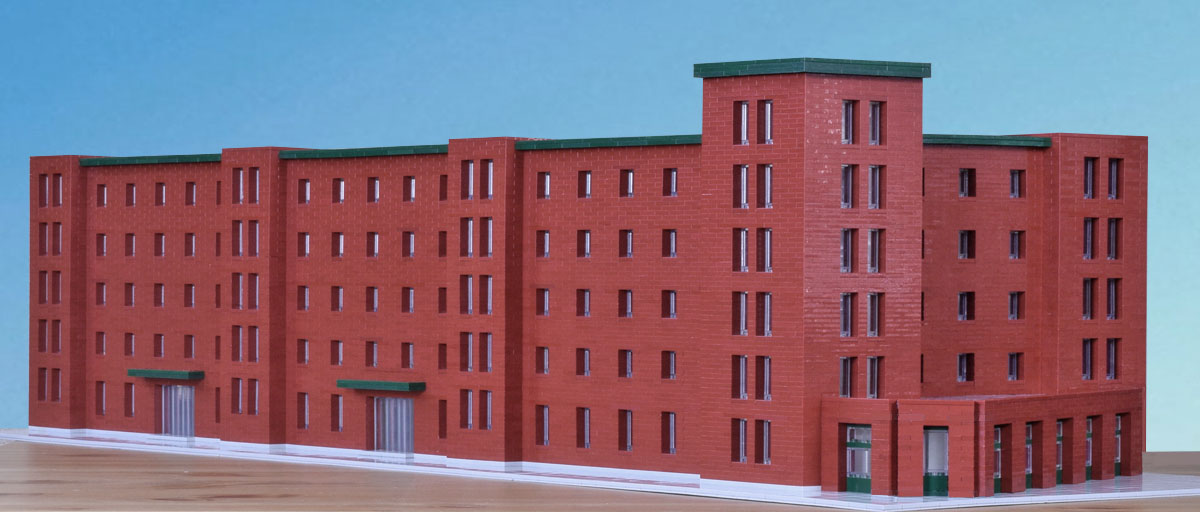
Another tribute to the Metropolitan Storage Warehouse in Cambridge, discussed in the previous post. Again, my interest is not to suggest a possible renovation or provide an alternative, but rather to experiment with its basic forms and work within an approximation of its site and program. And once more it is designed to provide a home to public or creative efforts—say an architecture department. I wanted a basic building that has some interest but, like the warehouse, appears rough and incomplete, that might invite completion, exploration, or reaction—as I argue for the warehouse in that post—and that doesn’t try to upstage or direct the work inside.

There is no substitute for the real thing. Age, wear, the historical style, the odd embellishments, the imperfections, the rough mass of the original—these cannot be reproduced in a model or an actual construction. Ensamble proposed a renovation that respects the integrity of the exterior of the original building while adapting the interior for the needs of the MIT SA+P. Their proposal can be found here.

Continue reading

Metropolitan Storage Warehouse: Fire Proof

I’m trying to imagine walking up Vassar Street alongside the Metropolitan Storage Warehouse, the minute or so that would take. Ahead, the corner tower a story higher; above, elaborate cornice work, reaching out, lifting up, dividing in crenelation. Further on, circular windows, arches, and stars of decoration. Beyond the tower, the main campus of MIT.

But the tower is distant, the embellishments high or few and faint. What I am most aware of from the ground is the continuing mass of brick pierced by small windows, its texture, its endless division, its warm color—the fact of brick itself, its presence, dominant for well over 500 feet.

Continue reading