Non-Monument #3

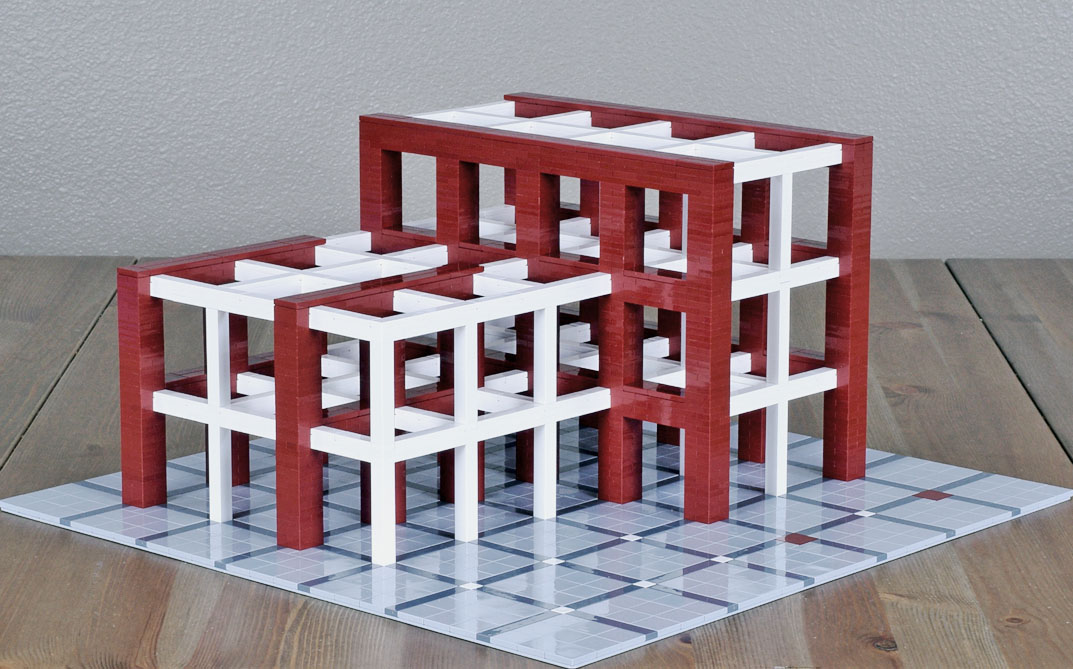
More a non-building than a non-monument that repeats the rational grid of many modern constructions, then separates the implied building into discrete parts. It is laid out on a 5 x 5 x 3 grid, positing a cube with sections missing.

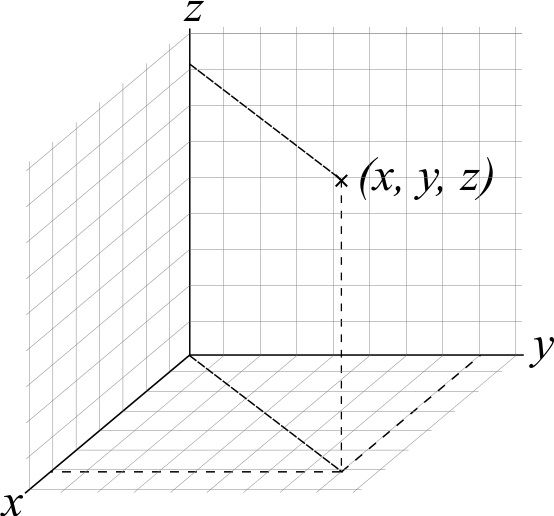
The Cartesian coordinate system is recalled, with all that might project, a way to map all space, thus the universe, or only a system of spacial points that refers only to itself and the math that defines it, thus encloses nothing.

Continue reading

Non-Monument #1

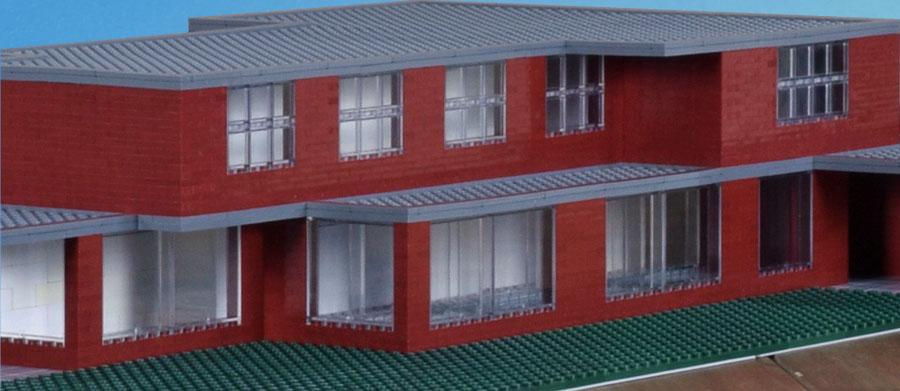
My first non-monument is loosely based on the type basilica. In Rome the basilica was a public building used to hold courts as well as serve other civic functions. It was located in the center, and every Roman town had one.

Basilica of Pompeii, 120 BCE. Later the basilica defined the construction of many early churches. The structure of secular administration passed on to sacred.

Fresco showing cross section of Constantine’s St. Peter’s Basilica, 4th century. I selected the type as a starting point for my first excursion because it is simple, basic, and structurally expressive. Also it has a past, and as such it figures historical precedence. It might encourage some public use, or at least promote the idea of such use and the notion of a public that has common interest. Or it might serve no purpose whatsoever and stand stranded at its site, in the present, in the course of history. Still, every built structure is an assertion of some sort, and, if it endures, serves as a reminder of time, of change, of memory. Most, it provides an alternative construction to the structures that now dominate our lives, overwhelmingly commercial and residential. We need ways, and expressions of those ways, to remind ourselves we live together, that something might exist beyond our daily functions, our individual interests, desires that are merely personal.

Continue reading

Mies van der Rohe/Haus Esters, early version, early vision; John Coltrane/Chasin’ the Trane

I wanted to make this house much more in glass. . . .

Mies is referring to Haus Lange, the companion villa at Krefeld, but the wish applies as much to Haus Esters, as evidenced in his early drawings. A photograph shows him working on pastel sketches of the garden and street facades, making final touches, maybe. My previous post has a model of the house as built, where you’ll find photographs for comparison, and I had it in mind while constructing this version.

Both pastels intrigue me no end, and I wanted to come to terms with them in this model. But I could only make rough guesses about placement and dimensions, and completing it was a matter of making uncertain choices, following them up, and finally stopping because I had no confidence alternatives would result in anything more correct or more convincing. There may be a point in that.

The garden face. Note the layout of the garden, an integral part of the design, raised, as in the version built. Time has taken its toll, but the drawing must have been faint in conception, in its realization, the image almost ethereal, scarcely more than receding perspective lines in a natural landscape beneath a vast, open sky. For the architect who valued structure and objectivity, it comes closer to pure spirit. Essentially, it is a horizontal presence, a restating of the horizon. From this presence the rest fades. It is a gesture, a glimpse into infinity, not a detailed working out of structure.

Continue reading

Mies van der Rohe: Krefeld/Haus Esters

Mies van der Rohe’s Haus Esters and Haus Lange, the Krefeld villas, conceived together and built adjacent, of similar design, were completed in 1930, early in his career. The drawings for the Brick Country House were exhibited some six years before; his Barcelona Pavilion was conceived about the same time as the villas and was constructed for the international exhibition in 1929. Contemporary with those more radical designs, the villas have endured an uneasy existence, at least in critical reception. Both have since been restored and converted to art museums, still active today. They have survived the ravages of the last century and stand in good shape.

Comparison might be made with Frank Lloyd Wright’s Robie House, built twenty years earlier, if only to reveal differences. Mies knew his work and likely was influenced. Both are long, brick, suburban homes built for clients of means. They sit low to the ground and emphasize the horizontal, and in doing so make us think of horizons and what horizons might imply. The Robie House, however, is an active play of horizontal planes, suspended, seemingly floating. Haus Esters, by contrast, is largely contained, reserved, and at first glance static. It lacks as well the dynamics of the open array of vertical planes in the Brick Country House and the Barcelona Pavilion. In abstracting the spirit of the industrial age, Mies left Haus Esters with a stark industrial cast. Isolated, without a sheltering roof, it looks exposed.

Continue reading

Centering a Town: 23rd. Effort/Homage to Mies (1/72 scale)

In the metopes below, eternal adversaries grappled in inextricable pairs: Lapiths and Centaurs, Greeks and Amazons, Greeks and Trojans along the north side in the direction of Troy, Giants and gods on the south. In many of the metopes the struggle was shown in mid-course: there was no victor, no vanquished. Warring opposites complemented each other in intricate, almost heraldic, groupings—and this is perhaps another essential aspect of the term Classical. It conjures aloofness, a sense of timeless idealism; but involvement, too, and violent involvement at that, is part of the Classical spirit.

Spiro Kostof, A History of Architecture

The drawings of Mies van der Rohe’s Brick Country House are nearly a century old. Reference to it in my “modern” design means that I’m following a tradition well in the past. His project implies that design, like life, is an active process, that the goal of architecture is to capture that understanding. It is Classical in the sense that we are aware of careful and thoughtful proportions, but also of proportions carefully shifted. And the design is Classical in the sense Kostof suggests, of competing stresses, contained but kept vital. Above, a metope from the Parthenon.

It is the challenge of contemporary architecture now, how to maintain yet enliven the modern tradition—it’s what we have—yet break away from the sterility of glass boxes and too well ordered grids. Too many solutions just push the box or attack it, without esthetic grounding, cultural context, or solid frame of reference, too often to excess. Mies’s design is reserved yet still fresh.

Continue reading

Centering a Town: 23rd. Effort/Homage to Mies van der Rohe’s Brick Country House

I first saw the drawings of Mies van der Rohe’s Brick Country House over forty years ago while in college, in H. H. Arnason’s History of Modern Art, a standard text on the subject at the time, the pictures illumined with only a few sentences of explication. First the three-dimensional drawing of a home spare yet engaged, complex yet composed, low lying yet forward looking—a lean, solid wedge opening out into the world and negotiating the earth and sky:

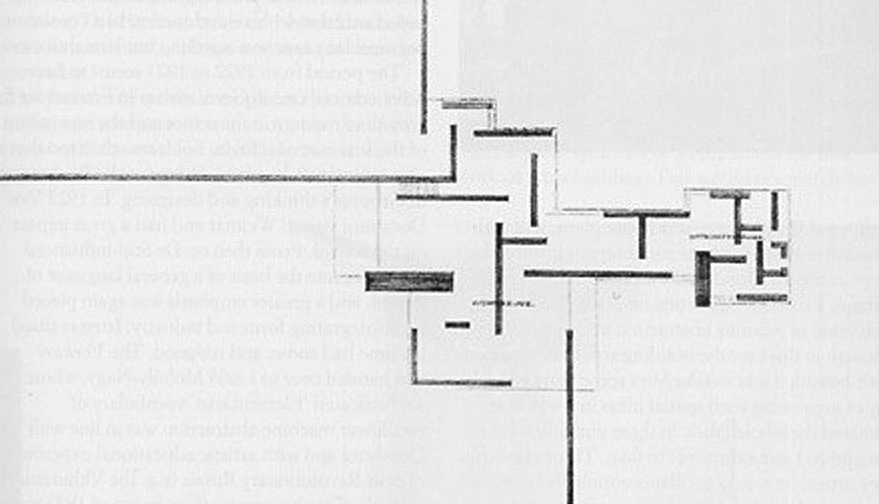
Below it the sketch of the ground floor plan, a grid of right angles that do not intersect, difficult to read as a living space, that extends, in seeming contradiction to the first drawing, out into space without clear containment, yet still a scheme coherent and compelling:

And a chord was struck within, or a tone cluster, that gathered and realigned.

From my essay “Completing the Mies van der Rohe Brick Country House, An Odyssey.” This effort pays one more homage to the house. The one thing I am certain of is that it is not the way Mies would have designed the building, had he taken on the project.

Continue reading

Centering a Town: 22nd. Effort/Under Construction

Structured, orderly, regular, and, but for the corners, symmetrical. The building explains itself in a few terms quickly grasped. The theme is Under Construction because the building retains the scaffolding that presumably was used in stages of its construction.

Although really their use is contained and their placement carefully planned. They are integrated into a completed structure and obviously intended to be permanent. Another possibility is a design that more resembles a building frozen in the process of its construction, incomplete and fragmented, that challenges itself, asks for completion or demolition—a temptation, though I don’t know if that could be done without invoking postmodern slapstick and irony.

The scaffolding pieces add decorum, and, in their openness, involvement, and tensions, provide a modern substitute for columns. The building has the look, in fact, of a Greek temple. The columns give energy to an otherwise static design, as well as add a note of modernness and technology. And since they support the ledges above the second floor and the roof and strengthen the largely glass walls, they are functional, not decorative. This is a building that speaks function, though that function is exaggerated, and with modern materials and techniques they aren’t needed.

Continue reading

Centering a Town: 21st. Effort/Acceleration

Art, and above all, music has a fundamental function, which is to catalyze the sublimation that it can bring about through all means of expression.

Xenakis

I often listen to Xenakis’s music for percussion when I design and build. Its staccato insistence and limited tonal range are appropriate for construction, which develops by extended repetition without the contrasts of tonal color or the arc of drama. Yet it has its own surprises. The music is a distraction, a diversion from silence, where I can’t think what to do next, but also a call for patterns and yet at the same time a break away from standard patterning. It encourages me to open up, think of other things, to think beyond set ways of thinking, beyond what I think I know.

xmusic

The percussive variations approach randomness without falling into chaos or noise, which themselves have their own possibilities. If nothing else, it pushes me to keep going without worrying about what I’m doing or where I’m headed. Listening provides a way to persist when there seems no direct course, nothing at all to do. I would like activities in the building to follow a similar course.

And a building can suggest sound, even music, even thought.

Xenakis designed the windows for Le Corbusier’s Tourette monastery, based on theories of mathematics and avant-garde music.

In order to avoid a monotonous repetition of standard elements in the immense façade of the building, Le Corbusier asked Xenakis to develop a principle for windows that he had caught sight of during the Chandigarh construction. . . . The resulting window configurations are very vivid. Xenakis developed the dimensions of the glass panels according to the blue and red series of the Modulor. Thanks to the resulting effect of dilatation and contraction, the façade seems to become a dynamic membrane. The principle finds its most virtuoso application in the Tourette monastery, a project that Xenakis worked on as of 1954, with the western façade conceived as a great architectural counterpoint.

From the Xenakis site, along with the drawing.

Photograph by Fernando Schapo, from dezeen.

Continue reading

Centering a Town: 20th. Effort/Push-Pull

A single brick, in itself, by itself, brings associations:

A brick is an obdurate object of ambiguity that hovers between idea and matter, between life and death. Its texture can be smoothed to glide our touch or left rough and abrade. It can be molded into even shapes for consistent construction or made uneven, presenting individual challenges each time one is laid in a course. The hues can be made consistent, offering an even appearance, or they can vary from one brick to another, presenting more individual challenges. But while it can come close to an ideal oblong shape, it never attains perfection, and it can as much be said that it approaches perfection as it resists it. A brick has the right heft for throwing through a window in revolt. It can also be stacked to encase one solidly. Its color takes on that of blood and the earth from which it is made, or both inseparably combined. Whether it preserves blood or shows it spilled, whether it reveals decay or stalls it—these questions cannot be answered. In spite of its ambiguity, however, we are always aware, in mind and in hand, of its touch, of its mass and weight, of its presence.

From my essay Completing the Mies van der Rohe Brick Country House, An Odyssey.

Continue reading